
In her recent review, Irish film critic, artist, writer June Butler informs film buffs that “James Morcan’s experimental film ANNO 2020 interrogates humans from the perspective of agency and explores what it means to be present, sentient, and mindful.”
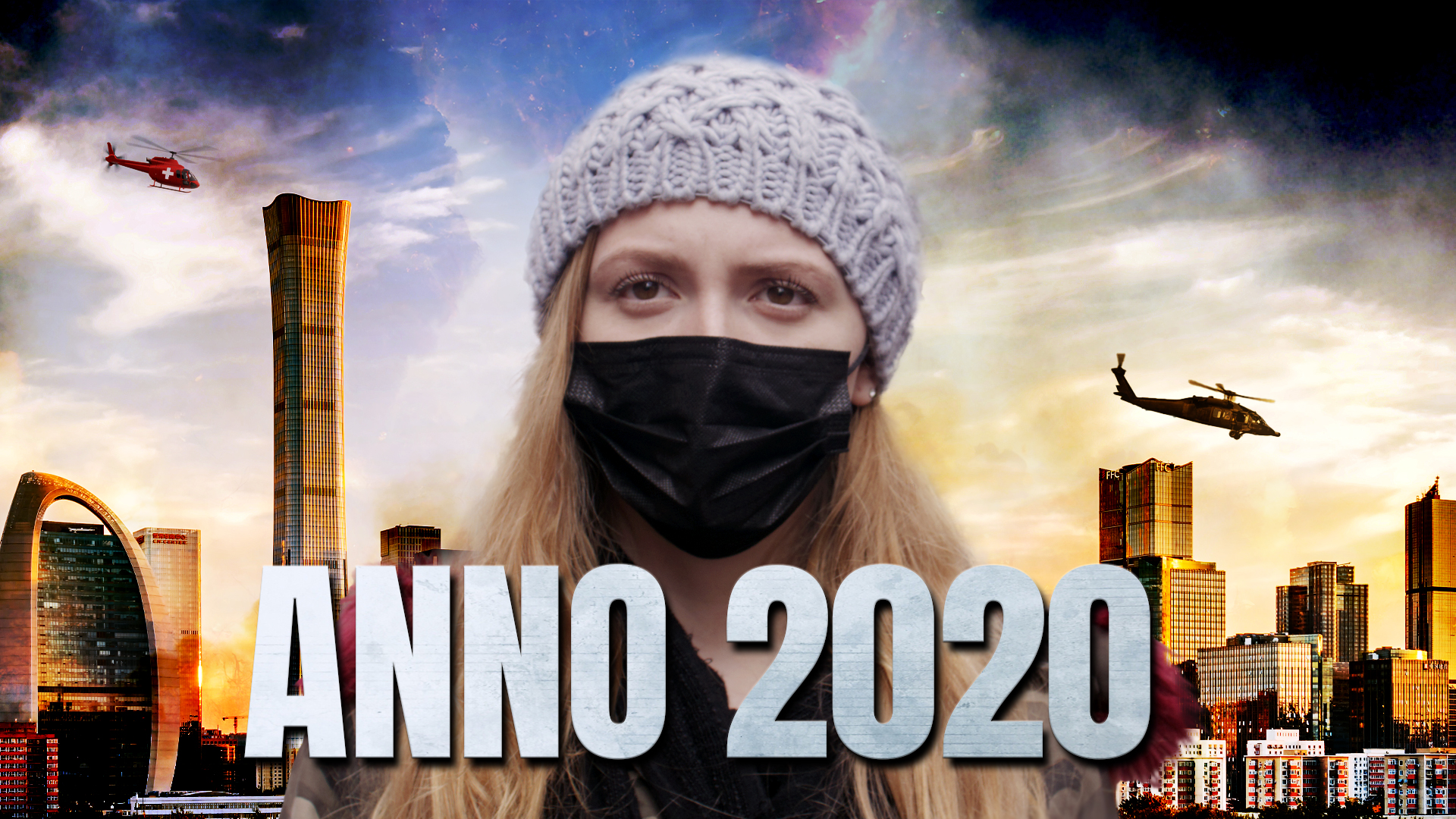
ANNO 2020… Produced by Gil Ben-Moshe / directed by James Morcan / streaming now on Fawesome TV.
Listed on Rotten Tomatoes as an acknowledged film critic and having written film and book reviews for Film Ireland for many years, Butler’s insights into the controversial, Australian-produced, Morcan-helmed mystery-drama are impressive.
It’s on the following sombre note that Butler begins her review of ANNO 2020:
December 2019, in the Chinese city of Wuhan, multiple hospitals began to experience an escalating influx of patients reporting symptoms of a sore throat, fever, severe cough, acute fatigue and rapid onset respiratory failure leading to death in some instances.
Excerpts from Butler’s review continue:
As infections started to rise, Chinese whistleblowers felt the wrath of their government in reporting what was rapidly gaining traction as an evidently more serious issue than authorities in China were willing to admit. There was a whole lot of finger-pointing with abject denials of culpability…
James Morcan, best-selling author, actor, and award-winning director wrote a novel in 2020 titled Anno 2020. Satisfied with the soundness of his idea, Morcan selected to make a film based on his book. There was one small issue however, in that there was precisely zero funding available. A minor stumbling block to be overcome with innovative filming and clever techniques –in this James Morcan succeeded beyond all expectations, going on to win Best Experimental Film at the Titan International Film Festival in 2024.
Narrating a tale of seismic existential crisis, Anno 2020 returns to a fundamental concept of core humanity. People for all their whims and peccadilloes, must deconstruct to realign appreciation of their own sentience. Filming across four continents, seventeen cities and five countries, Morcan brings audiences back to a moment prior to the lockdowns of 2020 where social media was yet another layer of keeping humans apart, making it easier to huddle in front of a computer screen where people can fulfil their fantasy of becoming anyone they want….
James Morcan was compelled to seek out a reversal to simplicity; a need to feel humble and tiny in the immenseness of this planet amidst its corners of breathtaking beauty. Morcan wanted life to become uncomplicated – abnegating the desire to be ‘seen’, instead searching seeking out genuine connections through tears and laughter, compassion and kindness.
Levi (Gil Ben-Moshe), a young Jewish man, reaches out to his lost love Esther (Lital Luzon), hinting at still harbouring affections towards her. Esther contacts her Italian friend Maria (Adriana Moccia), who knows Levi to be averse to intimate bonds with the women in his life, preferring to engage in casual relationships without any commitment. At a later stage, Levi is walking through a graveyard when he encounters Byron (James Morcan), a young disabled man accompanied by his minder. Both parties have differing views about how Jewish people were treated during World War II. Byron categorically refuses to accept the reality of the genocide of millions of people. Levi, incensed with Byron’s comments challenges the young man only to be met with counter arguments based on Byron’s personal odyssey. Both sides of the debate continue with furious abandon until Levi realises he cannot change a mindset of another and that people should be allowed to choose their own path regardless of who is right or wrong.
Emma (Jessica Castello), an American is living in China. She is convinced there is no pandemic, people are not dying from covid19, and vaccinations are causing further harm instead of providing antibodies against a virus, that in Emma’s view does not exist. She discusses her beliefs with Sally (Ruike Kuang), citing education as an inciter in becoming informed and rebelling against what she believes is a worldwide conspiracy to control people. Emma’s mother Heather (Sheila Ball), bewails the distance between Emma and herself, going on to tell her daughter that she is gravely ill.
Elijah (Kevin Scott Allen), a gay man, has been repudiated by his ultra-religious family, ultimately forcing Elijah to move to California. Mark (Greg Poppleton), his older brother is going through marriage difficulties with his wife Vicky (Erin Connor) – Vicky wants to end the union, but Mark is enraged and baffled by her actions. Journalists Jarrell (Andre Doc Williams) and Malik (Shaun Huff), once brothers in all but blood, have now come full circle. Their bonds have shattered amidst accusations of self-serving gain. Jarrell is being cast aside in favour of Malik’s desire to pursue a breaking news story and garner full credit for the scoop.
Had the Kuleshov effect never been coined, it would almost certainly have come into being after watching Morcan’s masterpiece. James created his story by alluding to character gaze as an ersatz mise-en-scène. Instead of employing sets, Morcan uses a third dimension of insinuation, evoking a to-and-fro as if the actors were physically present.
Understanding a story, is contingent on how well a point of view is conveyed to audiences. There is a bellcurve of inference among which most audiences lie and encouraging viewers imagination to see beyond the actual here and now, gives moviegoers greater autonomic license. Morcan has adroitly coaxed human ability towards a narrative to fit the scene in question. People are inclined to fill in the gaps themselves without exposition or being overtly prompted.
Given that Anno 2020 is experimental, there are few films that could compare to its style and it is difficult to place the piece within a defined genre. Morcan tips his hat with flair to David Lynch’s Inland Empire (2007), as a tribute to the great director during the dream sequence in the movie…
James Morcan’s insightful and moving film, gives us hope with the first glimmer of light shimmering over a distant horizon – he causes us to stop, listen, forgive, but most of all love.
Fittingly, Butler’s review of ANNO 2020 ends with the following quotation from Voltaire:
“Life is a shipwreck, but we must not forget to sing in the lifeboats; life is a desert, but we can transform our corner into a garden…”
For those who would like to read the full review go to: https://www.linkedin.com/feed/update/urn:li:activity:7505766632946892800/

June Butler…a highly acclaimed film critic.
June has a Bachelor of Arts Honours Degree in Psychology obtained from Dublin Business School, followed by a second Bachelor of Arts Honours Degree in Film Studies (first class honour awarded) also from Dublin Business School; she has a Master of Arts (M.A.) focused in Art in the Contemporary World from National College of Art and Design, and a second MA in Film and Creative Media from Dublin Business School where she received a first class honours along with a distinction for her dissertation and was also awarded Student of the Year for her faculty.
A self-taught artist, June has held two international art exhibitions in Tokyo. She has written film and book reviews for Film Ireland over 12 years, is listed on Rotten Tomatoes as an acknowledged critic in this field and is now branching out into freelance work.
To view June’s profile on Rotten Tomatoes go to: https://www.rottentomatoes.com/profiles/critic/june-butler
>>> Watch Anno 2020 now for free on Fawesome TV: https://fawesome.tv/movies/10769295/anno-2020
***************************************************************

