
Spanning five centuries, New Zealand: A Novel is a sweeping tale of discovery, destiny, and forbidden love in which the old and new worlds collide. While this novel may not always convey exactly what happened during the discovery and settlement of New Zealand, first by Pacific Islanders and later by Europeans, I believe it captures the spirit of those sometimes romantic, always fascinating and often bloody times. –Lance Morcan (Author)
CHAPTER 15
Aotearoa, Winter, 1500
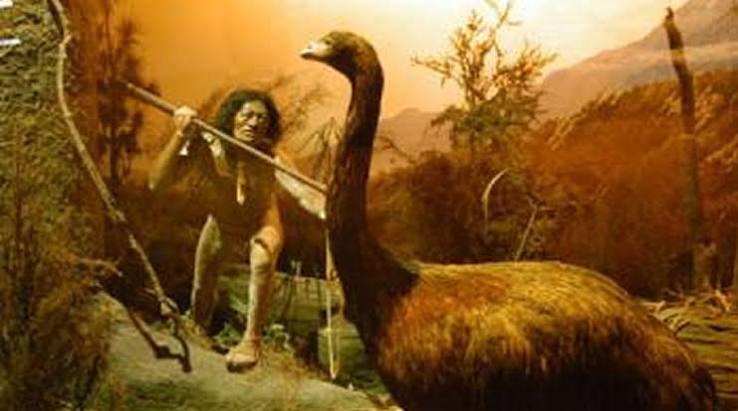
Half a dozen hunters followed a well-used trail through dense bush in the rugged central region of Aotearoa’s northern island, their bare feet slipping in the mud underfoot. The trail connected their tribe’s settlement at Rotorua, on the shores of a lake of the same name, to another village at Maketu, on the east coast. It was a gloomy winter’s day and they moved quickly to keep warm.
Tattoos adorned the face of each man, rendering his grim countenance even more fierce than it naturally was. The markings were a rite of passage among the tribe’s menfolk, and with few exceptions they underwent the painful process as soon as they were old enough to wield a club or throw a spear. In many cases their tattoos also adorned the chest and limbs.
The hunters were led by Apera, a descendant of Hotu who had followed in the footsteps of Kupe and brought his people to Aotearoa almost two hundred years ago. On his return voyage to Kupe’s land, Hotu had landed at Maketu aboard the giant voyaging waka Arawa as part of the Great Fleet. Apera was rangatira of the Te Arawa people whose iwi [tribe] was named after that same waka. It was a name he and his people wore with pride.
Like his fellow hunters, Apera wore a traditional grass skirt and dogskin shawl, and he wore his long black hair in a tight bun atop his head. Two white feathers protruded from it, distinguishing the rangatira from the others who each displayed a single white feather. In his right hand he held a huata, or long throwing spear, and hanging from a flax cord tied around his waist was a wooden patu [club]. Its intricately carved handle bore nine notches, each one denoting a kill in conflicts with warriors of other iwis. His fellow hunters were similarly armed.
Apera had inherited the family trait of other males in his line – the stub of an extra finger. In this case the stub comprised an extra small finger on his right hand.
Iwis now occupied Aotearoa from the far north to the deep south. Collectively, the people of these various tribes were known as Maoris – a name some, for reasons known only to themselves, translated as ordinary people. They did not think of themselves as Maori. They considered themselves to be of their iwi – even if that community numbered only a hundred or so souls. Still, they had many things in common: they considered Hawaiki their spiritual homeland and they believed their spirits returned there after they departed the physical realm. Many also considered themselves descendants of the great Hawaikan explorer Kupe although in most cases that noble connection might have been more wishful thinking than fact. In Apera’s case it was fact.
Apera and his men were on a mission. They were hunting moas, the giant flightless birds that had always been a staple part of their diet. Once found in abundance throughout the land, the emu-like birds were becoming increasingly scarce. In fact, many weeks had passed since Apera or any of his people had sighted a single moa. This was alarming for its meat was a vital source of protein, no small matter given this land was devoid of native animals. The moa’s feathers were prized as well for they made beautiful cloaks and shawls, which the rangatiras and high-born elders inevitably claimed for themselves.
In bygone years, moas congregated in large mobs along the river flats and in the valleys between the mountains and sea. It had been the Era of the Moa-Hunter in Aotearoa. Large-scale roundups sometimes resulted in a hundred or more moas being herded into some dead-end gully or driven to their deaths over the edge of a cliff. Their meat would feed an entire iwi throughout the winter. Those days were now long gone.
In recent years, hunting had greatly reduced the moas’ numbers. The surviving birds had been forced to retreat into dense bush in the most isolated regions to escape those who relentlessly hunted them.
After two centuries of abundance, the Te Arawa people, like Maoris everywhere, were facing starvation. Where previously the moa could be relied on to feed entire families, now each kill assumed great significance. Often it was the difference between full bellies and starvation, especially during the winter months. For most the flesh of the moa had been their main source of meat. These days they had to rely on smaller birds and fish to complement whatever fruit, seeds, berries, grubs and pikopiko, or fern shoots, they could find in the bush. Their coastal cousins also had access to shellfish and other seafood, but even they went hungry at times.
Apera hated seeing his people reduced to scavenging to survive. He knew his great ancestors who had guided the Arawa waka to this land would turn in their graves if they could see the state their descendants had been reduced to.
The golden age of the Maori was drawing to an end. In the two centuries since the big migration from Hawaiki, the people had thrived. There had been plenty for everyone; fish filled the rivers, lakes and seas; birds filled the forests and skies; there was abundant fertile land for crops and settlements; the people had few if any enemies; and iwis usually lived at peace with their neighbours. Aotearoa was the paradise Kupe had said it would be.
Now a change was coming over the land. It was becoming over-populated; forty tribes made up a population of one hundred-and-fifty-thousand people who occupied both the northern and southern islands. All the best sites for settlement and crops had been taken, and once-fertile land was becoming eroded and over-used. The climate was cooling noticeably and food was becoming scarce. Not only the moas were disappearing; so too were seals and various fish and bird varieties. The native pelicans and eagles were already extinct. Now it seemed the moa was going the same way.
The trail the hunters now followed linked Rotoiti and Rotoma, two volcanic lakes east of Rotorua. One day it would be known as Hongi’s Track – named after Hongi Hika, the leader of an enemy war party whose warriors would drag their wakas between the lakes in order to mount a surprise raid on Rotorua’s unsuspecting Te Arawa people. This trail was as muddy as the last one, and they slipped and slid as they descended a steep hill. Weeks of incessant rain had rendered all paths through the bush treacherous. Every now and then the trail skirted the edge of a steaming, hot, thermal pool or a bubbling mud pool. These along with live volcanoes and geysers were prevalent throughout the Te Arawa’s territory for it covered an active volcanic region.
Apera ordered his men to split up to improve their chances of finding a moa’s spoor. Two hunters immediately disappeared into the bush as they followed tributary tracks while the others made their own trails through the undergrowth.
Alone now, Apera continued along the same track he and the others had been following. The only sound apart from his breathing was the ever-present birdsong. It began at dawn and continued until dusk, never quietening unless a storm or some other significant natural event such as an earthquake was brewing. The cheet cheet of the tiny but fearless fantail, the melodic whistling accompanied by weird cackles and clicks of the beautiful tui, and the tui-like choruses of the bellbird combined with the unique calls of many other native birds to create a harmonious sound.
The rangatira stopped and cocked an ear. The distinctive wingbeats of a kereru [bush pigeon] carried to him. It took him a moment to spot the large bird with its green and white plumage. It was perched on one of the upper branches of a young kauri tree. The kereru was a favorite of his people. Its meat was delicious. He was tempted to spear it, but the urge quickly passed. He had bigger prey in mind.
Entering a gully at the foot of a hill he froze when he sensed movement amongst the trees on the hillside opposite. He remained motionless for several long minutes. Time seemed to stand still, nothing moved and he wondered if he’d imagined things.
Then he saw it: an adult moa. She was scouting for berries some thirty yards distant. He knew the moa was female because she was all of twelve feet tall, which was considerably taller than the males ever grew. This one, the tallest of her species, looked heavy, too. The rangatira estimated she must weigh all of six hundred pounds. She was so focussed on her search she didn’t notice the hunter whose spear was now raised.
Slowly extending his throwing arm full-length behind him, Apera took a deep breath before releasing his weapon. Propelled by a sling, the long spear flew with deadly accuracy, its serrated whalebone tip lodging in the breast of the unsuspecting moa. The big bird managed one solitary step backwards before toppling over. She was dead before her head hit the ground.
Apera let out a joyous shout. With luck the moa would feed his family and other families, too, for the remainder of the winter. The rangatira couldn’t wait to see the expressions on their faces when he lugged the moa’s mighty carcass back to his village. He hoped his fellow hunters had similar good fortune.
Suppressing his glee, he stood over the carcass and murmured a prayer of thanks to the spirits of the forest. He also thanked the moa. Tradition dictated that hunters thank the creatures they kill in appreciation of the fact that their flesh will feed them and their families. The moa’s feathers would also provide him with a fine feathered cloak, which would double as a warm blanket on cold nights, so he thanked her for her feathers also.
The kill was more significant than Apera could ever realise. He’d just slaughtered the last surviving moa in all of Aotearoa. The species was now extinct.
The Era of the Moa-Hunter had ended. A new and bloody era was about to begin.
CHAPTER 16
Aotearoa, Winter, 1501
For the first time, the hills and shores of Aotearoa echoed to the sounds of war. As competition for land and food resources increased, inter-tribal fighting became the norm. The inevitable result was war on a scale never before seen in Kupe’s land. Fighting was hand-to-hand, vicious and bloody.
One ugly side-effect of the conflict was cannibalism….
>>> NEW ZEALAND: A NOVEL continues next week.
*
This novel is available via Amazon as a hardcover, paperback, audiobook and Kindle ebook… https://www.amazon.com/New-Zealand-Novel-Lance-Morcan/dp/0473728524/
**************************************************************

