Archive for the ‘New Zealand: A Novel’ Category

The late thirteenth century had seen the advent of the pa, the fortified village that served as a stronghold for iwis under siege in Aotearoa. By the early 1500’s, those fortifications were becoming remarkably sophisticated. Nowhere was this better demonstrated than on the rocky headland at the southern end of the bay occupied by the Ngati Porou iwi. Like pa sites elsewhere, the iwi had made best use of the available terrain.

The headland that accommodated the pa extended some distance out into the Pacific and overlooked the entire bay as well as miles of coastline to the north and south. Cleared of bush, the only vegetation left was a line of pohutukawa trees that ran along the clifftops. The steep, white cliffs ensured that access was only possible from the land. Anyone who tried to attack from the sea could easily be repelled. A few boys throwing rocks would suffice.

The pa’s main defences were concentrated on protecting its entrance. Two lines of trenches had been dug from one side of the narrow headland to the other to help repel any raiders who chose to attack on foot. These same trenches could be turned into killing fields when enemies tried to cross them. Each was surmounted by a stockade to doubly protect the defenders, and underground tunnels enabled them to retreat if they were in danger of being over-run. This clever design, used by the Ngati Porou and increasingly by Maori everywhere, was surprisingly advanced and effective – as British troops would discover to their cost one day.

The pa itself comprised sturdy timber ramparts surmounted by wooden lookout towers and fighting platforms. These were the last line of defence should the trenches not do the job they were designed to do.

Behind the ramparts, an entire kainga [village] had been constructed. It comprised whares, storage houses, kumara pits and gardens, and most prominent of all a wharenui, or meeting house. It was here the eight hundred villagers would live if attacked.

The pa’s one drawback was that the headland it occupied had no stream or other source of freshwater, which explained why the iwi had opted to establish its permanent settlement on a riverbank half a mile inland. Iwi members only relocated to their coastal pa when there was risk of an attack – as was the case now.

Mahanga, the ageing rangatira of the Ngati Porou, paused in his early morning inspection of the fortifications to stare at a hill, which stood like a sentinel at the northern end of the bay that the pa overlooked. Kaiti Hill was the ancestral site of the Ngati Oneone hapu, a sub-tribe whose marae was located at the base of the hill. From the hill’s summit they had uninterrupted views north to the eastern cape where Mahanga knew the Te Arawa war party was preparing to launch its attack. He’d learned this from the enemy scout his men had captured and tortured several days earlier. Ngati Oneone residents would alert their Ngati Porou neighbours of any approaching threat as the two peoples were close allies. Unless they happened to be cut off, the former would relocate to the pa on the headland in the event of an attack.

Before dying, the Te Arawa scout had proven talkative after having had his feet held to the flames of a cooking fire. The information he’d imparted had given Mahanga a couple of sleepless nights.

Yawning as he continued his inspection tour, he reviewed what he’d learned. By all accounts the enemy’s rangatira, Apera, had three hundred battle-hardened warriors and numerous wakas, including those they’d taken possession of at Tokomaru Bay. More disturbingly, it was evident he was intent on invading the Ngati Porou pa.

The number of warriors the Te Arawa had didn’t concern Mahanga. He had that many and more, and he didn’t think the wakas would be of use to his enemies because any attack from the sea would be futile. If they didn’t already realise that, he thought, they soon would. What did concern the rangatira was the Te Arawa warriors were by all accounts battle-hardened, having prevailed in numerous conflicts with coastal iwis during their journey south from Maketu, a place Mahanga had never heard of. While his own warriors had been tested, having repelled half a dozen attacks on the pa by southern war parties in recent years, they could hardly be described as battle-hardened. The pa’s impressive fortifications had so far rebuffed any attacks, and his warriors had not yet had to engage in any serious hand-to-hand fighting. Such was the advantage those fortifications provided. The Te Arawa warriors might present an altogether different proposition. 

What most concerned Mahanga, however, was the pa’s lack of fresh water. Water had to be carried to the site in wooden calabashes and poured into purpose-built, rocky ponds, which had been designed to catch rainwater and act as reservoirs in times of need. However, even when full the ponds would only sustain the iwi’s eight hundred people for seven to ten days at most during dry periods. As luck would have it, the present winter was one of the driest in living memory, and there was no sign of rain on the horizon. In the event of a siege, someone would have to descend the cliffs in darkness, fill calabashes with water from one of the streams that emptied into the bay and return unnoticed. That he realised would be quite a challenge as any self-respecting enemy would be on guard against such attempts.

The rangatira’s thoughts turned to his Te Arawa counterpart as he stopped to observe half a dozen men who were replacing rotting timbers on either side of the pa’s entrance. He’d never heard of Apera, but thought he sounded like someone to be reckoned with even if only half what the captured scout had told him was true. The scout said the ancestors of Apera and his people had travelled to Aotearoa aboard the Arawa waka. Pondering that fact, Mahanga looked north again. As he did he subconsciously massaged the stub of an extra small finger on his left hand – a family trait his late father and great grandfather had also been born with. He remained unaware that Apera shared the same trait or that they were both descended from Hotu who had first journeyed to Aotearoa aboard the Ronui – the very waka which had landed on the same beach he now surveyed.

Since the arrival of Mahanga’s ancestors on these shores, his people had flourished. The land and sea had provided all they needed, and any inter-tribal disputes had generally been settled quickly and peacefully. Change was afoot unfortunately. Iwis were now at war throughout Aotearoa. And war was coming Mahanga’s way. Of that he was sure. 

The rangatira was distracted by the sounds of sticks clashing to the accompaniment of grunts of exertion. He looked around and saw his daughter-in-law Anahera sparring with a teenage boy nearby. The pair each wielded a wooden taiaha, or close-quarters staff, a weapon favoured by Maori everywhere. Useful for short, sharp strikes and stabbing thrusts, its use required superior hand-speed, deft footwork and considerable skill.

Mahanga’s daughter-in-law was, he thought, well named. Anahera in Maori folklore stood for Majestic and Powerful Angel. And that she was. Anahera’s sculpted body turned heads wherever she went, and although much lighter than the bulky teenager she sparred with, she was giving him a painful lesson. That was no surprise to the rangatira or to any of the other spectators who had gathered to watch the training session. The young wahine was after all a blooded warrior who had proved herself in battle. Wahines like her – and there were more than a few – often fought alongside their men with distinction.

The bulky teenager grunted in pain as his skillful tutor delivered a blow to an unprotected shin.

“Protect your legs!” Anahera said as she switched her grip on the taiaha and whacked the teenager across one shoulder with it, prompting another grunt from her victim.

“Protect your shoulders, too!” a spectator yelled, causing mirth amongst others watching and causing the teenager no small amount of embarrassment.

“Ignore them,” Anahera said to her bloodied and bruised student. “They can’t fight to save themselves.”

As the training session continued, Mahanga noticed one of his scouts jogging toward him through the pa’s entrance.

“The Te Arawa dogs are coming!” the scout shouted.

“Overland?” Mahanga asked as the breathless scout stopped in front of him.

“Ae…Overland…They will arrive in two days…Three at most.”

“How many?”

“We counted at least two hundred and fifty warriors.”

Mahanga pondered this as villagers began crowding around, keen to hear what the scout had to report. Anahera and her teenage sparring partner were among them.

Pushing through the crowd, Anahera stood before the scout. “Only two hundred and fifty warriors?” she asked. “The Te Arawa prisoner told us they had at least three hundred.” She knew that to be a fact as she was one of those who had held the captive’s feet to the fire before he died.

The scout didn’t like being questioned by a wahine, not even one related by marriage to Mahanga, and he glanced at the rangatira who nodded almost imperceptibly. “They left about forty warriors behind at Tokomaru to guard their slaves and wakas,” the scout mumbled.

Mahanga placed one hand on the scout’s shoulder. “You did well. Eat and rest, and then inform the others I want regular reports on our enemies’ progress.” The others he referred to were the other twelve scouts patrolling overland approaches to the pa.

The scout nodded and jogged off, leaving Mahanga to decide on the best course of action. He turned to Anahera. “Inform your husband of this news,” he said, referring to Nikau, his oldest son. “Bring him to the meeting house.”

Anahera hurried off to find Nikau while her father-in-law walked back to the quarters he shared with his three wives and their extended family. He wanted to check on them before he held a council of war with his headmen.

War was coming and he wanted his people to be ready.

Mahanga had good reason to be concerned: his Te Arawa counterpart, Apera, was at that moment leading a two hundred and sixty-strong raiding party north from Tokomaru Bay, their destination the Ngati Porou pa. They would present the biggest challenge his people had ever faced.

The Te Arawa raiders had set out on foot at first light from Tokomaru Bay. Their number included six slaves. Forty warriors remained behind to guard the remaining slaves, wakas and other plunder they’d acquired…

For the first time, the hills and shores of Aotearoa echoed to the sounds of war. As competition for land and food resources increased, inter-tribal fighting became the norm. The inevitable result was war on a scale never before seen in Kupe’s land. Fighting was hand-to-hand, vicious and bloody.

One ugly side-effect of the conflict was cannibalism.

Eating the flesh of enemies provided a new source of meat as well as having symbolic significance for the victors. Cannibalism quickly became part of Maori culture, just as it had throughout the islands of the South Pacific. The losers in warfare accepted they would end their days in slavery or on the cooking fire, or probably both. Slaves provided labour for hard manual work and were a source of food when their meat-starved captors were hungry.

Feuds erupted between iwis which had previously lived side by side in peace. As rivalries intensified, bloodshed followed. Given the Maori preoccupation with mana [prestige] any slight was an invitation to violent retribution. The concept of mercy was unknown and the cycle of revenge that resulted was known as utu, or blood vengeance.

Utu would become the law by which Maori lived. It would survive, indeed flourish, until well into the nineteenth century.

Apera’s Te Arawa iwi had consolidated their tribal base at Rotorua, the inland whakatikatikatanga [settlement] located on the shores of the same thermal lake where they’d resided since relocating from coastal Maketu. But like most tribes of the day they needed more land for their ever-expanding population. It was because of this their rangatira decided to lead a sizeable war party down the east coast in search of slaves and new territory.

The decision to make war was not taken lightly. The Te Arawa had long been insulated from the feuding that was now common amongst coastal tribes. Increasing demand for new territory had recently seen their own tribal lands come under threat. Fortunately, their superior numbers had enabled them to repel any invaders. However, this was not enough to ensure their survival. More land, slaves and riches were needed.

Winter was always the worst time to travel or to make war. The land was cold and food was at its scarcest, but the Te Arawa warriors chose to make their move in the middle of winter when their enemies would likely be least prepared.

Almost one year to the day after he killed the last surviving moa, Apera led a war party of two hundred warriors to the coast. Among the headmen in their midst was the rangatira’s younger brother and right hand man, Kaihautu. He, too, was a natural leader, which was fitting because his name translated as A man with leadership qualities.

The brothers were always to the fore in any conflict. Opposites in many ways, they were a study in contrasts: Apera was tall and lean while Kaihautu was squat and heavy. The latter hadn’t inherited the family trait, and Kaihautu often ribbed his older bro about the stub of the extra small finger on his right hand. Both men possessed strength and courage in equal measure, often fighting side by side as was their wont. Individually, they were fearsome fighters; together they were an unstoppable force, overpowering all opposition they’d encountered.  

Joining with their cousins at Maketu, the original landing place of the Arawa waka, Apera now commanded a force of some three hundred warriors. Six mighty double-hulled wakas carried them south, their destination a coastal cape that was said to be Aotearoa’s most easterly point. Te Arawa scouts had earlier reported the hunting and fishing was good around the cape and the land there was ready for the taking.

Along the way, Apera’s warriors plundered and looted many of the coastal villages, sometimes attacking from the sea, sometimes overland and sometimes simultaneously from land and sea, using a pincer-like strategy. The raids, like those occurring everywhere else in Aotearoa, began and ended with a mighty haka, or war dance, performed by the raiders – unless it was a surprise attack in which case no haka was performed beforehand.

Unfortunately for the Te Arawa raiders, the early pickings were slim. Heavily-armed northern invaders had recently swept south, wreaking havoc in the villages, slaughtering or enslaving their inhabitants and taking whatever caught their fancy.

Apera discovered that since his scouts’ reports had come in, those same northerners had invaded the eastern cape region as well. By the time the Te Arawa war party rounded the cape it had little to show for its exploits other than twenty or so undernourished slaves and some modest spoils. Those spoils included food, feathered cloaks, tools and weapons, and a single-hulled waka, which Apera used to transport the slaves.

An area just south of the cape held greater promise, according to the slaves who were predictably eager to please their captors. It was, they advised, the territory of the Ngati Porou iwi whose village was some thirty miles away. War parties from the north hadn’t ventured that far and incursions from the south had been repelled by the local iwi, so there were riches to be had there.

#

Dusk was fast approaching when the Te Arawa raiders’ flotilla entered a picturesque bay local Maori called Tokomaru Bay. On the beach, twenty or more wakas lay at rest above the highwater mark, and atop a small rise overlooking it was a pa, or fortified village. It appeared to accommodate about three hundred people, which tallied with estimates Apera’s slaves had provided earlier. The rangatira counted about eighty whares [huts] within the pa’s stockades. Smoke from cooking fires curled up into a darkening sky.

The Te Arawa flotilla’s appearance in the bay caused considerable panic on shore. Armed warriors took up defensive positions while others prepared to launch wakas to intercept the enemy’s flotilla. They evidently had second thoughts when they saw the size of the fleet, retreating instead behind their fortifications to await the invaders’ arrival, which could now be measured in heartbeats.

Apera was standing in the bow of the front waka, his legs braced to maintain his balance. He looked around at his brother who was standing in the bow of the following waka. “Are they Ngati Porou?” he shouted.

Kaihautu turned around and consulted a slave who sat immediately behind him. Looking back at Apera, he shouted, “Ae…They are Ngati Porou.”

The rangatira nodded and turned his attention back to the villagers on shore. He thought it more likely they were a sub-tribe of Ngati Porou given their small numbers and the fact that their settlement was located in that iwi’s territory. His lip curled into a cruel smile as he imagined how much the villagers would now be regretting they hadn’t relocated to the Ngati Porou’s coastal stronghold to the south.

“They are ripe for the plucking,” a warrior at Apera’s shoulder murmured.

The rangatira nodded. “Ae…They are,” he agreed. Though tempted to bypass the village, the lure of a quick slaughter, slaves, wahines and other bounty was strong – too strong to resist.

As the leading waka caught a wave and surfed the last forty yards to the beach, Apera studied the pa’s defences. He was pleased to note the stockade was in a state of disrepair, and there was no sign of the trenches, lookout towers or other defences that were a hallmark of bigger, well-defended pas like the Te Arawa’s own one at Rotorua and their allies’ pa at Maketu.

The Te Arawa raiders were among the very first outsiders to have visited Tokomaru Bay in such numbers, so remote was it, and the villagers believed their isolation kept them safely removed from the conflicts that raged elsewhere – until today.

The conflict that followed was as bloody as it was brief; resistance was weak and short-lived because the villagers had little experience of war.

Apera’s raiders killed almost every villager, sparing only the rangatira Rawiri, his two wives, thirty warriors and twenty-five nubile wahines. The warriors, all big men, were considered suitable candidates for slavery while the wahines would be used by the raiders for pleasure before being enslaved or killed.

As darkness fell, flames lit up the night sky after the raiders set fire to the whares and other structures. It wasn’t long before Rawiri’s whare was the only one left standing. Warriors wandered amongst the fallen, dispatching survivors with a savage thrust of a spear or blow from a club. The larger, meatier corpses – males and females – were stacked in a pile on the marae, a communal meeting place in the middle of the pa. These would be cooked, and the flesh and organs of many would be eaten before the night was over. Uneaten flesh would be cut into strips then smoked, packed and saved for eating in the days and weeks ahead.

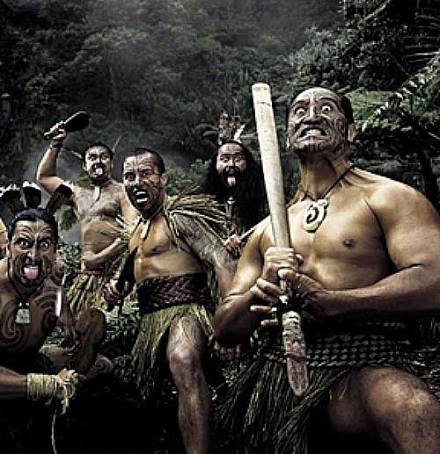
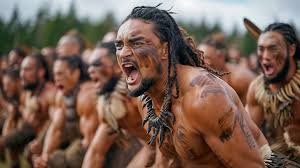
It wasn’t long before the cries of the wounded faded. The only sounds were the crackling of flames and the triumphant shouts of the victorious Te Arawa warriors. Those same warriors then performed an impromptu haka to celebrate their triumph. Chanting, gyrating, leaping and stamping the ground in unison, the war dance was awesome, gut-wrenching and terrifying all at the same time. Between chants, the participants poked out their tongues, a chilling reminder that those vanquished would be eaten. Warriors needed no such reminding for all were aware, regardless of which iwi they belonged to, that that was the likely fate of those killed or enslaved. Maoris believed they inherited their enemies’ strength when they ate them.

#

Later that night, after the Te Arawa warriors had had their fill of human flesh and the flames of burning structures had dwindled to smouldering embers, Apera and Kaihautu interrogated the vanquished rangatira. The brothers along with four other warriors had headed straight for Rawiri’s whare at the outset of hostilities. Larger by far than the other structures in the village, it accommodated twenty or so people, including the rangatira’s two wives and their six young children. All except for the rangatira and his wives had been slaughtered.

Rawiri, whose name translated as The Beloved One, trembled as Apera jabbed him with the tip of a spear. He was well named for he was loved by all his people. It wasn’t fear that made Rawiri tremble; it was grief and pain that caused his tremors. A blow from a club had left his right arm shattered, and blood flowed from a head wound. The pain caused by his wounds, however, was nothing compared to the pain he felt at the tragedy that had befallen his people. Around him the bodies of slaughtered children and other members of his extended family lay scattered about like rag dolls. The level of violence and depravity was like nothing the vanquished rangatira or his people had ever before witnessed.

“Are you Ngati Porou?” Apera asked, jabbing the defeated rangatira yet again with his spear.

Rawiri nodded dumbly. “Ae,” he mumbled through bleeding lips, tearing his eyes away from the broken body of his youngest son who lay close by.

The Beloved One’s two wives looked on as the questioning of their husband continued. They were distraught over the loss of their children whose mutilated bodies were almost unrecognisable, but the younger wife, a woman of striking appearance, did her best to hide her distress. She remained surprisingly stoical. This was noted by her husband’s interrogator. 

“How far are we from the coastal pa of the Ngati Porou?” Apera asked.

Rawiri remained silent. He just glared at his opposite, his hatred clear for all to see. Apera jabbed his prisoner again, harder this time, causing Rawiri to grunt in pain as the spear’s sharp tip pierced the flesh of his good arm. Blood flowed from the wound.

“Tell him what he wants to know, Rawiri!”

The order came from the bloodied rangatira’s younger wife Emere. A beautiful wahine, she displayed little deference to the raiders who had so brutally invaded her sanctuary and destroyed the world she knew. The screams of wahines being raped outside carried to her, threatening to destroy her resolve. Determined to keep her fear under control, she pretended not to hear them.

Apera observed the outspoken wahine coldly. Unaware that two of the slaughtered children in the whare – a young boy and girl – were hers, he promised himself he would have her later. Returning his attention to Rawiri, he warned that he would kill both his wives if he didn’t cooperate. The warning prompted an outburst of crying and pleading from the older wife.

“It is a two-day trek along the coast to the Ngati Porou pa,” Rawiri said, grimacing as pain shot through his broken arm. 

Apera studied his opposite, looking for some sign of subterfuge. He saw no such sign. “How many warriors do they have?”

Rawiri didn’t reply. Apera could see his opposite was struggling to remain conscious. He repeated his question, louder this time.

“About three hundred warriors,” Rawiri mumbled before toppling over, unconscious.

The comatose rangatira’s oldest wife crawled over from where she’d been cowering to comfort her husband while his interrogator considered what he’d learned. The estimate of enemy numbers tallied with the information he’d already received from other sources, so he could now plan his next moves accordingly.

Sensing Kaihautu was becoming restless, Apera nodded toward Rawiri. “Kill him,” he said. This prompted a cry of distress from the older wife. “And do what you like with her,” he added, pointing at the distraught wahine.

“What about her?” Kaihautu asked, looking lustfully at Emere.

“She is mine,” Apere said, locking eyes with the younger wife.

Kaihautu wanted to rape Emere. He had lusted after her the moment he’d set eyes on her. However, he held his tongue for he’d learned the hard way it was unwise to disobey the rangatira, even though they were brothers. Instead, he quickly despatched the still unconscious Rawiri with a savage blow from the club he held then dragged the older wahine, kicking and screaming, from the whare to have her.

Apera had kept his eyes on Emere when his brother killed her husband. He’d noticed she displayed no emotion. Not even a grimace or a flinch. Now she looked directly at him. Their eyes locked once again and he was impressed that she still showed no fear. Suddenly aroused, he realised he needed her. Urgently. Throwing his spear to one side, he stood up and moved toward her.

Emere held up her hand, motioning to him to stop. Apera pulled up one pace short. They stared at each other for one long drawn-out moment, each searching the other’s eyes.

Finally, Emere murmured, “Not here.” The wahine glanced around at the bodies of the others, including her own children. She needed to distance herself from this place of death.

Apera understood. He slowly extended his right hand, and after the briefest hesitation Emere took his hand in hers and allowed him to pull her to him. She came into his arms and he clasped her tight to him, pushing his groin hard against hers. To his surprise, she didn’t resist.

“Not here!” she said again, more insistent this time.

Apera nodded. He led her quickly from the whare in search of a quiet place, his passion increasing with every step.

Emere shared his passion in equal measure. It was something she couldn’t begin to explain or even understand. The widowed wahine mourned the loss of her beloved husband and children yet lusted after the man who had killed them. It went against everything she’d ever believed in, and the suddenness and intensity of her feelings for this monster next to her frightened her. She wondered if it was some kind of defensive reaction to help her remain sane and not succumb to the feelings of darkness and despair that threatened to overwhelm her.

Outside, on the marae, Emere ignored as best she could the celebrations underway. Apera’s warriors were cooking the carcasses of their victims on spits that had been erected over a dozen or more cooking fires while others took turns to rape those wahines who had been spared. Spirits were high. It was always the case after a successful raid. At the sight of the carcasses, the wahine closed her eyes. Her people used to roast moas like that before the big birds became extinct. 

Warriors cheered their rangatira after they noticed him emerge from the whare with his captive. The pair ignored them as they hurried off into the darkness.

Apera pulled Emere by the hand into the bush behind the pa, stopping only when they came to a grassy clearing. Away from the prying eyes of the others, they hurriedly discarded their garments then lay down and gave themselves fully to the passion that had overtaken them both.

#

At dawn the following day, Apera dispatched four of his best scouts to survey the Ngati Porou pa further down the coast. They travelled on foot via an inland route in order to avoid the coastal walking tracks and villages. Their orders were to report back on the numbers of enemy warriors, their preparedness and weapons at their disposal, and the strength of their fortifications. Because of the circuitous route they followed, they had a three-day trek ahead of them before they reached the enemy’s pa.

#

Six days later, three of the scouts who had been sent to survey the Ngati Porou stronghold returned. Breathless, they reported directly to Apira’s brother.

“Where is Kiwa?” Kaihautu asked of the missing scout.

“He was captured by Ngati Porou hunters,” the senior scout said.

Kaihautu scowled. “So our enemies know we are coming.” He glared at the senior scout as if he blamed him personally. “What did you learn?”

“Our enemy’s territory includes good hunting and fishing grounds,” the senior scout said.

“Their village has much worth taking,” said the youngest scout who was barely into his mid-teens.

That caught Kaihautu’s attention. “Go on,” he said.

“Many slaves,” the young scout said. “Too many to count… And their wahines must be the most beautiful in the land!”

The other scouts rolled their eyes, indicating their youthful companion may be exaggerating.

Undeterred, the young scout added, “I saw wakas also. Maybe fifty wakas on the beach.”

Not to be outdone, the third scout delivered his assessment of the Ngati Porou iwi’s wealth, further confirming there were rich pickings to be had.

Kaihautu was wise enough to realise people with so much territory and wealth would be no pushover in a conflict. “What are their numbers?” he asked.

“At least eight hundred,” the senior scout said, “including three hundred fighting men.”

“And their defences?”

“Strong. Very strong.”

As the rangatira’s brother listened to the scout describe what he and his companions had observed, he quickly came to the realisation that victory over the Ngati Porou in battle would be no foregone conclusion. When the scouts finished telling him everything they’d observed he strode off to convey the sobering news to Apera. He found him inspecting the raiding party’s cache of weapons and informed him of what he’d learned.

“What of the Ngati Porou fortifications?” Apera asked.

“The scouts reported the pa’s fortifications are strong. Our enemies occupy high ground on a rocky peninsular that cannot be invaded from the sea, and deep trenches have been dug in front of the ramparts.”

The brothers looked at each other gravely. There were some big decisions to make – not the least being whether to risk everything in what could well be a costly attack on a well-defended pa.

The late fourteenth century had seen the advent of the pa, the fortified village that served as a stronghold for iwis under siege in Aotearoa. By the early 1500’s, those fortifications were becoming remarkably sophisticated. Nowhere was this better demonstrated than on the rocky headland at the southern end of the bay occupied by the Ngati Porou iwi…

Half a dozen hunters followed a well-used trail through dense bush in the rugged central region of Aotearoa’s northern island, their bare feet slipping in the mud underfoot. The trail connected their tribe’s settlement at Rotorua, on the shores of a lake of the same name, to another village at Maketu, on the east coast. It was a gloomy winter’s day and they moved quickly to keep warm.

Tattoos adorned the face of each man, rendering his grim countenance even more fierce than it naturally was. The markings were a rite of passage among the tribe’s menfolk, and with few exceptions they underwent the painful process as soon as they were old enough to wield a club or throw a spear. In many cases their tattoos also adorned the chest and limbs.

The hunters were led by Apera, a descendant of Hotu who had followed in the footsteps of Kupe and brought his people to Aotearoa almost two hundred years ago. On his return voyage to Kupe’s land, Hotu had landed at Maketu aboard the giant voyaging waka Arawa as part of the Great Fleet. Apera was rangatira of the Te Arawa people whose iwi [tribe] was named after that same waka. It was a name he and his people wore with pride.

Like his fellow hunters, Apera wore a traditional grass skirt and dogskin shawl, and he wore his long black hair in a tight bun atop his head. Two white feathers protruded from it, distinguishing the rangatira from the others who each displayed a single white feather. In his right hand he held a huata, or long throwing spear, and hanging from a flax cord tied around his waist was a wooden patu [club]. Its intricately carved handle bore nine notches, each one denoting a kill in conflicts with warriors of other iwis. His fellow hunters were similarly armed.

Apera had inherited the family trait of other males in his line – the stub of an extra finger. In this case the stub comprised an extra small finger on his right hand.

Iwis now occupied Aotearoa from the far north to the deep south. Collectively, the people of these various tribes were known as Maoris – a name some, for reasons known only to themselves, translated as ordinary people. They did not think of themselves as Maori. They considered themselves to be of their iwi – even if that community numbered only a hundred or so souls. Still, they had many things in common: they considered Hawaiki their spiritual homeland and they believed their spirits returned there after they departed the physical realm. Many also considered themselves descendants of the great Hawaikan explorer Kupe although in most cases that noble connection might have been more wishful thinking than fact. In Apera’s case it was fact.

Apera and his men were on a mission. They were hunting moas, the giant flightless birds that had always been a staple part of their diet. Once found in abundance throughout the land, the emu-like birds were becoming increasingly scarce. In fact, many weeks had passed since Apera or any of his people had sighted a single moa. This was alarming for its meat was a vital source of protein, no small matter given this land was devoid of native animals. The moa’s feathers were prized as well for they made beautiful cloaks and shawls, which the rangatiras and high-born elders inevitably claimed for themselves.

In bygone years, moas congregated in large mobs along the river flats and in the valleys between the mountains and sea. It had been the Era of the Moa-Hunter in Aotearoa. Large-scale roundups sometimes resulted in a hundred or more moas being herded into some dead-end gully or driven to their deaths over the edge of a cliff. Their meat would feed an entire iwi throughout the winter. Those days were now long gone.

In recent years, hunting had greatly reduced the moas’ numbers. The surviving birds had been forced to retreat into dense bush in the most isolated regions to escape those who relentlessly hunted them.

After two centuries of abundance, the Te Arawa people, like Maoris everywhere, were facing starvation. Where previously the moa could be relied on to feed entire families, now each kill assumed great significance. Often it was the difference between full bellies and starvation, especially during the winter months. For most the flesh of the moa had been their main source of meat. These days they had to rely on smaller birds and fish to complement whatever fruit, seeds, berries, grubs and pikopiko, or fern shoots, they could find in the bush. Their coastal cousins also had access to shellfish and other seafood, but even they went hungry at times.

Apera hated seeing his people reduced to scavenging to survive. He knew his great ancestors who had guided the Arawa waka to this land would turn in their graves if they could see the state their descendants had been reduced to.

The golden age of the Maori was drawing to an end. In the two centuries since the big migration from Hawaiki, the people had thrived. There had been plenty for everyone; fish filled the rivers, lakes and seas; birds filled the forests and skies; there was abundant fertile land for crops and settlements; the people had few if any enemies; and iwis usually lived at peace with their neighbours. Aotearoa was the paradise Kupe had said it would be.

Now a change was coming over the land. It was becoming over-populated; forty tribes made up a population of one hundred-and-fifty-thousand people who occupied both the northern and southern islands. All the best sites for settlement and crops had been taken, and once-fertile land was becoming eroded and over-used. The climate was cooling noticeably and food was becoming scarce. Not only the moas were disappearing; so too were seals and various fish and bird varieties. The native pelicans and eagles were already extinct. Now it seemed the moa was going the same way.

The trail the hunters now followed linked Rotoiti and Rotoma, two volcanic lakes east of Rotorua. One day it would be known as Hongi’s Track – named after Hongi Hika, the leader of an enemy war party whose warriors would drag their wakas between the lakes in order to mount a surprise raid on Rotorua’s unsuspecting Te Arawa people. This trail was as muddy as the last one, and they slipped and slid as they descended a steep hill. Weeks of incessant rain had rendered all paths through the bush treacherous. Every now and then the trail skirted the edge of a steaming, hot, thermal pool or a bubbling mud pool. These along with live volcanoes and geysers were prevalent throughout the Te Arawa’s territory for it covered an active volcanic region.

Apera ordered his men to split up to improve their chances of finding a moa’s spoor. Two hunters immediately disappeared into the bush as they followed tributary tracks while the others made their own trails through the undergrowth.

Alone now, Apera continued along the same track he and the others had been following. The only sound apart from his breathing was the ever-present birdsong. It began at dawn and continued until dusk, never quietening unless a storm or some other significant natural event such as an earthquake was brewing. The cheet cheet of the tiny but fearless fantail, the melodic whistling accompanied by weird cackles and clicks of the beautiful tui, and the tui-like choruses of the bellbird combined with the unique calls of many other native birds to create a harmonious sound.

The rangatira stopped and cocked an ear. The distinctive wingbeats of a kereru [bush pigeon] carried to him. It took him a moment to spot the large bird with its green and white plumage. It was perched on one of the upper branches of a young kauri tree. The kereru was a favorite of his people. Its meat was delicious. He was tempted to spear it, but the urge quickly passed. He had bigger prey in mind.

Entering a gully at the foot of a hill he froze when he sensed movement amongst the trees on the hillside opposite. He remained motionless for several long minutes. Time seemed to stand still, nothing moved and he wondered if he’d imagined things.

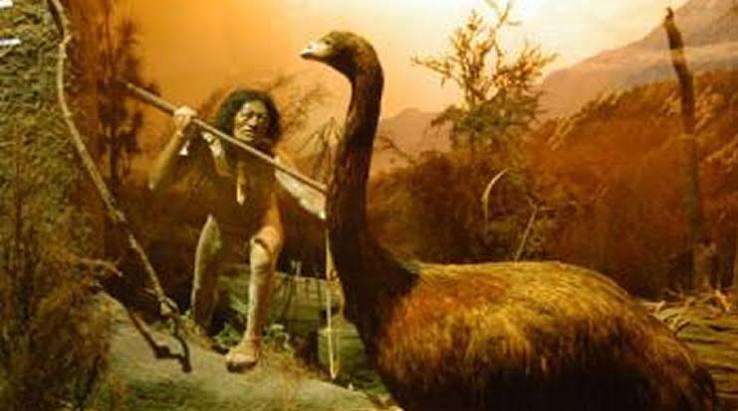
Then he saw it: an adult moa. She was scouting for berries some thirty yards distant. He knew the moa was female because she was all of twelve feet tall, which was considerably taller than the males ever grew. This one, the tallest of her species, looked heavy, too. The rangatira estimated she must weigh all of six hundred pounds. She was so focussed on her search she didn’t notice the hunter whose spear was now raised.

Slowly extending his throwing arm full-length behind him, Apera took a deep breath before releasing his weapon. Propelled by a sling, the long spear flew with deadly accuracy, its serrated whalebone tip lodging in the breast of the unsuspecting moa. The big bird managed one solitary step backwards before toppling over. She was dead before her head hit the ground.

Apera let out a joyous shout. With luck the moa would feed his family and other families, too, for the remainder of the winter. The rangatira couldn’t wait to see the expressions on their faces when he lugged the moa’s mighty carcass back to his village. He hoped his fellow hunters had similar good fortune.

Suppressing his glee, he stood over the carcass and murmured a prayer of thanks to the spirits of the forest. He also thanked the moa. Tradition dictated that hunters thank the creatures they kill in appreciation of the fact that their flesh will feed them and their families. The moa’s feathers would also provide him with a fine feathered cloak, which would double as a warm blanket on cold nights, so he thanked her for her feathers also.

The kill was more significant than Apera could ever realise. He’d just slaughtered the last surviving moa in all of Aotearoa. The species was now extinct.

The Era of the Moa-Hunter had ended. A new and bloody era was about to begin.

For the first time, the hills and shores of Aotearoa echoed to the sounds of war. As competition for land and food resources increased, inter-tribal fighting became the norm. The inevitable result was war on a scale never before seen in Kupe’s land. Fighting was hand-to-hand, vicious and bloody.

One ugly side-effect of the conflict was cannibalism….

Night-time could not come quickly enough. Nicholas hoped against all hope there’d be a repeat of the previous night’s erotic experience following the visitation of the mystery wahine.

Earlier that day, he’d put his free time to good use, seeking out Tupaia to ask his advice on a sensitive and potentially embarrassing issue. He felt the amiable Tahitian was the only one he could trust with such matters.

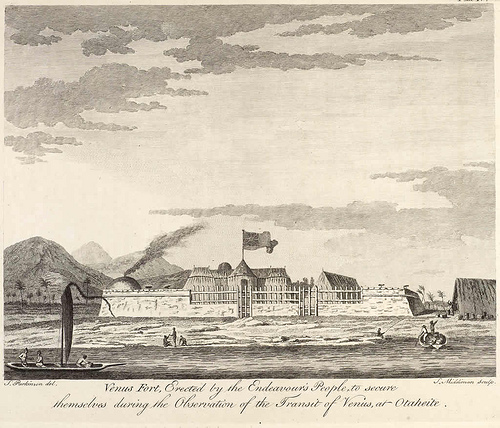
The younger man had observed that Tupaia seemed to be spending more time in the company of the visiting seamen, either at nearby Fort Venus or aboard the Endeavour, than with his own people. It was becoming obvious to him that his new friend and confidant had his own agenda. He’d found him inside a large tent that had been erected at the fort’s observatory. Open to the elements on one side, it accommodated a table upon which the astronomical clock would sit in readiness for the transit observation. Opposite the tent and facing the same table was a wooden platform, which would support the astronomical quadrant as well as the two large telescopes that were still safely secured aboard the bark.

Anxious to have some privacy and distance himself from his crewmates, Nicholas had suggested that Tupaia join him for a walk along the sand spit. Away from the others, he had confided in his friend and received some valuable advice in return. Advice he hoped he’d be able to put into practice that very evening.

#

Apart from the fact that he hadn’t seen or heard from Queen Obadia all day, the early omens for the night ahead were promising: the routine of the previous day was repeated with the same beautiful servant girl delivering his evening meal and returning later to lay out his bed-mat. He noticed the wahine gave him a knowing smile before departing.

Now, lying naked on his bed-mat, it wasn’t long before his Little General, as he called it, was standing at attention.

Two hours went by and he was becoming impatient – and sore. His Little General was still on full alert, and he feared if someone didn’t come soon he’d have to take matters into his own hands.

Another hour passed.

Where the hell is she?

He promised himself he would identify the mystery woman when, or if, she returned. There was a full moon, and, although it was dark inside the bure, he knew he’d soon identify her if he could glimpse her outside in the moonlight. He tensed when the fleeting silhouette of an unmistakably-feminine figure appeared in the doorway. Instinctively he knew it was his same mystery lover of the previous night even though she remained a shadow in the darkness.

The wahine silently approached. Stopping a pace from the bed-mat, she loosened a garment. It softly brushed Nicholas’s face as it fell to the floor. Nothing happened for a few moments and he found himself once more holding his breath in anticipation.

Who are you?

In the dark, he could hear her breathing. Realising she was standing above him he reached out and grasped her slender ankles. She immediately knelt down astride him; her womanhood enveloped his extended member, quickly transporting him to another place. A place he’d only ever visited once before.

He felt himself coming almost immediately and willed himself to act on Tupaia’s advice to avoid repeating his mishap of the previous evening. That wasn’t to be.

Damn it!

As before, he exploded, unable to contain the lust that had been building up, layer upon layer, over the last twenty-four hours. His mystery lover had anticipated this and again she rocked and twisted expertly above him, panting and whimpering, until her release came.

Nicholas, his Little General now only partially at attention, lay panting on his back, fully satiated. In that state he still had the presence of mind to note that this time his lover – for that’s how he thought of her now – showed no intention of leaving. Instead, she laid her head on his chest, snuggled up to him and soon fell asleep.

Feeling her warm breath on his skin, he felt both content and dissatisfied. Dissatisfied because in the heat of passion he’d failed to put Tupaia’s advice to good use. He replayed in his mind the somewhat awkward conversation he’d had with the Tahitian during which he’d alluded to his experience of the previous night, and he vowed to do better next time.

#

Nicholas woke to discover his mystery lover gently pulling him over on top of her. Only now did he realise he’d fallen asleep. How long he’d been out to it, he hadn’t a clue. He also realised every part of him was at full attention, and he felt his passion building as the woman began moving sensuously beneath him.

So far, the routine of their first two trysts was being repeated, but with two crucial differences: this time he was on top, and instead of thinking about his lover, his mind was entirely focused on an image of the ugliest woman he’d ever seen. Closing his eyes tight, he shut out all except for that image and the words of wisdom Tupaia had conveyed to him earlier.

Tupaia’s words were now imprinted on his brain.

We have a saying in Tahiti, Nicholas. Do not be too eager to enter paradise… The paradise I refer to is a woman’s magical inner rings of fire. And another thing…When a man does enter paradise, he must think of other things, not about what he might be doing or the woman he is with at the time…What do I think about at such times? Anything! It does not matter…Think of the ugliest woman you have ever seen.

 At Tupaia’s prompting, Nicholas had described a wrinkled, toothless, old whore he’d often seen peddling her ageing wares around London’s dockyards. And that’s who he was thinking of now because the Tahitian had told him he should keep her image uppermost in his mind to help delay the inevitable whenever he entered paradise.

By now, his mystery lover was beginning to whimper, her breathing coming in short gasps. Occasionally she let out a muffled cry as her pelvic gyrations pleasured her. Still Nicholas hadn’t given into the temptation to explode inside her.

Somewhere in the distant recess of his brain, he heard Tupaia’s voice. His friend was saying, “Welcome to paradise, my friend!”

Nicholas banished the words from his mind and re-focused on the wrinkled, old whore. Slowly, he allowed his thoughts to turn from her to the wondrous creature writhing beneath him. Exploring her face and body with his hands, he tried to determine whether or not his lover was Queen Obadia. She was certainly firm and athletic like the queen, but he couldn’t say for sure whether it was her or her servant girl.

Risking a couple of tentative movements of his hips, he immediately solicited a response from his partner whose movements became more urgent. Cautiously, he began matching her actions so they moved in unison, causing her to cry out again, louder this time. He could feel himself gaining a measure of control, and so he began rocking harder, grinding his pelvis into hers. In his mind he held onto the image of the old whore as he buried himself deeper and harder inside the woman beneath him.

For the first time, his mystery lover spoke. Her voice was soft and throaty, and he found that unbelievably sensual in itself. He couldn’t understand her as she spoke in her native tongue, but he sensed she was murmuring endearments and guiding him on how he could best pleasure her. As their passion built toward a crescendo, she grabbed his hand and guided his fingers to her clitoris. He massaged it, very gently at first and then more firmly, causing her to arch her back and cry out in ecstasy.

Somewhere, far away, a clap of thunder boomed out. It was followed by another Boom! – louder this time. At the same time Nicholas felt his lover’s juices flow, and his seed ejected into her in a triumphant, almost painful spurt. They came together, noisily, in a glorious, sweaty tangle of arms and legs.

Nicholas felt he had truly entered paradise. He also felt overwhelmed and more than a little emotional. For the first time, he knew, he’d brought real pleasure to a woman.

More thunderclaps followed, announcing the approach of an electrical storm. The lighting that followed was close now. A flash lit up the bure’s interior and in that brief moment Nicholas identified his mystery lover.

They made love twice more that night, each time even more satisfying than the time before.

#

Before dawn, while Nicholas was still sleeping, his lover departed the bure. She quickly crossed the narrow strip of grass that separated the small dwelling from the royal quarters and hurried to keep an appointment with Queen Obadia.

The beautiful queen, herself an early riser, greeted the servant girl and enquired how her latest tryst had gone with Nicholas.

Bowing, the servant girl simply said, “He is ready, my queen.”

#

Walking alone in the hills behind the village, Nicholas was too deep in thought to even notice the panoramic views around him. He was consumed by memories of the glorious lovemaking he’d experienced overnight – and he was puzzled by the fact that his mysterious lover was Queen Obadia’s servant girl and not the queen herself.

When Tupaia had informed him Queen Obadia had invited him to stay at the village, Nicholas had hoped it was not just because she wanted some stimulating conversation. He’d hoped she was as physically attracted to him as he was to her. Not that he was disappointed by the hospitality he’d experienced these last two nights. The servant girl was almost the queen’s equal in terms of beauty, and she’d pleasured him beyond anything he could have imagined. However, he still lusted after the older woman who had dominated his dreams since he’d first seen her.

Nicholas hoped he’d learn more soon. Hercules of all people had informed him earlier that Queen Obadia had invited him to join her for dinner in the royal quarters. The lad cautioned himself not to build up his hopes too much.

Best not get ahead of yourself, my good fellow.

#

While Nicholas explored the hills, Queen Obadia strolled naked from her quarters to the nearby lagoon for her daily swim. She would normally swim half a mile, or further if she desired. Then in keeping with her usual routine she would walk along the beach, interacting with fishermen and other villagers, collecting seashells and anything else that caught her eye while delighting in the sights and sounds of Matavai Bay. It was a routine she enjoyed as it helped keep her healthy and her body firm, and it was a good opportunity to interact with her subjects. As usual she was accompanied by a retinue of servants and by two armed warriors who were part of her personal guard.

The queen was more excited than she’d been in a long, long time. Tara, the servant girl who had pleasured Nicholas these past two nights, had delivered the news she’d been awaiting: the young white god from the tall ship was now ready to pleasure her. As the most skilled concubine in the village, Tara had been tasked with ensuring Nicholas was sufficiently accomplished in the art of lovemaking to pleasure the queen. He would then be more likely to give her a son – a strong son worthy of her ancestor’s spirit.

Had Nicholas known of this arrangement, he would most certainly have approved of it for he’d enjoyed the last two nights beyond measure.

#

Dusk was descending when Nicholas reported to the royal quarters to keep his engagement with Queen Obadia. He wore a change of clothes he’d had the foresight to bring with him to the village – a white cotton shirt and a pair of khaki breeches – and he was barefoot, having decided to dispense with his shoes for the occasion.

In the balmy evening, most of the villagers were preparing their evening meals outside their bures. Smoke from a hundred or more cooking fires spiralled into the darkening sky.

Nicholas felt rested, having slept through the heat of the day after exploring the village surrounds. He was also excited beyond measure by the possibilities the evening held for him.

The young man had recovered from his surprise that his mystery lover was the queen’s servant girl. Tara had delivered his breakfast as usual after their night of lovemaking, and she showed no sign of embarrassment. Although she couldn’t speak English, she had conveyed her name to him after he’d formally introduced himself. She hadn’t stayed long, but the twinkle in her eye made it clear she was still available if that was his wish.

Entering the royal quarters, he was relieved to see there was no sign of the surly Hercules. A servant led him to a large bure behind the main structure. The delicious aromas of island food carried to him from within the dwelling.

Inside, he found the woman of his dreams sitting on a plush Persian rug before a meal fit for a queen. She hadn’t noticed Nicholas’s arrival, busy as she was supervising those servants who were responsible for preparation of the food. A traditional grass skirt and brightly coloured shawl showed off her mesmerising figure, and her long, black hair, which she’d pinned up for the occasion, was topped off by a red hibiscus flower. The overall effect was stunning. Even the servants seemed in awe of her beauty.

The guest took in every feature of his beautiful queen. While Tara may be the most desirable girl on the island, Queen Obadia was the most desirable woman. To his eyes, the older wahine’s maturity only added to the powerful attraction she had for him. A familiar tingling in his loins reminded him of that and he quickly tried to think of something else as his Little General threatened to go on parade.

Behave yourself! 

Looking around the bure, he saw that the furnishings and trappings were similar to those he’d seen in the reception room of the royal quarters during his first visit. Carpets, drapes, paintings and other items secured in trades were in evidence, giving the bure a distinctly European feel. Torches jutting out at an angle cast flickering shadows over everything.

Queen Obadia flashed a smile when she finally noticed her guest. Her almond eyes sparkled. “Welcome, Nicholas.” She patted the rug, indicating he should sit next to her.

The guest of honour did as she suggested. “Good evening…ah…my queen.”

She smiled at his formality. “You like?” she asked, pointing at the delicious food that had been laid out before them.

“Very much.”

The queen motioned to him to help himself to the food as she selected a serving of baked breadfruit and a bowl of fresh coconut milk for herself. At the same time, she dismissed the servants.

Nicholas selected morsels of roast pork and baked turtle flesh, but only pecked at the food. He found he’d lost his appetite. This was noticed by his hostess. Unnoticed by her guest, she smiled to herself. She could understand his loss of appetite: she wasn’t hungry either and, like him, she had other things on her mind.

Dinner turned out to be a pleasantly languorous affair that spanned several hours. Nicholas’s initial nervousness was soon eased by the charm and warmth of his beautiful hostess, her easy way with words and their stimulating conversation. One result of this was he regained his lost appetite and ate heartily.

Their dialogue continued from where it left off last time, and once again the surgeon’s boy marvelled at how easy she was to talk to. She questioned him closely on the habits of Englishwomen and the role they played in English society. In particular she was interested in their status in comparison to the menfolk. He quizzed her on the history of her family and her people generally – especially their apparent preoccupation with warring against other island nations.

Conversation eventually lapsed and in the ensuing silence Nicholas noted they seemed to have the bure and adjoining royal quarters to themselves.

Did she dismiss all her servants to ensure privacy?

Suddenly conscious of his close proximity to his hostess, he was very aware that their knees were touching. Her touch seemed electric.

Queen Obadia felt it, too. She looked at her young companion and smiled. “Come,” she said, taking his hand. In one smooth movement she stood and led him to a dark corner of the large room. Full of anticipation, he realised his heart was racing as he accompanied her.

The queen stopped in front of a pile of rugs, which evidently served as a mattress in place of the traditional bed mat. Nicholas could only watch as she slipped out of her garments, revealing a body more beguiling and stunning than he’d thought possible. Smiling, she removed the hibiscus flower from her head, letting her hair fall down to her shoulders. She then disrobed her young guest while slowly, excruciatingly slowly, allowing her fingers to brush against his skin.

Nicholas allowed her to pull him down onto the rugs. He gasped as she took his erect penis in her mouth and performed wondrous deeds with her lips and tongue. That was another first for him and he couldn’t believe how nice it felt. The lovemaking that followed was better even than he’d ever imagined. Better than anything he’d experienced before.

From Queen Obadia’s perspective, the young god who shared her bed was everything she’d hoped for. His lithe, youthful body thrilled her and transported her back to the days of her own carefree youth. She quickly discovered that she couldn’t get enough of him.

The queen was in no doubt she would miss Nicholas when he finally departed, but she was comforted by the knowledge she would one day bear his son, the future ruler of her people. It was ordained. Tupaia had said so.

The priest’s words remained imprinted on her mind.

The spirit of Hotu told me a young, virile god would arrive on our shores aboard a tall ship. He said that I would recognise this god when I saw him. He said you must take this god to your bed mat and he will fill you with his seed, which will bear fruit.

#

Nicholas soon discovered the routine of the past twenty-four hours would be the pattern for the days and nights that followed for the remainder of his idyllic sojourn in the village. He found the new routine immensely stimulating.

His nights were spent in the company of Queen Obadia, conversing and dining with her before making love to her – off and on all night long sometimes. His days were spent exploring the island, swimming and resting, more often than not in Tara’s company for he enjoyed the servant girl’s companionship immensely, and she enjoyed his.

Queen Obadia was aware that Tara continued to have sexual relations with Nicholas. Her spies had told her as much, but she didn’t mind. It was, after all, the island way to share lovers, wives and husbands as well as possessions. Besides, she had him to herself every night, and she could tell that her accomplished servant girl was teaching him new tricks every day – tricks that pleasured her immensely.

Although Nicholas didn’t realise it, he was now more experienced than most young men in the art of lovemaking. And, despite the lewd boasts of his crewmates, it was fair to say he was already more skilled than many of them if only because he had two of the finest tutors a man could have.

Young and fit as he was, he soon found he had to escape during the day to catch up on lost sleep and recover his energy away from noisy children and other sounds around the village. Satisfying two energetic and sexually active wahines was proving daunting – enjoyable, but exhausting. Nevertheless, he wasn’t complaining.

#

Rain threatened as Nicholas decided to head back to the village after another hike up into the hills. Two weeks had passed since his first sexual liaison with Queen Obadia, and in that time, he estimated he’d trekked hundreds of miles. He felt he knew every track in this corner of the island.

As he descended a steep, rocky path, his eyes were drawn to the Endeavour out in the bay. He could see officers and crewmen boarding her. They’d obviously returned from a shore excursion. He guessed Cook was among the returning officers though they were too far away to say for sure. The captain had been visiting the Fort Venus observatory at least once daily to ensure everything was in place for the transit of Venus that was only three days away now. It was a reminder for Nicholas that his time in paradise was nearing an end.

#

Aboard the Endeavour, Cook hurried below deck to escape the rain that was now bucketing down. The transit was imminent, and the captain was anxious that all that could be done had been done for when the big day arrived. He was even more apprehensive about the weather and wasn’t at all happy to hear thunderclaps close by. “Damn the weather gods!”

No-one knew better than Cook that one of his expedition’s primary goals would not be achieved if June 3rd was cloudy: cloud would prevent observation of the transit, and the Lords of the Admiralty wouldn’t be amused.

Half a dozen hunters followed a well-used trail through dense bush in the rugged central region of Aotearoa’s northern island, their bare feet slipping in the mud underfoot. The trail connected their tribe’s settlement at Rotorua, on the shores of a lake of the same name, to another village at Maketu, on the east coast. It was a gloomy winter’s day and they moved quickly to keep warm…

Nicholas was drowning in his own desire beneath beautiful Queen Obadia’s all-knowing gaze as she approached. He feared he might collapse. His legs nearly gave way beneath him and he realised he was having trouble breathing.

Pull yourself together, man!

The Tahitian queen looked faintly amused by his current state. Nicholas’s reaction wasn’t lost on Hercules either. The rangatira’s permanent glare became an open snarl. This brought Nicholas back to reality and he had the presence of mind to bow to the queen.

Queen Obadia sat down on the only chair in the room and dismissed her entourage with a wave of her hand. They all departed except for Hercules who stood his ground. The queen looked at him sternly, and Nicholas was surprised at how quickly the big rangatira’s defiance crumbled. After some fidgeting and studying his inflated navel, Hercules left the royal quarters looking decidedly sulky. Nicholas had to fight hard to suppress a smile.

The queen returned her full attention to Nicholas. She admired him openly, her eyes taking in the wondrous sight of the young god standing before her. He was the one! She could feel it. She had known there was something about him the first time she’d seen him.

Nicholas couldn’t hold her level, admiring gaze. He studied a spot on the wall just above her head as she appraised him, and he wondered what she was thinking. More than that, he wondered what exactly her interest was in him.

Queen Obadia felt that Hotu’s spirit had chosen well: the young white god was tall, slim and well-formed. He looked fit and strong – and virile. His blue eyes sparkled with humour and intelligence, and his handsome, sun-tanned face, framed as it was by long, blond hair, shone with youthful innocence. She had no doubt he was the father of her future son.

Without warning, a fluttering sensation rippled through her lower tummy, like a butterfly, spreading its wings all the way down to her loins. She felt moistness down there, and she recognised feelings of passion building inside her. Feelings she had almost forgotten.

“Welcome to my home, Nicholas,” she said breathlessly.

Nicholas blinked. This was the first time he’d heard her speak. Her English was better than Tupaia had indicated and her voice sounded seductively husky. “Th… thank you…Your Majesty…er…Your Highness.”

Queen Obadia smiled at his formality. “Do not be nervous,” she said. Glancing at the Persian rug beneath her feet, she said, “Sit with me.”

Nicholas did as commanded. He noticed the queen’s eyes were now closed. She appeared to be murmuring a silent prayer, and he guessed, correctly, that she was praying to one of her Tahitian spirits. She was actually thanking the Tahitians’ god of fertility for delivering the glorious young man to her, but to him, her words meant nothing.

As the queen continued praying, Nicholas surreptitiously observed her. Gone were her royal garments. Here in the privacy of her quarters, she dressed much like the village wahines: a light cloth made from the crushed bark of the mulberry tree hung from her shoulders, revealing a tantalising glimpse of her perfect breasts; a grass skirt hanging from her slim waist parted to expose her long, slender legs; and her golden-brown skin gleamed in the flickering torchlight.

Again Nicholas had to catch his breath.

This is surely the most beautiful creature the good Lord ever created!

He casually lowered his hands to cover himself as he felt himself hardening yet again. This wasn’t lost on Queen Obadia whose prayer had just finished and whose eyes by now were sparkling with amusement. Embarrassed, Nicholas looked away.

“Tell me about yourself, Nicholas,” the queen commanded.

Nicholas obliged, describing his family, his Derbyshire upbringing, his London schooling, his recruitment to serve aboard the Endeavour and the highlights of his voyage to Tahiti. Nervous at first, he quickly became more confident and the queen appeared genuinely interested in everything he had to say, interrupting him frequently to ask questions. To his surprise, he found her surprisingly easy to talk to. The more they conversed, the more the age difference between them seemed to evaporate.

After an hour’s earnest discussion, Queen Obadia stood up, indicating their meeting was at an end. “We will talk again, Nicholas,” she announced, “tomorrow.”

Taking his leave, Nicholas stood and bowed to the statuesque woman before him. Turning to depart, he hesitated. “I… ah… I was wondering what it is you want of me?” he mumbled.

The queen smiled at him, but said nothing.

Resigned to remaining none the wiser for the moment, Nicholas departed.

Outside, he wasn’t surprised to discover it was already dark. It was a reminder that dusk turned to night quickly in the Tropics. As he returned to his nearby bure, he wondered whether Queen Obadia desired him as he did her. He was in no doubt she liked him, but unfortunately he couldn’t recall receiving a single sign from her that his feelings for her were mutual.

Inside the doorway to his bure, he found bowls of food and drink awaiting him.

Someone is looking after me.

Nicholas downed the bowls’ contents before relieving his full bladder outside, behind the bure, and then retiring for an early night. He had no sooner re-entered the bure when torchlight announced the arrival of one of the queen’s beautiful servant girls. He’d noticed her earlier in the royal quarters. The wahine, who he guessed was a little older than himself, was carrying a European-style blanket that had evidently been procured in a trade. As she stooped to enter the bure, she saw Nicholas, and, smiling unabashedly, handed the blanket to him. He returned the smile and openly admired her beauty.

He couldn’t help thinking how envious his crewmates would be if they could see him now.

They wouldn’t believe me.

If he wasn’t mistaken the wahine lingered a little longer than necessary before departing. Smiling to himself, he lay down on the traditional Tahitian bed-mat that had been left for him. It was surprisingly comfortable. He had no use for the blanket except to use it, folded, as a substitute pillow. It was too hot and muggy a night for blankets.

Hotter than Hades!

He threw off his clothes and lay back, staring up into the darkness and reliving the conversation he had with Queen Obadia. He tried to imagine what form his next encounter with her would take. For perhaps the hundredth time he pondered exactly what she wanted with him. He was asleep before he’d considered all the possibilities.

#

Nicholas awoke in a panic, unable to breathe. It felt as if there was a great weight on his chest and he was being smothered.

Am I having a nightmare?

As the mists of sleep cleared, he realised someone was on lying top of him. He could just make out a shadowy figure. It was too dark to ascertain who it was or even their gender. Reaching for his assailant’s head, he grabbed a handful of long hair. His assailant emitted a distinctly feminine cry, causing him to freeze. Now he was even more afraid. For the first time in his life her realised a woman was lying astride him. He wondered if it was his queen.

Is it you?

Not knowing what to do, he lay completely still as the mysterious visitor with the long hair and the feminine cry began moving slowly above him.

Nicholas’s fear gave way to a feeling of wonderment. His hands, which had dropped to his sides, began to explore the other’s body. Despite his inexperience, he quickly deduced that his uninvited visitor was naked and most definitely female. He gasped as his hands came to rest on a magnificent pair of firm breasts, their erect nipples nudging into his palms, which suddenly seemed exquisitely sensitive. His mouth instinctively travelled to where his hands had been and he felt the wonderful creature above him squirm with delight as he teased her nipples with his tongue.

Before he realised what was happening, the mystery wahine lowered herself fully down on him, encompassing his very manhood in a hot, fiery grip of ecstasy. He’d never experienced such a sensation before, and he cried out almost immediately as he felt himself explode inside her.

Above him, the wahine felt him coming and arched her back to better assist the short, sharp circular motions she was making with her pelvis. Seconds later she let out a contented sigh and gradually ceased her gyrations. Slowly, she subsided so her full weight was on him once more.

They remained like that, lying close together, for several minutes. Nicholas dared not move or speak. He didn’t want to break the spell. Nor did he want to wake up and discover it really was all a dream.

The wahine sighed again and he knew for sure he wasn’t dreaming. His senses were hyper-alert. He could clearly hear her breathing, and her warm breath and natural perfume consumed him. Her long hair cascaded down onto his face. Best of all, her body felt warm and firm and so…

Feminine…so feminine.

Still he remained inside her and still he didn’t know who she was. She remained a shadow in the darkness of the bure.

“Who are you?” he asked when he finally plucked up the courage to speak.

The mystery woman stirred and rolled off him, breaking their intimate connection. She lay on her side, facing him. So close, he could still feel her warm breath on his face.

Are you my queen?

“Who are you?” he asked again.

“Shhh!” she whispered. Then she kissed him on the forehead, stood up, collected garments she’d left on the floor and disappeared as quietly as she’d arrived.

Nicholas sprang up and raced to the doorway in the hope he’d catch a glimpse of her. Too late. She was gone like a ghost in the night. His eyes were drawn to the nearby royal quarters. He thought it likely the wahine had entered those same quarters. It would explain her sudden disappearance and it reinforced his suspicion that he’d just been seduced by Queen Obadia.

He stood in the doorway for several long minutes trying to make sense of the feelings that surged through him. Despite his confusion he understood that something wonderful had just taken place and that his life would never be the same again.

Finally, he returned to his bed mat, still half-dazed. As he lay there, unable to sleep, he reviewed his unforgettable experience over and over in his mind. It wasn’t long before his throbbing member was erect once more as wonderful memories came flooding back.

#

Nicholas woke early next morning thinking about his life-changing experience. He had so many unanswered questions. The one that haunted him most was who the mystery wahine was. He still suspected it was Queen Obadia, but he wasn’t certain.

A shadow fell across the doorway. The same servant girl who had brought his blanket the previous evening appeared before him like a beautiful apparition. She was the bearer of still more gifts. This time she carried a bowl of fresh fruit and berries, and another containing fruit juice.

Nicholas self-consciously pulled his blanket over him to hide his nakedness. He observed the wahine as she set the bowls down in front of him. She returned his level stare with the open frankness so typical of the uninhibited wahines of Tahiti.

“Was it you?” Nicholas asked at length.

The wahine looked at him, smiling. If she was the mystery visitor, she wasn’t letting on. Still smiling, she departed, leaving Nicholas to enjoy his breakfast alone with his thoughts.

#

The second royal summons came much earlier than Nicholas expected. He’d planned to check on his crewmates at Fort Venus to see how they were faring, but was pleasantly surprised to receive an invitation to join Queen Obadia in the royal quarters around mid-morning.

To his bemusement, the beautiful queen showed no sign of any recollection of the sexual encounter he’d enjoyed overnight. Rather, the conversation continued, innocently, as it had the last time they’d spoken. The queen seemed intent on learning about England and improving her English.

It seems that’s all she wants from me.

He was confused, his mind filled with doubts. It was becoming clear his mysterious overnight visitor may not have been her.

Who the hell was it then?

His thoughts turned to the servant girl who visited his bure.

Was it her?

Despite his confusion, he found he enjoyed the queen’s company even more than their first time together. She was filled with a desire to learn, and she genuinely appeared to enjoy his company while he, almost inevitably, fell more in love with her.

Night-time could not come quickly enough. Nicholas hoped against all hope there’d be a repeat of the previous night’s erotic experience following the visitation of the mystery wahine.

Earlier that day, he’d put his free time to good use, seeking out Tupaia to ask his advice on a sensitive and potentially embarrassing issue. He felt the amiable Tahitian was the only one he could trust with such matters…

Time passed ever so slowly – excruciatingly slowly for Nicholas. The lad noticed the bure he’d been allocated was only yards from the rear entrance to the royal quarters. He wondered if that had any significance. Curious, he entered his new temporary home.

Inside, he found the bure was typical of others on the island. Constructed of bamboo, bark, palm tree fronds, ferns and pandanus leaves, it looked comfortable enough. There was only one small window opening, set into the far wall, but its location opposite the open doorway ensured that sea breezes would pass through, providing welcome relief from the oppressive heat and humidity. Fronds covered the grassy floor, and a flax bed-mat lay atop a mattress of ferns beneath the window.

The morning sun gave way to the afternoon, and still there was no sign of Tupaia or the queen. To occupy himself, Nicholas went for a stroll round the village. He discovered most of the villagers were inside their bures or sitting in the shade of palm trees to escape the sun. A few playful children scampered around between the dwellings. Everyone who saw the handsome young European smiled or waved at him. He responded in kind, but further communication was impossible without Tupaia being present to translate.

Hot and thirsty, he returned to his bure to discover someone had kindly left food and water in separate wooden bowls just inside the doorway. He greedily satisfied his hunger and thirst. Suddenly tired, he lay down on the bed-mat and let his mind wander. He found himself wondering what Queen Obadia could possibly want with him. And he recalled that fleeting instant their eyes locked the first time he’d seen her, but he dared not read anything into that.

I probably imagined it.

His eyes grew heavy and he was asleep before he knew it.

#

Nicholas didn’t know how long he’d been sleeping when he was roused from his slumber by Tupaia. “What…what took you so long?” he asked, yawning.

 “That not important my friend.” The Tahitian didn’t reveal that he’d spent the day reassuring Queen Obadia that she was doing the right thing and that the surgeon’s boy had been sent to her by the gods. “What is important is…queen now ready to meet you.”

This news both elated and alarmed Nicholas.

“Come,” Tupaia commanded, heading for the doorway.

A nervous Nicholas followed. Outside, he discovered the afternoon shadows had lengthened considerably since he’d fallen asleep.

Tupaia stopped in front of the main entrance to the royal quarters and indicated to the younger man that he should enter the queen’s residence.

“Are you not coming with me?” Nicholas asked.

“Queen say she want to see you…alone.”

“I surely need you to translate.”

“Queen Obadia speak English. Not good as me, of course, but good enough to understand.” Tupaia strode off, smiling to himself.

Watching his escort depart, Nicholas wondered if this new development had anything to do with the engaging interpreter. He dismissed the thought as quickly as it occurred because he couldn’t imagine how his good fortune could possibly benefit Tupaia.

Inside the royal quarters it took his eyes a minute or two to adjust to the darkness. He suddenly tensed. Seated against the dwelling’s far wall was the shadowy but unmistakable outline of Hercules. The hulking rangatira sat as motionless as a giant statue.

Slowly, Hercules came to life. The Buddha-like figure uncrossed his tree-trunk legs, and, grunting with the exertion, pushed himself to his feet. Nothing was said. There was no word of greeting or even any acknowledgment of the visitor’s presence.

In the drawn-out silence, Nicholas couldn’t help but notice the rangatira now seemed to be scowling at him. The lad looked around for some sign of the queen. She was nowhere to be seen.

“Queen Obadia…she join us soon,” Hercules said in broken English, his deep voice disturbing the silence and causing Nicholas to jump for the second time in as many minutes. 

Another strained silence followed.

Now that his eyes had adjusted to the darkness, the disconcerted visitor was alarmed to see Hercules was still glaring at him.

What’s his problem?

It seemed the rangatira was fully aware of the lust he had for his queen.

Can he read my mind?

Hercules had seen many young men – some from other ships – receive the queen’s royal summons. He knew she desperately wanted a child above all else and was devastated when he, the mighty rangatira of her people, couldn’t give her what she wanted. Consequently, he’d long-since been banished from the marital bed-mat. Hercules knew the problem was not his for he’d fathered many children through his surrogate wives who were scattered all round the island. It had always been immensely damaging to his pride that so great a rangatira did not have any legitimate wives. He was from another island and local custom did not permit an outsider such as him to take a Tahitian wife. Although widely known that he had many children by other women, that could never be publicly acknowledged and that was a constant source of grief to him as he had no official successor.

The queen’s obsession with bedding younger men in her desperate attempts to conceive was another blow to Hercules’ esteem in the eyes of his people. It was as though she was trumpeting to one and all that she needed to be mounted by younger, more virile lovers. This had been noted far beyond Matavai Bay, and rival rangatiras and enemies alike had long-delighted in reminding him of it.

Hercules thought his queen had given up on her aspirations to have a child. As far as he knew, she hadn’t had relations with anyone since the Dolphin visited these shores. On that occasion, she’d enjoyed some wild nights of passion with a young lieutenant from that tall ship. The rangatira scowled at the memory, and Nicholas cringed involuntarily, thinking the scowl was meant for him.

After what seemed an eternity, Queen Obadia made her entrance. She was accompanied by an armed warrior and two servant girls. The warrior was carrying a flaming torch, which lit up the room to reveal the dwelling was similar to Nicholas’s own bure in its construction. That was where any similarity ended, however. Many times larger than his temporary quarters, its sandy floor was almost completely covered by a huge carpet that featured a woven image of the reigning French king, Louis XV. It evidently came from one of the French ships that visited Tahiti and was complemented by an original gold-framed portrait of the same monarch, which hung on one wall. The young visitor recognised King Louis immediately because he’d seen paintings of him before. Displayed as they were beneath the bure’s thatched roof, the combined effect of the carpet and the painting struck him as incongruous.

Nicholas’s attention was grabbed by a flash of light reflected from a sword hanging on the facing wall. At first he thought it was the sword presented to the rangatira by Cook, but closer scrutiny revealed it was Warrant Officer Wilkinson’s stolen ceremonial sword. It was still in its jewel-encrusted scabbard. He could only imagine what the officer would say when he learned his beloved sword occupied pride of place in the royal quarters.

Safer if I say nothing perhaps.

Nicholas forgot all about the sword when Queen Obadia stepped out of the shadows. Time stood still while he marvelled at the magnificent sight before him. The queen was even more stunning than he remembered.

As she had the first time he’d seen her, she let her exquisite almond eyes rest on his face. This time she held his gaze.

Nicholas was drowning in his own desire beneath beautiful Queen Obadia’s all-knowing gaze as she approached. He feared he might collapse. His legs nearly gave way beneath him and he realised he was having trouble breathing…

It was early May and the men of the Endeavour were enjoying their stay at Matavai Bay so much that many had all but forgotten the purpose of their visit. As the transit of Venus neared, Cook reminded his men in no uncertain terms of the reason they were in Tahiti.

Construction of a fort, appropriately named Fort Venus, at the northeastern end of the bay was almost complete. With the assistance of some of the villagers, work on it had begun within days of the Endeavour’s arrival. It was located on a sandy spit Cook had named Point Venus, and had been extended to accommodate an observatory. Everything was in place except for the telescopes and other technical observation equipment. These would remain under lock and key aboard ship until closer to the big day.

June 3rd was fast-approaching and the captain was worried. May was throwing up some depressingly cloudy weather, not ideal conditions for observing a distant planet. All eyes were on the skies and Cook had taken to praying for fine weather during his daily devotions.

Nicholas was among a number of crewmembers selected to assist with the preparations at the observatory. The captain had long been aware of the usefulness of his intelligent, hard-working surgeon’s boy. Surgeon Monkhouse’s reports left no doubt that Nicholas Young was a gifted lad, and Cook needed the services of such people for the task ahead. Monkhouse also confirmed there wasn’t a lot for him or his assistant to do in the ship’s surgery now that the bark lay at anchor.

The surgeon might not have been so confident if he’d foreseen the number of men who any day now would begin reporting to the sickbay with the pox – an unfortunate result of their licentious activity since arriving in Tahiti.

#

Nicholas was one of eight hand-picked individuals now based at the observatory within the fort. He reported directly to chief carpenter John Satterley while the other seven were under the supervision of astronomer Charles Green. The observatory team’s main task was the construction of a sturdy, dead-level, observation tower. This was completed under Green’s critical eye within days and well ahead of schedule.

Like the other members of Cook’s crew, team members now had considerable spare time on their hands. Nicholas used his free time to explore Matavai Bay, more often than not alone. Although attracted to the local wahines, his heart was set on Queen Obadia. To his mind her beauty overshadowed that of all other women. So he channelled his energy into climbing the rugged hills, exploring the picturesque coastline and swimming in the bay and in the streams that emptied into it: blissful days for a lad from Derbyshire. He soon became a familiar and popular figure with the villagers. His only regret was he’d be leaving here eventually and would be separated from his beautiful queen forever. It was a continuing frustration to him that he’d hardly seen her since the welcoming feast. On those rare occasions he had seen her, she’d been surrounded by members of her personal guard or by throngs of villagers, or both. Thinking of her now made him tingle all over.

Nicholas’s comings and goings in and around Matavai Bay were noted by the nattily-dressed Tupaia. Although now ensconced in his new quarters aboard the Endeavour, the navigator-priest-turned-interpreter would often stumble across the surgeon’s assistant and engage him in conversation on those occasions he went ashore. A genuine friendship was developing between them.

One day, in the company of his new friend, Nicholas broached the subject that had been nagging at him. “Do you see much of your queen?” he asked nonchalantly.

Tupaia paused and smiled to himself before answering, “Uh. As high priest, I spend time…with all, ah, member of royal family.”

“Is…is she happy?” Nicholas probed further.

The Tahitian adjusted his cocked hat. “Do you mean is she happy being…consort…of our great rangatira?”

“Well…yes.”

“They not live together…as lovers…for many year. It more to help keep peace…with other tribes.” Tupaia explained that the rangatira was from another island. “He be with Queen Obadia, ah, help protect our people…against attack from enemy.”

“I see.” Nicholas felt relieved. He hadn’t been able to cast from his mind the awful image of Hercules violating his beloved queen.

“You are interested…in Queen Obadia?” Tupaia enquired innocently.

“Not really,” Nicholas responded lightly before quickly changing the subject.

The conversation had set Tupaia thinking. He now viewed Nicholas potentially as his passport out of Tahiti. From talking to the occupants of the tall ships which had visited his island, he’d learned there was a big world out there and he yearned to discover it for himself. Besides, he had ambitions that were far too grand for this little corner of the world. The amiable Tahitian knew if he could secure a permanent berth aboard the Endeavour he’d realise his ambitions. And so he hatched a scheme he vowed to put into action that very day.

His conscience was clear about what he intended doing. No-one would get hurt. Misled maybe, but not hurt. If everything went to plan, everyone would be happy. Captain Cook would be happy, Queen Obadia would be happy and Nicholas would be happy. Very happy.

On second thoughts, he realised, perhaps the rangatira the visitors called Hercules wouldn’t be happy.

Fortuitously for Tupaia’s plan, today was a sacred day, a monthly occasion devoted to prayer and devotions. Traditionally, after dinner on such a day, Tupaia and the other priests would join with Queen Obadia to pray to their island gods and thank them for protecting their people. If the villagers were enjoying an especially good growing season or the fishermen brought in a big catch from the sea, the queen would sometimes order a human sacrifice be made to the spirits as a gesture of appreciation. Usually, a new-born child would be sacrificed. Thankfully, no such offering would be made on this occasion. Tupaia had no stomach for such acts. He considered them barbaric. Although as high priest he often had to officiate during human sacrifices – it was sometimes he who delivered the fatal blow or knife thrust – inwardly he loathed the practice. He wondered how the gods could be so generous and immediately so ruthless in demanding payment for their generosity. It crossed his mind that if the priests’children were the only ones eligible for sacrifice, there would be fewer sacrifices. He also wondered how a person of such physical beauty as Queen Obadia could order acts of such cruelty. He’d been tempted to speak out, but he knew that would be punishable by death.

Usually, after the evening’s deliberations, the other priests would retire with Hercules to the outer chamber of the royal quarters to talk long into the night over bowls of kava. Tupaia would stay behind to engage the queen in some lively conversation if she was receptive. She usually was for she enjoyed her high priest’s company. He just hoped she’d be receptive tonight.

#

That night, after dinner in the royal quarters, Tupaia was relieved Queen Obadia indicated he should stay as Hercules and the other priests departed. He was content that so far everything was going to plan.

Like her high priest, the queen had a keen mind and a quick wit. She loved Tupaia’s company, if only for his conversation these days. Unlike the amiable priest sitting before her, she had all but forgotten their night of lust. It was so long ago and there’d been so many young men since. As for Tupaia, he could never forget that night, but on these occasions he’d learned to force all carnal thoughts from his mind and concentrate on entertaining the queen with his conversation instead of his body.

Tonight, concentrating was easy as he was about to call on all his considerable powers of persuasion. In deference to his queen, he waited for her to speak first. She was in no hurry. While he waited, he noticed she appeared troubled. He smiled to himself. Her apparent anxiety would aid his plan.

“Tupaia, my trusted companion,” Queen Obadia began. “You know I do enjoy our talks.”

“Yes, my queen.” Tupaia bowed his head respectfully.

“Tonight I need your advice.”

“Something ails you?” Tupaia asked hopefully.

“Uh. A change is coming over our people. They are growing fat and lazy.”

Tupaia glanced over his shoulder. He hoped Hercules was out of earshot.

Queen Obadia continued, “Our warriors spend their waking hours drinking kava and sleeping. The young men spend their days filling our wahines with their seed. The wahines are no better. Our people grow soft.”

Tupaia nodded. He knew this to be true.

“If those devils from Bora Bora attacked tomorrow, we would be crushed like turtle eggs beneath a falling coconut!” the queen continued passionately.

“That is so,” Tupaia said. It was one of the reasons he knew he had to escape this place. Outwardly he looked as concerned as his queen. Inwardly he rejoiced. The conversation was leading exactly where he’d hoped it would.

“What can we do about this state of affairs?” Queen Obadia implored. “I fear so for my people.” Her distress was genuine.

Tupaia adopted a thoughtful expression befitting a high priest. When he had the other’s full attention, he spoke with authority and feeling. “My queen… I hesitate to tell you this.” He paused dramatically.

“Uh? Go on!”

“On the last Holy Day, I had a vision.”

Queen Obadia’s eyes widened.

“I saw the spirit of your ancestor Hotu, and he spoke to me.” He referred to the great Hawaikan explorer and rangatira whose youngest daughter, Obadia, the queen’s namesake, had been abducted when Tahitians raided Hawaiki more than four centuries earlier. The girl, a beauty so legend had it, had not only survived her enslavement, but had married well and produced many children.

By now Tupaia could see he had the queen’s full attention.

“Why did you wait so long to tell me?” she asked.

“Because…It is delicate.”

Queen Obadia waved a hand contemptuously. “Phsst! Tell me what Hotu’s spirit said.”

“He referred to your barren state, my queen.”

The queen looked like she’d been slapped in the face. She was shocked into silence. Her barren womb was a taboo subject. No-one on the island ever mentioned it or even referred to the fact that she was childless. If they did, they risked an almost-certain painful death.

Tupaia took a deep breath before continuing. He was gambling his life on the fact that he was the high priest and had, after all, been in direct communication with Hotu’s spirit, or so he claimed. As the queen was a direct descendent of Hotu, he was reasonably sure she’d hear him out. “Do you wish to hear the rest?” he asked nervously.

“Tell me all,” she hissed, stony-faced.

“Hotu said a strong people cannot be ruled by a barren queen. He said the gods had decreed that a queen must be able to give her people a son, a future ruler to continue the dynasty. Without this your kingdom will decay and die.”

Queen Obadia’s face crumpled. Her shoulders sagged and she wept silently. Tupaia struggled to suppress a smile.

“What can I do?”

“Fear not, my queen. The spirit of your ancestor gave me the answer.”

The queen’s face lit up. Hope gleamed in her almond eyes. “What is the answer?”

“Again, it is delicate.”

“Please tell me!” she implored, grabbing his arm.

“The spirit of Hotu told me a young, virile god would arrive on our shores aboard a tall ship. He said that I would recognise this god when I saw him.”

“Go on!”

“He said you must take this god to your bed mat and he will fill you with his seed, which will bear fruit.”

Queen Obadia instantly knew this to be true. She’d long felt she was not barren. The fault, she was sure, was with her consort and other partners. For years she’d had a succession of young, healthy lovers in her attempts to conceive. Tupaia had been one of those albeit briefly. In recent times, she’d become celibate, having tired of striving unsuccessfully for the thing she wanted most in life. Now she had a chance to achieve what she wanted as a result of a message from the spirit world. “Have you seen this young god?” she asked at length.

“Yes my queen, I have seen him. And so have you.”

Queen Obadia searched her memory. She flashed back to the handsome, blond-haired youth she’d seen at the feast given in honour of the crew of the Endeavour. She remembered the instant impression he’d made on her, and she recalled the way he’d looked at her. “Let it be him,” she murmured to herself.

Tupaia could see from her expression she remembered the young god. “I will bring him to you,” he promised.

The queen’s relief was palpable. She laughed joyously and threw her arms around the priest. “My dear Tupaia, how could I live without you?”

Tupaia was tempted to say, “Hopefully, you will find out soon!” But instead he said, “My queen, there is something else I haven’t told you.”

Concern registered on Queen Obadia’s face once more.

Tupaia continued, “The spirit of Hotu said the young god’s seed would only bear fruit if he remained alive until the baby’s birth. He said he could only guarantee his safety if I sailed with him as his protector when his tall ship leaves our shores.”

“Then you must go with him!” the queen commanded.

Tupaia smiled. The exotic ports of the world suddenly seemed closer.

“Does this young god have a name?” Queen Obadia asked.

“They call him Nicholas.”

#

After returning to his temporary lodgings aboard the Endeavour, Tupaia sought out the captain. The Tahitian was still glowing after his fruitful meeting with Queen Obadia earlier that same evening. He found Cook in his cabin and was pleased to see that despite the late hour he was awake and working at his desk.

“Mister Tupaia, welcome,” the captain said, looking up from an astronomers’ chart of the heavens spread out on the desktop. At his elbow was a glass of port. “A drink?” he offered.

Tupaia declined graciously. He’d only ever tasted the white man’s liquor once and had vowed never again after suffering a hangover to end all hangovers.

“What brings ye here at this hour?” Cook enquired.

“Captain, I have message…from Queen Obadia.”

“Ah! Your beautiful queen. And what does she say?”

“She is impressed with your surgeon’s boy.”

“Nicholas Young?”

“Yes. She judge him be…intelligent…and ask if he…ah…be her guest in village until you leave. She want learn more about England and…um… other distant land, and believe Nicholas make good talk, ah, conversation.”

“Queen Obadia is obviously a good judge of character,” Cook responded. “Master Young is one of the finest young men aboard this good ship.”

Tupaia nodded.

“Ye can tell the queen I am happy to oblige,” Cook said without a hint of suspicion in the other’s motives. Returning his attention to the chart on his desktop, he added, “I’ll get orders to Master Young tomorrow to relocate to your village for the remainder of our stay.”

Tupaia hesitated.

“Was there something else?” Cook asked, looking up.

Tupaia could see the captain wanted to get back to his work. Taking a deep breath, he said, “Yes, Captain…. I hope you keep me as interpreter…for remainder of your voyage?”

It was Cook’s turn to hesitate. Tupaia had already proven his worth as an interpreter, and if reputation was any guide he was a good navigator as well. The captain knew he’d have need of those services in the future, but it could be years before Tupaia would be able to return home, if at all. “Let me think about it,” he replied non-committedly.

“Yes, Captain.” Feeling slightly let down Tupaia retired to his quarters. The Tahitian felt he was nine tenths of the way toward achieving his dream. He only had to twist the captain’s arm a little more, he thought. He’d pick his moment.

#

On shore, in the royal quarters at Matavai Bay, Queen Obadia was too excited to sleep. She sat, cross-legged on the floor, thinking about the young god who’d been sent to her by Hotu’s spirit. She felt her womb flutter in delicious readiness for the son she believed would soon be growing inside her.

#

Nearby, at Fort Venus where the Endeavour’s shore crew was based, Nicholas lay fast asleep on his bunk, oblivious to what was in store for him over the remainder of his stay at Matavai Bay, and oblivious also to the snores of the other crewmembers who had been assigned to shore duties until the eclipse.

#

Breakfast in the fort’s mess was scarcely over when Captain Cook’s servant Will Howson appeared bearing written orders for Nicholas. At sixteen, the Londoner was one of only two crewmembers younger than the surgeon’s boy. Sighting Nicholas seated alongside others on the far side of the mess, he marched straight over to him and handed him a sealed document. “The captain asked me to give this directly to ye, Nick,” he said in the strongest of London’s East End accents.

“What’s all this about, Will?” Nicholas asked, opening the document.

“Dunno,” the young Londoner said. He couldn’t care less what it was about. This was one of his few trips ashore and his full attention was on a beautiful wahine he’d spotted through the near window of the mess. Wearing only a grass skirt, she was walking along the sandy spit upon which the fort sat.

Nicholas was impressed when he saw the orders were penned in the captain’s own handwriting. He couldn’t believe his eyes as he read and re-read the letter.

“What is it, lad?” enquired carpenter John Satterley who sat opposite.

“That captain has ordered me to move into the village as guest of Queen Obadia for the remainder of our stay,” a disbelieving Nicholas mumbled.

“What?” Satterley snatched the document from Nicholas before he remembered he couldn’t read.

“Perhaps I can help.” It was Tupaia who came to the rescue. Having a vested interest in proceedings, he’d accompanied Will ashore. He studied the document. Feigning surprise, he looked up. “It is as Master Young says. He is to re…ah…relocate…to village as guest of queen.”

“Well, fuck me!” Satterley exclaimed.

“We’d rather not!” one of Satterley’s fellow carpenters ventured. The others, who by this time had gathered around to hear Nicholas’s news, laughed bawdily.

Ignoring the jibe, Satterley muttered, “Some bastards have all the luck!”

Tupaia addressed the still-incredulous Nicholas. “If you collect belongings…I escort you to meet gracious queen.”

Nicholas nodded and hurried from the mess. He returned minutes later, slightly more composed, with a small knapsack over one shoulder. “Lead the way,” he said to Tupaia.

A barrage of crude comments followed the pair as they retreated from the fort and set off for the village. Most were directed at Nicholas and they included all manner of suggestions as to how he should repay the queen’s hospitality. Normally, he’d have responded to such jesting with barbs of his own, but he was so incredulous he’d been struck dumb; his prayers had been answered, and he couldn’t believe it. 

When the pair reached the village, Tupaia escorted Nicholas to a small bure, which adjoined the larger dwellings that made up the royal quarters.

“This be your home…until Endeavour set sail,” the Tahitian said, stopping outside the bure.

Nicholas nodded dumbly.

“Wait here…I announce arrival.”

Nicholas watched as his companion disappeared into the royal quarters. Alone with his thoughts, he tried to make sense of the latest developments.

I must surely be dreaming!

The lad couldn’t believe his good fortune. The statuesque and beguiling queen was the object of all his Earthly desires. He could feel his manhood hardening thinking about what might follow.

Time passed ever so slowly – excruciatingly slowly for Nicholas. The lad noticed the bure he’d been allocated was only yards from the rear entrance to the royal quarters. He wondered if that had any significance. Curious, he entered his new temporary home.

Inside, he found the bure was typical of others on the island. Constructed of bamboo, bark, palm tree fronds, ferns and pandanus leaves, it looked comfortable enough. There was…

A few full moons shy of two years after arriving in Aotearoa, Hotu was ready to honour his promise to return for those he’d left behind in Hawaiki. The rangatira had vowed he’d return for them. Now he planned to make good on that.

Sitting on the same beach Ronui had delivered him to, he reflected on his time in the land of Kupe. The migration had proven to be an inspired move, and, after a difficult period of adjustment, the new land had been good to him and his followers.

This peaceful and bountiful place was everything he’d hoped for and more. He felt content. But he was aware he couldn’t truly relax until he’d brought the remainder of the villagers from his Hawaikan homeland to this southern sanctuary – or until he’d brought those prepared to undertake the dangerous voyage at least. He wondered if his beloved parents would be among them. That was if they were still alive.

Hotu surveyed the blue waters of the bay. This was his bay. Already it had the familiarity of home. It was almost as though he’d been born here. To his right was the headland he viewed as the guardian of the bay, and beyond the bay’s calm waters he could make out the white caps of the open sea. Far beyond them, in his mind’s eye, he could picture another bay – a bay more tropical than this, fringed by palm trees and guarded by the twin volcanic peaks of Ronui and Tautira.

A cool easterly breeze ruffled the waters of the bay, prompting Hotu to pull his feathered shawl about his broad shoulders. It was a reminder that temperatures in the new land were significantly cooler than the Tropics. Summer was fast approaching, but it still felt more like winter.

Hotu’s thoughts turned, as they often did, to Ra and the others aboard Tautira. The rangatira and his men and had spent many long weeks searching north and south along the coastline, but there’d been no sign of the others and no sightings of bodies, possessions or flotsam from their canoe. The obvious conclusion was they’d perished at sea. He wasn’t to know his fellow voyagers had landed safely several hundred miles to the north. A trek of many weeks separated the two groups, and they would never meet in his lifetime.

Of equal or greater concern to Hotu was the non-appearance of one or more of the great fleet of canoes that had been expected to follow soon after he and Ra departed Hawaiki. He had anticipated at least one of the seven vessels would have made landfall on this section of the coastline, but there hadn’t been any sightings to suggest that others had arrived in Aotearoa.

Hotu suspected the fleet had either been destroyed by storms or by his people’s longtime enemies, the Dogfaces. In fact, he was right on both counts. A cyclone had delayed the fleet’s departure, sinking three of the craft, and their enemies had arrived soon after, commandeering the remaining canoes and killing many villagers.

The sounds of construction brought the rangatira back to the present. Above the high water mark a little way along the beach, a dozen men were busy adding the finishing touches to a new voyaging canoe Hotu had named Nuku Hiva after the Hawaikan island that was once their home. Smaller than the giant craft that had delivered them to these shores, it was nevertheless a sturdy vessel capable of carrying as many as thirty passengers and crew. They called it a waka, their name for this new style of canoe, and it was now only days from completion.

The rangatira became aware of Kafoa’s presence as the boy sat next to him on the sand. Now eight, his son remained a source of great pride. He reminded him of himself at that age. They acknowledged each other with a smile.

“I wish I could go with you, papa,” a wistful Kafoa said.

“Our people need a leader while I am away,” Hotu reminded him.

Kafoa nodded. He knew the real reason he wouldn’t be accompanying his father was the outward journey, against the prevailing winds, would be very dangerous and only the most experienced sailors could cope with the challenges it would throw at them. “When do you leave?”

“Soon.” Hotu put an arm around his son’s shoulders. “It must be soon if we are to avoid the cyclone season.”

Kafoa absentmindedly studied the stub of the additional finger on his left hand. At length, he said, “You will return safely, papa.” He spoke with the confidence of the young.

“Of course,” Hotu agreed. “The spirits of our ancestors are with us.”

They studied the nearby waka. The Nuku Hiva was of similar design to Ronui, but smaller and constructed of different timbers. A hand-picked crew of twenty experienced sailors would accompany Hotu. They would include Rangi, the rangatira’s faithful navigator of many years.

#

A week later, the Nuku Hiva departed for Hawaiki with Hotu at the helm. The journey proved every bit as arduous as he had feared. Fierce storms dogged the voyagers for much of the way, testing them to their limits. The waka capsized twice and three crewmembers were lost overboard before the survivors reached Hawaiki some seven weeks after departing Aotearoa.

Hotu and his men received a rapturous welcome from the Hawaikan villagers. Tearful reunions and celebrations lasted many days as friends and family members were reunited and their stories were shared.

There was sadness, too, as the new arrivals learned of the deaths of loved-ones who had perished as a result of illness, old age, famine or violence at the hands of their enemies. Among those who had passed were Hotu’s parents. The rangatira learned his father had died in his sleep a year earlier, and his mother of a broken heart shortly after. There were many similar stories.

Hotu was hailed as a hero by the villagers. Against all odds, their rangatira had not only found Kupe’s land, but he’d returned for them – just as he’d promised.

Returning to Hawaiki proved something of a bitter sweet experience for the new arrivals. While it was wonderful to be reunited with loved-ones, the sights that greeted them upon their arrival confirmed their decision to leave had been the right one. The village had been attacked quite recently by the Dogfaces. Almost every bure had been burnt to the ground, most of the fighting men had been slaughtered and many of the women and children killed or taken as slaves. Those villagers who remained were despondent. The returned travellers felt guilty they hadn’t been here to protect them.

Hotu learned that neighbouring settlements, including Ra’s former village, had suffered a similar fate. To make matters worse, the people were starving after two years of drought and failed crops, and one of the worst cyclones in living memory had levelled most of the coastal villages.

It took little persuasion to convince the villagers – or those of them who were young and fit enough at least – to rebuild the fleet and return to Aotearoa with Hotu and his men. The prevailing attitude was different now that the existence of Kupe’s land had been proven beyond all doubt. To the downtrodden Hawaikans it sounded like paradise.

So, the rebuilding of seven giant voyaging wakas began and it wasn’t long before the sounds of construction rang out from dawn to dusk at various seaside villages around the island. This would be the big migration, and departure of the great fleet was scheduled for early the following spring.

Hotu personally supervised the design and construction of the vessels. He named one of them Arawa in honour of his late grandfather. Villagers made human sacrifices and prayed to their gods, asking them to keep cyclones and enemies at bay until after the great fleet departed.

For once the gods listened.

#

In the spring of 1304, the seven wakas that comprised the Great Fleet departed Hawaiki for Aotearoa. The southern ocean’s winds and currents dispersed the fleet far and wide, but at least five vessels, including the Arawa, reached their destination. Landfall for the new arrivals was at widely separate points along the eastern and western coastlines of Aotearoa’s northern island. More migrations would follow with wakas landing on the shores of both the northern and southern islands.

The descendants of these people would retain their common ancestry, and their tribal names would forever link them with the craft that brought them to these shores. Unfortunately, this would count for nothing when Aotearoa became over-populated and the competition for land and food began.

It was early May and the men of the Endeavour were enjoying their stay at Matavai Bay so much that many had all but forgotten the purpose of their visit. As the transit of Venus neared, Cook reminded his men in no uncertain terms of the reason they were in Tahiti.

Construction of a fort, appropriately named Fort Venus, at the northeastern end of the bay was almost…

The morning after the Endeavour’s arrival at Matavai Bay dawned bright and sunny, a welcome change from the recent foul weather.

Even before the crew had finished breakfasting in the mess, a cry went up that a canoe was approaching. Nicholas and several other crewmen hurried topside and saw two paddlers propelling the canoe toward them across the calm waters of the lagoon. Behind the paddlers sat an impressive-looking Tahitian resplendent in a fine black cloak. His handsome head was adorned by a head-dress of colourful feathers. It was obvious from his appearance, and from the ornate carvings on the bow of his canoe, he was someone of importance.

Aboard the Endeavour, the bosun gave the order to prepare for the arrival of the mystery visitor. A ladder was thrown over the starboard rail as the canoe arrived and two sailors leaned over the side to help the Tahitian on board.

Nicholas noted the visitor appeared to be in his mid-twenties. He possessed an engaging smile, which he flashed frequently, and, to everyone’s surprise, he spoke passably-good English and even better French – a legacy of earlier visits by other ships, and a testimony also to his intelligence and penchant for foreign languages.

“Bonjour mes amis,” the visitor announced grandly, “je suis Tupaia.” Switching to English, he added, “Tupaia is your trustworthy guide and…ah…interpreter for time you stay Matavai Bay.”

Nicholas and the others were astounded to hear someone they considered a savage speaking both French and English so far from Europe and Mother England.

The visitor seemed amused by their reaction. “You wonder how I know your language,” he said perceptively. His smile widened, revealing a set of pearly white teeth. “You not first white men I seen.”

Bosun Robert Molyneaux, as taken aback as the rest by the confidence of the multilingual fop standing before them, muttered, “Looks like we’ve got ourselves a real fucking charmer here.” Turning to a sailor, he said, “Fetch the captain.”

The sailor hurried off and the ever-smiling Tupaia waited patiently, seemingly unbothered by the inquisitive looks he was attracting.

Several minutes later, Cook appeared on deck. “Greetings, Mister Tupaia,” the captain said, having been alerted to the visitor’s name.

“Good day, Captain,” Tupaia beamed as he clasped Cook’s hand between both of his hands.

Cook took an immediate liking to the visitor. He judged him to be a confident chap with an intelligent air. A charming savage, he told himself.

As the two men sized each other up, Nicholas and the other onlookers made their own evaluations. Like most Tahitians, Tupaia cut a fine figure. Yet he was very different to his countrymen. Slender of build and more refined than most, he seemed thoughtful and inquisitive, his sparkling eyes forever moving from one white face to the next as he assessed the strangers around him.

It was Tupaia who spoke next. “Captain, as I, ah, tell your people…I am guide and interpreter…for rest of your stay.” It was a statement, not a request. “Make your time here easy for you.”

Cook looked at him shrewdly. He was sure the Tahitian’s services would be useful, and he was in no doubt the man would expect to be well paid for those services.

As if reading his mind, Tupaia continued smoothly, “Captain, I also high priest and very good navigator. It give me great, ah, happy…to be of service.”

Delighting in the other’s charm, Cook dropped his reserve and clapped the Tahitian on the shoulder. “By thunder, Mister Tupaia, I can see ye will be an asset to this vessel and all who sail aboard her!” Turning to the bosun, he said, “Mister Molyneaux, bring our visitor to the quarterdeck.”

“Aye, Captain,” the bosun said.

With that, Cook turned heel and strode off, leaving Molyneaux to escort Tupaia to the quarterdeck.

Intrigued, Nicholas followed at a discreet distance. At the foot of the ladder leading to the deck, he invented an imaginary cleaning task to attend to. From there he could just make out the gist of the conversation.

“I was priest at Raiatea,” Nicholas heard Tupaia saying, “not far from here, when we…invaded by cannibals…from Bora Bora. I lucky to escape and end here…at mercy of beautiful Queen Obadia.”

On the quarterdeck, the mention of a queen caught Cook’s attention. He guessed she belonged to the big rangatira they’d met the previous day – the man his crew referred to as Hercules. “How many other ships have visited here?”

“Three other tall ships.”

Cook looked up sharply. He knew the English frigate, the Dolphin, had visited Tahiti two years earlier – in 1767. It was her charts he was using now. The Royal Navy had suspicions that the Spanish had visited since. This new information would seem to confirm it. “Do ye recall what flag they sailed under?” he asked.

Tupaia looked puzzled.

“What nationality were they?” Cook asked.

“First was from your country. The Dolphin… I think. I learn my good English, ah, from men on Dolphin.”

“Ye obviously had fine teachers,” Cook said sincerely.

Tupaia beamed.

“And the other two?” Cook prompted.

“They both from France.”

“From France?”

The Tahitian nodded. He could see he had Cook’s full attention now.

“Ye are sure?” the captain persisted.

“Oui, Monsieur,” Tupaia said, switching to fluent French. In that same tongue, he added, “That is why my French is, how you say, first class.”

“How long since they were here?”

Switching back to English, Tupaia said, “First not long after Dolphin go…and second only, um, two full moons ago.”

Cook made a note to record the facts in his logbook. The Lords of the Admiralty would be interested to learn of these developments. The race between nations to add new lands to their ever-expanding empires was now truly underway. Confirmation of France’s interest in these far-flung territories would add to the concerns England already had over Spain’s aggressive expansionist policies.

Tupaia’s information confirmed for Cook he’d be more than useful as a guide and interpreter for the duration of the Endeavour’s stay. After some robust negotiation, a deal was struck between the two men.

From his post, Nicholas learned the charming interpreter would receive payment in the form of European cloth, garments and other items as well as having full use of cramped but private quarters aboard ship.

Tupaia was enthusiastic in his thanks. As something of a ladies’ man, he knew the white man’s clothes would make him even more desirable to Matavai Bay’s wahines.

For his part, Cook thought he’d gotten the best of the deal. He was sure the English-speaking popinjay would be valuable to him in the weeks ahead. His sole concern, apart from the safety of ship and crew, was to complete a successful observation of the transit of Venus, now less than seven weeks away. To facilitate this, he knew he’d need to have the goodwill of the local villagers, and he was confident Tupaia would help smooth the way. The very thought of having to contend with warring natives while trying to carry out so precise an astronomical assignment was too awful to contemplate.

Yes, Cook thought, Tupaia would indeed be useful.

Before leaving, the Tahitian extended an invitation on behalf of Queen Obadia for Cook and his entire company to attend a feast in their honour the following day. The captain readily accepted the invitation then he and his crewmen watched as Tupaia descended the ladder to the waiting canoe and was paddled back to the beach.

For the entire return trip, the smiling Tahitian sat about-face at the stern, waving at his newfound friends aboard the Endeavour. Tupaia was excited that after tomorrow’s feast he would take up temporary lodgings aboard the white man’s vessel. He hoped those lodgings might become permanent for he longed to see for himself what lay beyond Tahiti’s shores.

#

The following day dawned hot and humid in Tahiti. “Good feckin drinking weather,” Cook’s men decreed aboard the Endeavour.

Two of the bark’s longboats were used to ferry the captain and some eighty-five men – officers, marines and crew – to shore where they would be guests of the island’s queen at the feast she’d planned. Several return trips were needed to complete the exercise.

Nicholas counted himself lucky to be among those chosen to go ashore. An armed guard of nine men, including two marines, remained on board to protect the bark.

On shore, the visitors were greeted by a crowd of several hundred friendly villagers. Nicholas was once again struck by the physical presence of these people. The wahines were as fetching and beguiling as any man could imagine, and the men were tall and upright of stature with strong, athletic physiques.

To the fore was the ever-smiling Tupaia who appeared to have taken it upon himself to direct proceedings. The English-speaking priest looked markedly different today, dressed as he was from head to foot in European garments he’d acquired the previous day as advance payment for his services. Those garments included a gentleman’s gold-embroidered waistcoat, knee breeches and white stockings, an over-the-head white shirt with ruffled sleeve-ends displaying ornamental buttons, a cravat-like neck cloth, and a tricorn, or cocked hat, with folded brim. The fop’s outfit was spoiled only by his heeled, leather shoes, which were obviously too small and which caused him to limp noticeably.

While Tupaia attracted amused looks and comments from the visitors, Nicholas noticed he also drew admiring glances from the wahines and looks of envy from the Tahitian men. He couldn’t help liking the interpreter and promised himself he’d engage the man in conversation at the earliest opportunity.

Before the visitors could object, they were individually hoisted onto the shoulders of their hosts and carried up well-worn pathways leading to the village, which was situated among palm trees on a rise overlooking the beach and the reef beyond it. Special treatment was afforded Cook who was transported in the queen’s own covered litter, which was supported on bamboo poles and was carried by six muscular warriors, all members of the queen’s personal guard.

The aromas of the feast awaiting them were detectable well before the visitors reached the village. Roast pork, barbecued turtle, fried breadfruit and a myriad of other exotic foods smelled irresistible to men who had been on ship’s rations for so long.

Upon entering the village, the visitors noted it was surrounded by a stockade constructed of sharpened bamboo poles and it accommodated several hundred bures. The dwellings provided shelter from the elements courtesy of their distinctive thatched rooves while their basic design meant they could easily be rebuilt if levelled in a cyclone.

The villagers appeared to be familiar with adversity and warfare as the signs were everywhere. Many of the males were armed or had their primitive weapons close by, and sun-bleached human skulls adorned the top of the bamboo poles along the seaward side of the stockade. Nicholas estimated some five hundred skulls were on display – grizzly mementos of past battles over many decades or perhaps centuries.

There was evidence here, too, of cannibalism. Crewmembers stumbled across a cooking pot containing the remains of some poor soul. His tattooed head, minus his eyes and tongue, together with his arms and one fleshy thigh were all that remained. The men were thankful the pot was some distance from where the feast was being prepared.

Questioned about this gruesome find, Tupaia vehemently denied any knowledge of cannibalism among his people. He did admit it was practised by their enemies – “Especially those evil, piss-drinking, shit-eating pigs from Bora Bora!” – but certainly not by his people.

Beyond Tahiti’s shores little was known of the remote island nation’s bloody history even though some mighty sea battles had taken place in these waters. One of the biggest involved some five thousand war canoes. That conflict took place when some of the village elders were young boys. Those same elders claimed the bloodshed turned the waters of Matavai Bay red.

Cook had heard reports from reliable sources of epic sea battles between warring parties here and also further north, in Hawaii. Apparently, some war canoes could accommodate over a hundred warriors, and, from specially-constructed fighting platforms, they would hurl spears and rocks down at their enemies.

The captain didn’t underestimate his hosts. Despite their hospitality and friendly nature, it was clear these were a people capable of extreme violence. Turning to Second Lieutenant Hicks, he said, “Ensure your men remain vigilant, Mister Hicks!” Shouting to make himself heard above the hullabaloo around them, he added, “They’re to have muskets at the ready at all times.”

“Aye, Captain,” Hicks said. The officer dropped back to ensure the marines under his command were ready for trouble. As a professional fighting man, he shared his captain’s cautious attitude – as did his subordinate Sergeant Edgecumbe.

At the same time, Cook decided their first task once the festivities were over would be the construction of a sturdy fort near the beachhead. He was aware they’d need a secure land base from which to operate in the weeks ahead. It was as though he’d had a premonition. His misgivings were well-placed for it would be on another Pacific island as captain of another vessel that natives like these would take his life. But that was nearly ten years away and Cook would cross more oceans before then.

#

Any concerns about how the day would go were soon dispelled. The Tahitians turned out to be generous hosts. Europeans were still a novelty here even if they didn’t engender the excitement crews of earlier ships had. Those visitors had been greeted as white gods who had been delivered to these shores on the backs of giant seabirds – a belief fostered by the billowing sails first seen when the ships were still far out at sea. The Tahitians knew better now. Even so, the visitors from the Endeavour were treated like royalty for the villagers lusted after the sparkling beads, fancy garments, modern tools and other trade items they’d brought with them.

In the village centre, the guests sat with their hosts on grass mats, which had been laid out in a semi-circle. They were waited on by smiling wahines bearing generous servings of the juice of some exotic fruit served in the husks of hollowed-out coconuts. 

Never having been exposed to such beauty and generosity before, Nicholas looked on wide-eyed. He wasn’t alone. Even those crewmen who were hardened sailors lapped up the attention being lavished upon them.

Soon the hubbub of chatter and laughter ceased. Only the small children, naked and oblivious to the politics of the occasion, continued making a noise as they played nearby.

Tupaia made sure he sat next to Cook in order to provide his new master with a running commentary of the proceedings. “We await, ah, arrival of Queen Obadia and her, um, consort,” he informed the captain.

Cook nodded. The captain was eager to meet the queen. If he could forge good relations with the island’s ruler, his stay would be so much easier.

The minutes dragged by. In the oppressive heat and humidity the men of the Endeavour grew restless. Some grumbled that valuable drinking time was going to waste. Scowling, Cook and his lieutenants shot furious glances at the main culprits.

A sudden fanfare heralded the arrival of the royal party. Two trumpeters had begun blowing into conches. The haunting sound the large seashells produced quietened even the children for a few moments.

Nicholas, seated near the front just behind Tupaia, had already decided Tahiti was everything he’d dreamed it would be, surrounded as he was by beautiful wahines. Already one or two of them had caught his eye. Any thoughts he had for them vanished the second he laid eyes on Queen Obadia. She emerged from a cluster of large bures that comprised the royal living quarters. At her side, but always one step behind, was her consort Hercules. The massive rangatira towered over her, but everyone had eyes only for the queen.

At the sight of Queen Obadia, the air was driven from Nicholas’s lungs. It was as if Hercules himself had punched him in the gut.

She’s beautiful!

Nicholas fought for breath as he took in every feature of the royal figurehead who was now standing only a few paces from him. He knew there wasn’t a more exquisite creature on the face of the planet. Others around him were equally impressed. Despite the fact that she was probably nearer forty than thirty, her radiance and beauty outshone that of the prettiest wahine. Statuesque, her golden skin was unblemished, and beneath the colourful cape that hung from her graceful shoulders her body was, in Nicholas’s opinion, perfection personified. When she moved she glided gracefully, like the dancer she once was. High cheek bones gave her face a rare and exotic beauty, but her most riveting feature was her almond eyes. Large and hypnotic, they roamed over the faces of the visitors seated before her, settling for one magical instant on Nicholas’s face. In that split-second he thought he saw something register in the queen’s eyes. Then it was gone as she turned her attention to others.

In the few moments since Queen Obadia’s appearance the villagers had prostrated themselves before her, arms outstretched and foreheads touching the grass. She gestured to them to rise then sat down regally on a throne-like chair that her servants had placed behind her. The chair had been fashioned from driftwood and was covered in colourful cloaks.

Nicholas had noted the ever-present Hercules was the only villager who remained standing while the others bowed down before their queen. Knowing he was the queen’s consort repelled him. He couldn’t imagine so beautiful a woman sharing her bed mat with such a grotesque hulk.

As if on cue, the hulk stepped forward and launched into a welcoming speech in his native tongue – a speech that seemed to go on forever. When he finally finished, he stepped back and nodded to Tupaia. At this pre-arranged signal, the priest who doubled as an interpreter jumped to his feet and delivered a mercifully-shortened translation of the rangatira’s speech. It wasn’t without humour – thanks largely to Tupaia’s somewhat creative interpretation and theatrical delivery.

A traditional exchange of gifts followed. With the assistance once more of Tupaia as interpreter, Cook presented Queen Obadia with an expensive blue robe made of pure silk. The queen accepted it gracefully.

To Hercules, Cook presented a ceremonial sword, not dissimilar to the one stolen from Warrant Officer Wilkinson’s cabin two days earlier. The queen’s consort beamed his appreciation as he accepted the sword. Looking on, the still-miffed Wilkinson wondered if his stolen sword was occupying pride of place in Hercules’s bure. For sure, he thought, the big lump would have commandeered his most prized possession. The same thought had apparently crossed Cook’s mind and he shot a wry glance at his grim-faced officer.

Queen Obadia and Hercules reciprocated, producing gifts of their own, which servants distributed to Cook. Their offerings included a litter of six young piglets for the captain’s crewmembers to take back with them to the Endeavour. A murmur of appreciation immediately went up from the seamen. Not since Rio had pork been on the menu.

The feast that followed was worth the wait. Served on trays fashioned from the bark of trees, it included all manner of exotic fruit, fresh crayfish, prawns and oysters, and roasted pork and turtle meat topped with coconut cream. The food was served with generous quantities of kava, which, despite being an acquired taste, was well received by most of the visitors.

Throughout proceedings Nicholas tried in vain to catch another glimpse of the queen – his queen, for that’s how he thought of her now. He was aware from the first second he laid eyes on her he’d fallen hopelessly in love. She was his first true love. Unfortunately, he never saw more than a fleeting glimpse of her again that day as she remained surrounded and largely hidden from view by throngs of her admiring subjects.

Nicholas’s reaction to the queen’s stunning beauty hadn’t been lost on his crewmates who, to his everlasting embarrassment, began ribbing him mercilessly. It had also been noted by Tupaia. He’d seen the surgeon boy’s star-struck reaction to the queen’s appearance. It didn’t surprise him. Over the years, he’d seen many others come under her spell – himself included.

More significantly, however, Tupaia had noted his queen’s reaction upon seeing the lad. It had only been a fleeting one, barely lasting a second, but Tupaia recognised it. She’d once looked at him like that. His loins tingled at the memory of the solitary night of passion that had followed. It was a memory he nurtured and would carry with him to the grave.

Ever the schemer, Tupaia filed his astute observations in his ever-active brain.

By now the celebrations were in full swing and many of the visitors were becoming intoxicated. Some of the worst-affected of the Endeavour’s company lay in a stupor on the ground while those still sober or partly sober participated in the trading now underway; others took advantage of the comforts offered by friendly wahines. Many of the womenfolk were either married or betrothed yet their promiscuity seldom caused arguments. The Tahitians’ unconstrained attitude to sex and, indeed, to life itself, was as far from European ways as Tahiti was from England.

Unfortunately, venereal disease would soon sweep through the Endeavour’s crew, affecting thirty-two sailors and six of the marines – an unfortunate development that would surprise Cook. Surgeon Monkhouse had assured him his men were not poxed before they reached Tahiti, and the Dolphin’s medical records confirmed that the clap had not been a problem during her visit to these same shores. This could only mean the French were the culprits as their ships had been the only vessels to anchor in Matavai Bay since the Dolphin’s historic visit.

#

The afternoon shadows were lengthening before the last of the shore party were ferried back to the Endeavour. Cook was satisfied the feast had helped establish good relations with Queen Obadia and her people; the crewmembers were happy about the hospitality they’d enjoyed – especially those who had been entertained by the wahines; and Nicholas was more than happy he’d set eyes on the beautiful queen. His beautiful queen.

A few full moons shy of two years after arriving in Aotearoa, Hotu was ready to honour his promise to return for those he’d left behind in Hawaiki. The rangatira had vowed he’d return for them. Now he planned to make good on that.

Sitting on the same beach Ronui had delivered him to, he reflected on his time in the land of Kupe. The migration had proven to be an inspired move, and, after a difficult period of adjustment, the new land…

The early days in the new land were difficult days for those Hawaikans who survived the epic sea voyage from their homeland. In the first year more deaths further reduced their number although those were partly offset by the births of several babies. And so far the land of the long white cloud was living up to its name: it was cloudy. With the clouds came rain and cooler temperatures, and the new arrivals shivered as they adapted to life in this foreign place.

Food, or lack of it, was the most crucial issue facing them. The abundant food sources of the islands of the South Pacific were sadly lacking. There was no sign of the pigs, turtles, bananas, coconuts, kumaras or yams they were familiar with. Wild berries from the hīnau, karaka and other native trees were the only fruits available. Though there was a profusion of fish and bird life, new fishing and hunting techniques had to be mastered before those creatures could be added to the recently arrivals’ diet in any quantity.

More than a few of the Ronui survivors wondered if they’d made the right decision in coming here.

Hotu remained staunch. The rangatira knew there’d be hardships to overcome before his people would be at one with the land. He was sure Kupe’s followers had faced the same problems all those centuries ago. Whether they had survived was another story. The same unanswered question applied to Ra and the others aboard Tautira as well as to those who had planned to follow Ra and himself to the new land as soon as their craft were seaworthy.

So far not one sign of another human being had been found. Not even a solitary footprint.

The first hunting expedition into the unexplored interior provided a much-needed boost for flagging spirits. Concerned they’d seen no pigs, or any animals for that matter, along the coast, Hotu led a dozen hunters inland. Their number included Kafoa who made up for his tender age and inexperience with enthusiasm. The hunters never found pigs, but what they did find soon proved to be as good.

On the flatlands and rolling hills between the coast and the mountains, they discovered mobs of giant birds. The biggest of these emu-like creatures stood taller than the tallest man, and, Hotu observed, they had plenty of meat on their bones. Better still, like some other birds in this land, they were flightless. With no natural predators, until now, they had no need of wings. The moa, as they came to be called, were timid and easily killed. Moas quickly became a staple part of their hunters’ diet and would remain so until their extinction less than two centuries later.

In a land curiously devoid of land animals – apart from the dogs and rats the new arrivals brought with them – the moa’s meat provided a valuable source of much-needed protein. And their plumage, like that of their smaller relative, the kiwi, was put to good use making warm and decorative feather cloaks and blankets.

As the months passed and the summer of 1302 faded into autumn, Hotu’s people learned new hunting and fishing techniques, and other foods were added to their diet. These included numerous species of birds, fish, eels, shellfish, berries and root crops. The latter included the shoots and root of the commonplace fern.

As familiarity with the land’s natural resources grew, so did mastery of new building techniques grow. Small, single-entrance, windowless whares [huts], designed to keep their occupants snug and warm, were constructed while native flax was used as the basis for clothes and matting in place of the paper mulberry tree of the islands.

Life slowly became more bearable for the new settlers. Hawaiki and those loved-ones who had been left behind were always in their thoughts, but every one of them accepted their future was here, in Aotearoa. Here, they were safe. They had no enemies. Not yet at least.

By the end of their second summer, they were already becoming tangata whenua – people of the land.

The morning after the Endeavour’s arrival at Matavai Bay dawned bright and sunny, a welcome change from the recent foul weather.

Even before the crew had finished breakfasting in the mess, a cry went up that a canoe was approaching. Nicholas and several other crewmen hurried topside and saw two paddlers propelling the canoe toward them across the calm waters of the lagoon. Behind the paddlers sat an impressive-looking Tahitian resplendent in a fine black cloak. His handsome head was adorned by a head-dress of colourful feathers. It was obvious…

This novel is available via Amazon as a hardcover, paperback, audiobook and Kindle ebook… https://www.amazon.com/New-Zealand-Novel-Lance-Morcan/dp/0473728524/