
Spanning five centuries, New Zealand: A Novel is a sweeping tale of discovery, destiny, and forbidden love in which the old and new worlds collide. While this novel may not always convey exactly what happened during the discovery and settlement of New Zealand, first by Pacific Islanders and later by Europeans, I believe it captures the spirit of those sometimes romantic, always fascinating and often bloody times. –Lance Morcan (Author)
CHAPTER 17
Aotearoa, Early 1500s
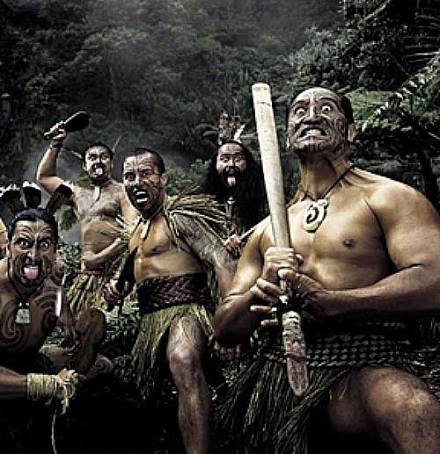
The late thirteenth century had seen the advent of the pa, the fortified village that served as a stronghold for iwis under siege in Aotearoa. By the early 1500’s, those fortifications were becoming remarkably sophisticated. Nowhere was this better demonstrated than on the rocky headland at the southern end of the bay occupied by the Ngati Porou iwi. Like pa sites elsewhere, the iwi had made best use of the available terrain.
The headland that accommodated the pa extended some distance out into the Pacific and overlooked the entire bay as well as miles of coastline to the north and south. Cleared of bush, the only vegetation left was a line of pohutukawa trees that ran along the clifftops. The steep, white cliffs ensured that access was only possible from the land. Anyone who tried to attack from the sea could easily be repelled. A few boys throwing rocks would suffice.
The pa’s main defences were concentrated on protecting its entrance. Two lines of trenches had been dug from one side of the narrow headland to the other to help repel any raiders who chose to attack on foot. These same trenches could be turned into killing fields when enemies tried to cross them. Each was surmounted by a stockade to doubly protect the defenders, and underground tunnels enabled them to retreat if they were in danger of being over-run. This clever design, used by the Ngati Porou and increasingly by Maori everywhere, was surprisingly advanced and effective – as British troops would discover to their cost one day.
The pa itself comprised sturdy timber ramparts surmounted by wooden lookout towers and fighting platforms. These were the last line of defence should the trenches not do the job they were designed to do.
Behind the ramparts, an entire kainga [village] had been constructed. It comprised whares, storage houses, kumara pits and gardens, and most prominent of all a wharenui, or meeting house. It was here the eight hundred villagers would live if attacked.
The pa’s one drawback was that the headland it occupied had no stream or other source of freshwater, which explained why the iwi had opted to establish its permanent settlement on a riverbank half a mile inland. Iwi members only relocated to their coastal pa when there was risk of an attack – as was the case now.
Mahanga, the ageing rangatira of the Ngati Porou, paused in his early morning inspection of the fortifications to stare at a hill, which stood like a sentinel at the northern end of the bay that the pa overlooked. Kaiti Hill was the ancestral site of the Ngati Oneone hapu, a sub-tribe whose marae was located at the base of the hill. From the hill’s summit they had uninterrupted views north to the eastern cape where Mahanga knew the Te Arawa war party was preparing to launch its attack. He’d learned this from the enemy scout his men had captured and tortured several days earlier. Ngati Oneone residents would alert their Ngati Porou neighbours of any approaching threat as the two peoples were close allies. Unless they happened to be cut off, the former would relocate to the pa on the headland in the event of an attack.
Before dying, the Te Arawa scout had proven talkative after having had his feet held to the flames of a cooking fire. The information he’d imparted had given Mahanga a couple of sleepless nights.
Yawning as he continued his inspection tour, he reviewed what he’d learned. By all accounts the enemy’s rangatira, Apera, had three hundred battle-hardened warriors and numerous wakas, including those they’d taken possession of at Tokomaru Bay. More disturbingly, it was evident he was intent on invading the Ngati Porou pa.
The number of warriors the Te Arawa had didn’t concern Mahanga. He had that many and more, and he didn’t think the wakas would be of use to his enemies because any attack from the sea would be futile. If they didn’t already realise that, he thought, they soon would. What did concern the rangatira was the Te Arawa warriors were by all accounts battle-hardened, having prevailed in numerous conflicts with coastal iwis during their journey south from Maketu, a place Mahanga had never heard of. While his own warriors had been tested, having repelled half a dozen attacks on the pa by southern war parties in recent years, they could hardly be described as battle-hardened. The pa’s impressive fortifications had so far rebuffed any attacks, and his warriors had not yet had to engage in any serious hand-to-hand fighting. Such was the advantage those fortifications provided. The Te Arawa warriors might present an altogether different proposition.
What most concerned Mahanga, however, was the pa’s lack of fresh water. Water had to be carried to the site in wooden calabashes and poured into purpose-built, rocky ponds, which had been designed to catch rainwater and act as reservoirs in times of need. However, even when full the ponds would only sustain the iwi’s eight hundred people for seven to ten days at most during dry periods. As luck would have it, the present winter was one of the driest in living memory, and there was no sign of rain on the horizon. In the event of a siege, someone would have to descend the cliffs in darkness, fill calabashes with water from one of the streams that emptied into the bay and return unnoticed. That he realised would be quite a challenge as any self-respecting enemy would be on guard against such attempts.
The rangatira’s thoughts turned to his Te Arawa counterpart as he stopped to observe half a dozen men who were replacing rotting timbers on either side of the pa’s entrance. He’d never heard of Apera, but thought he sounded like someone to be reckoned with even if only half what the captured scout had told him was true. The scout said the ancestors of Apera and his people had travelled to Aotearoa aboard the Arawa waka. Pondering that fact, Mahanga looked north again. As he did he subconsciously massaged the stub of an extra small finger on his left hand – a family trait his late father and great grandfather had also been born with. He remained unaware that Apera shared the same trait or that they were both descended from Hotu who had first journeyed to Aotearoa aboard the Ronui – the very waka which had landed on the same beach he now surveyed.
Since the arrival of Mahanga’s ancestors on these shores, his people had flourished. The land and sea had provided all they needed, and any inter-tribal disputes had generally been settled quickly and peacefully. Change was afoot unfortunately. Iwis were now at war throughout Aotearoa. And war was coming Mahanga’s way. Of that he was sure.
The rangatira was distracted by the sounds of sticks clashing to the accompaniment of grunts of exertion. He looked around and saw his daughter-in-law Anahera sparring with a teenage boy nearby. The pair each wielded a wooden taiaha, or close-quarters staff, a weapon favoured by Maori everywhere. Useful for short, sharp strikes and stabbing thrusts, its use required superior hand-speed, deft footwork and considerable skill.
Mahanga’s daughter-in-law was, he thought, well named. Anahera in Maori folklore stood for Majestic and Powerful Angel. And that she was. Anahera’s sculpted body turned heads wherever she went, and although much lighter than the bulky teenager she sparred with, she was giving him a painful lesson. That was no surprise to the rangatira or to any of the other spectators who had gathered to watch the training session. The young wahine was after all a blooded warrior who had proved herself in battle. Wahines like her – and there were more than a few – often fought alongside their men with distinction.
The bulky teenager grunted in pain as his skillful tutor delivered a blow to an unprotected shin.
“Protect your legs!” Anahera said as she switched her grip on the taiaha and whacked the teenager across one shoulder with it, prompting another grunt from her victim.
“Protect your shoulders, too!” a spectator yelled, causing mirth amongst others watching and causing the teenager no small amount of embarrassment.
“Ignore them,” Anahera said to her bloodied and bruised student. “They can’t fight to save themselves.”
As the training session continued, Mahanga noticed one of his scouts jogging toward him through the pa’s entrance.
“The Te Arawa dogs are coming!” the scout shouted.
“Overland?” Mahanga asked as the breathless scout stopped in front of him.
“Ae…Overland…They will arrive in two days…Three at most.”
“How many?”
“We counted at least two hundred and fifty warriors.”
Mahanga pondered this as villagers began crowding around, keen to hear what the scout had to report. Anahera and her teenage sparring partner were among them.
Pushing through the crowd, Anahera stood before the scout. “Only two hundred and fifty warriors?” she asked. “The Te Arawa prisoner told us they had at least three hundred.” She knew that to be a fact as she was one of those who had held the captive’s feet to the fire before he died.
The scout didn’t like being questioned by a wahine, not even one related by marriage to Mahanga, and he glanced at the rangatira who nodded almost imperceptibly. “They left about forty warriors behind at Tokomaru to guard their slaves and wakas,” the scout mumbled.
Mahanga placed one hand on the scout’s shoulder. “You did well. Eat and rest, and then inform the others I want regular reports on our enemies’ progress.” The others he referred to were the other twelve scouts patrolling overland approaches to the pa.
The scout nodded and jogged off, leaving Mahanga to decide on the best course of action. He turned to Anahera. “Inform your husband of this news,” he said, referring to Nikau, his oldest son. “Bring him to the meeting house.”
Anahera hurried off to find Nikau while her father-in-law walked back to the quarters he shared with his three wives and their extended family. He wanted to check on them before he held a council of war with his headmen.
War was coming and he wanted his people to be ready.
Mahanga had good reason to be concerned: his Te Arawa counterpart, Apera, was at that moment leading a two hundred and sixty-strong raiding party north from Tokomaru Bay, their destination the Ngati Porou pa. They would present the biggest challenge his people had ever faced.
CHAPTER 18
Aotearoa, Early 1500s
The Te Arawa raiders had set out on foot at first light from Tokomaru Bay. Their number included six slaves. Forty warriors remained behind to guard the remaining slaves, wakas and other plunder they’d acquired…
>>> NEW ZEALAND: A NOVEL continues next week.
**********************************************************************

