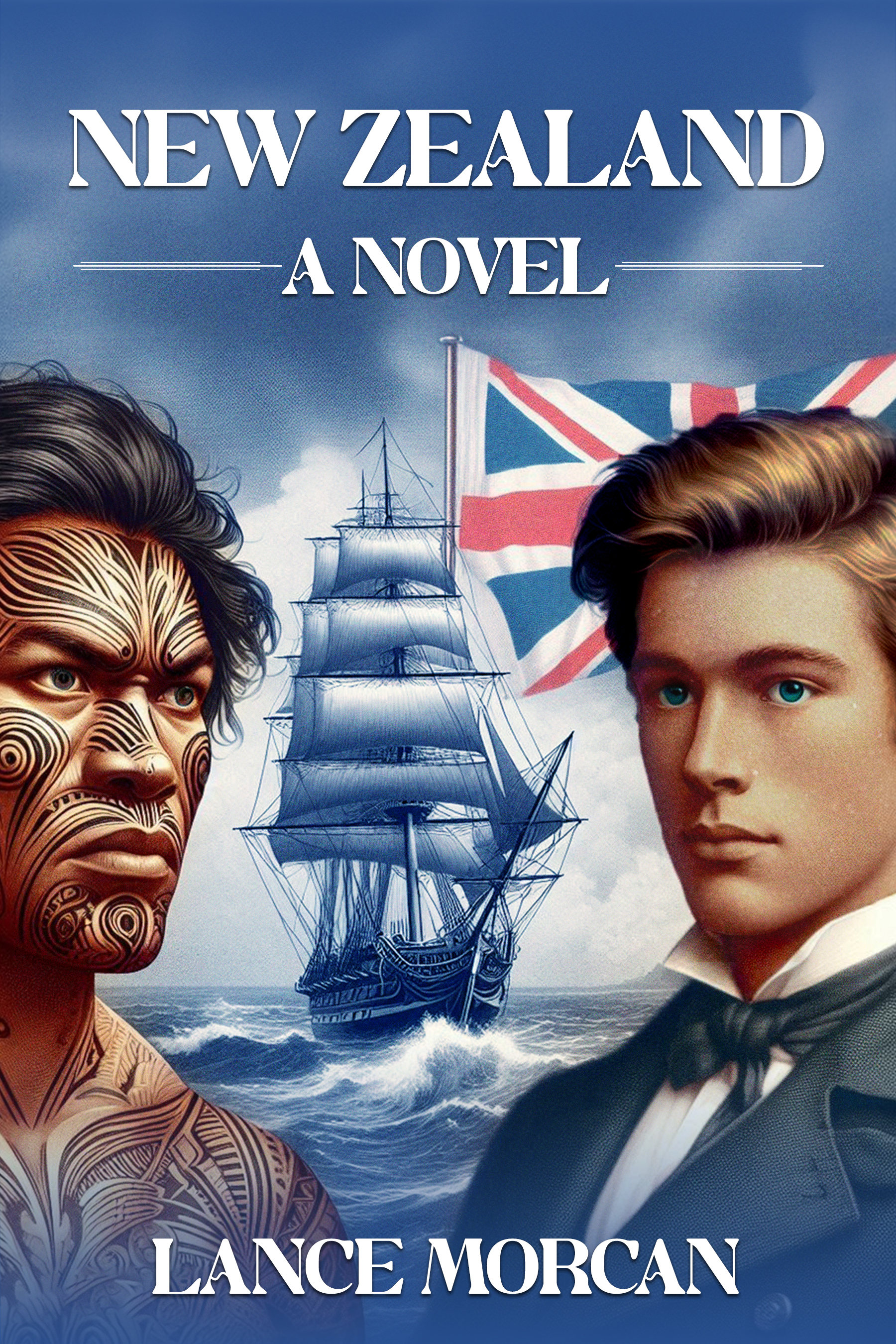
Spanning five centuries, New Zealand: A Novel is a sweeping tale of discovery, destiny, and forbidden love in which the old and new worlds collide. While this novel may not always convey exactly what happened during the discovery and settlement of New Zealand, first by Pacific Islanders and later by Europeans, I believe it captures the spirit of those sometimes romantic, always fascinating and often bloody times. –Lance Morcan (Author)
CHAPTER 19
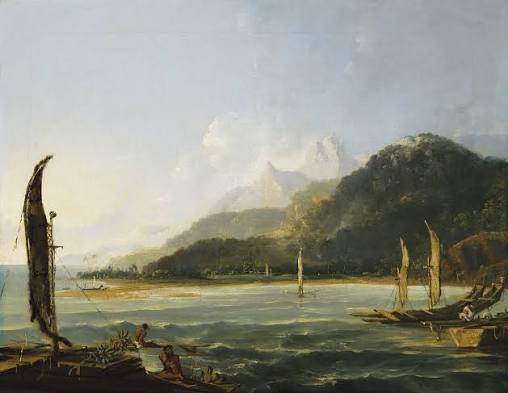
Matavai Bay, Tahiti, June 3, 1769
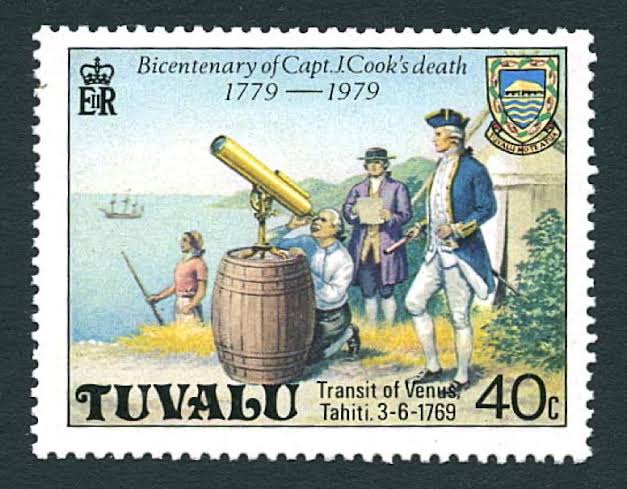
Nicholas’s sojourn in paradise ended as abruptly as it began. Early on the morning of the transit of Venus, Captain Cook’s servant Will Howson arrived at the village to pass on the captain’s orders: the surgeon’s assistant was to make haste to the observatory. More sobering was the news they’d be sailing the next day.
Nicholas had almost forgotten the reason he and his crewmates were here. The two wahines in his life had kept him so busy of late that the scheduled observation of the transit had all but escaped his mind. He looked up at the sky and was relieved to see not a cloud in sight.
The captain will be pleased.
“I’ll accompany ye to the fort,” Will said.
Nicholas shook his head. “No, you go ahead. I have some matters to attend to first.”
“See ye there.”
As Will set off toward the beach, Nicholas immediately sought out Tara and her queen to bid them farewell. He found Tara outside the bure she shared with other servant girls, and, using a simple form of sign language they’d developed, he conveyed to her that he was soon to depart. Kissing her one last time, he murmured, “I will never forget you, my beautiful island girl.”
Tara tried to hide her disappointment behind a smile, but Nicholas wasn’t fooled. For one moment he considered hiding on the island and spending the remainder of his days with her and her queen, but the moment passed as he thought of the adventures and new horizons that lay ahead.
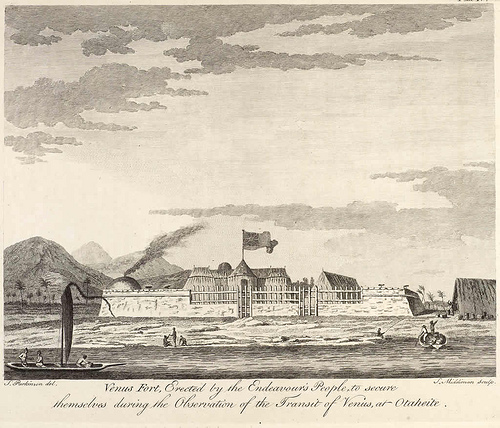
Nicholas then went in search of Queen Obadia, but she was nowhere to be found. Disappointed, he headed for Fort Venus just as the longboat arrived from the Endeavour with officers on board. Tupaia was among them, but there was no sign of Cook. He imagined the captain was already in the observatory preparing for the day’s event.
Tupaia spotted Nicholas in the distance and waited for him to join him. The Tahitian smiled as soon as his young friend was within earshot. “Hello, Nicholas.”
“Good morning, Tupaia.” Nicholas noticed he seemed even more cheerful than usual. “What are you so happy about?”
The Tahitian raised his hands to the sky. “I happy captain has…ah…beautiful day to view heavens…above”
Nicholas suspected his friend wasn’t being entirely truthful, but he let it go.
Tupaia was hiding something. Cook had just the previous evening granted his request to join the Endeavour as his official interpreter for the remainder of the voyage. He’d ordered the new recruit not to mention it to anyone until he had broken the news to his officers.
Entering the fort, Tupaia glanced at his young companion. “Did you enter paradise, my friend?” he asked slyly.
Nicholas smiled, but said nothing.
The Tahitian had no difficulty translating that answer.
#
Tupaia wasn’t the only one in a good mood that morning. After a sleepless night, an anxious Cook had risen well before dawn to greet the new day. After days of indifferent weather, no-one had been more delighted than him to see the sun rise in a cloudless sky.
The captain had rejoiced, announcing to all aboard ship there would be an extra rum ration dispensed.
The start of the transit was now only an hour away, and Nicholas noticed Cook was making final adjustments to one of the large telescopes he and astronomer Charles Green would be using. Although it was still only eight o’clock, the observatory was buzzing with activity. An air of expectancy was building.
Nicholas felt himself caught up in the excitement even if he didn’t fully understand the significance of the event. The astronomical clock, with its gridiron pendulum, occupied pride of place in the centre of the tent. A few paces opposite stood the astronomical quadrant and journeyman clock. The telescopes themselves were the reflecting type, each with a focus of two feet, and Nicholas couldn’t help being impressed by their size.
Cook spent the next hour pacing while studying the sky. He was becoming noticeably anxious even though there was nary a single cloud in sight.
As the time approached, all chatter ceased and the fort became deathly quiet. The only sounds were the squawks of gulls overhead and the laughter of children playing further along the beach.
When the transit began, Nicholas watched intrigued as Cook and Green manned the telescopes.
“Damnation!” Cook cursed, startling the onlookers. Still peering through his scope, he said, “There’s cloud up there.” He looked around at Green who nodded, indicating he concurred.
Glancing up at the clear blue sky, Nicholas wondered what the captain was talking about. The expressions on his fellow crewmates’ faces indicated they were similarly bemused.
“Venus has its own atmosphere,” Cook explained as if he’d read the minds of his men. Still peering into the scope, he said, “The planet’s rim is obscured.”
Nicholas now understood that conditions on the surface of Venus were not as clear as they were in Matavai Bay. He marvelled that such an observation could be made of a planet so far away. Exactly how far, he didn’t know.
More than a few thousand miles if I had to bet.
For the next twenty-five minutes, the men watched the captain and the assistant astronomer go about their work. As each minute passed, discussions between the pair signalled that weather conditions on the planet’s surface were steadily improving.
Nicholas could see that both men were becoming increasingly excited. Glancing at the pendulum clock that sat on a table between the two scopes, he saw it was still not quite nine-thirty.
“That’s it!” Cook said excitedly. Still peering into his scope, he added, “That’s an accurate fix, Mister Green.”
“Aye, Captain,” Green agreed. “It’s a fix.”
A triumphant Cook glanced at the clock and then wrote an entry in an open diary. Nicholas thought the captain had never seemed more alive or animated than he was at that moment.
Total immersion followed nineteen minutes later, and Cook invited the milling onlookers to take turns to look through one of the telescopes.
Nicholas was thrilled to see for himself the small black dot of Venus as it moved across the face of the sun. As soon as his turn finished, he queued for another look at the astronomical phenomenon. While he waited, Cook’s earlier words came back to him, reminding him of the importance of what he was witnessing.
It has become a matter of international prestige, lad. Calculating the distances between Earth and the sun and between Earth and Venus are the first requirements for accurately mapping the solar system. Navigation depends on such knowledge.
#
Several hours later, a relieved Cook proudly announced that despite the hazy atmosphere around the planet, the observation was a success. The captain might not have been so confident if he’d known the learned gents of the Royal Society would be disappointed, complaining that data and drawings of the transit were inconsistent. Most of the blame for this would be apportioned to Green, although it would be acknowledged that the hazy conditions made it difficult to accurately record times and that observers at other locations around the world experienced similar problems.
Now that the first part of the Admiralty’s orders had been executed, the captain was keen to embark on the next stage of the voyage. He immediately issued orders to disassemble the observatory and the fort, and to transfer everything back to the bark. At the same time, he announced that Tupaia would remain on board as interpreter and navigator.
News of Tupaia’s promotion was well received by most for they’d come to like him. However, some diehard veterans privately questioned the wisdom of recruiting a Tahitian for the remainder of the voyage, one of them even suggesting, “The savage best watch out or we’ll use him as shark bait.”
Cook’s good mood soured when he discovered his pocket telescope, which he usually carried around on his person, had been stolen. Too small to be used to observe the transit, he’d removed it from his belt and left it on a chair just outside the fort. His men reported seeing a Tahitian youth uplift it. Attempts to prevent the thief’s escape had failed.
For Cook, this was the last straw. He had an intense dislike of thieving and it was a constant source of irritation to him that the peoples of Tahiti, and other Pacific islands, too, had no qualms about taking what wasn’t theirs to take. He was ready to make good on his promise to make an example of the next thief he caught.
The captain dispatched five marines to catch the culprit. This they did in surprisingly short order. A concerned Hercules had assisted them. The big rangatira was keen to stay on good terms with the visitors for he’d benefitted from trading with them – and he’d witnessed the power of their muskets.
The thief, who was scarcely older than Nicholas, was delivered by canoe to the Endeavour where he was paraded on deck in front of the crew. Cook insisted that every crewmember on board be present to witness the offender’s punishment. Hercules and his entourage were also in attendance courtesy of an invitation from the captain.
Nicholas noted the young thief was smiling, seemingly unaware he’d transgressed. Like all the Islanders, he held to the view what’s yours is mine and mine is yours. It had always been that way.
Using Tupaia as interpreter, Cook advised the assembled Tahitians neither he nor the master of any other English vessel in their waters would countenance thieving. After a barely discernible nod from the captain, Jamie Flogger Andrews stepped forward from the ranks. Flogger was so-named because he carried out the floggings when Cook decreed a crewman should be lashed. The hard-nosed, hard-drinking Scotsman made no secret of the fact he enjoyed his work. He was known as a man not to cross.
Cook’s punishment was quick, but it forever changed the way Nicholas and the others would view the captain.
Andrews tied the still-smiling offender’s hands behind his back, stepped behind him and then, with two practised flicks of a sharp razor, cut off both his ears. Blood spurted from the wounds on either side of the victim’s head, splattering the deck. The youth stared in disbelief at his bloodied ears, now both lying at his feet, before letting out a scream of agony.
“Get him off the ship!” Cook shouted above the victim’s wailing. “And let that be a lesson to these savages!” Turning to his bosun, he said, “Send the natives on their way and ready the vessel for tomorrow’s departure, Mister Molyneaux.”
“Aye, Captain,” the bosun said, hurrying to carry out his orders.
The captain strode off to his cabin, satisfied he’d dispensed a valuable lesson to the Tahitians – and to his men.
As Molyneaux ushered Hercules and the other Tahitians to the rope ladders leading down to their waiting canoe, Nicholas felt sick. He had just seen a side of Cook he’d never seen before. Glancing around, he noted the departing Tahitians seemed stunned. It was evident they weren’t entirely sure what grave sin the youth had committed to warrant such punishment.
#
In his cabin, Cook had already forgotten about the incident topside. His mind was on his next logbook entry. It would be his most important entry to date, and possibly the most important one for the entire voyage. He’d been crafting it in his mind ever since returning to the Endeavour, and he couldn’t wait to commit it to paper.
The familiar sounds of crewmen preparing the Endeavour for tomorrow’s departure and the next stage of her voyage carried to him as he sat down at his desk. Above deck the faint shouts of riggers could be heard as they inspected the bark’s masts and sails; below deck the sound of full water barrels could also be heard as they were rolled into the storeroom and stacked alongside crates of salted beef, smoked fish, fresh fruit and vegetables, and other victuals.
Cook inked his quill and began writing:
June 3rd, 1769: The day proved as favourable to our purpose as we could wish. Not a cloud was to be seen and the air was perfectly clear so that we had every advantage we could desire in observing the whole of the passage of the planet Venus over the Sun’s disk: we distinctly saw an atmosphere or dusky shade round the body of the planet, which very much disturbed the times of the contacts, particularly the two internal ones.
The captain paused in his deliberations to trim his quill with a pair of scissors. Before he resumed writing he wondered how the report would be received by his masters in London.
CHAPTER 20
Matavai Bay, Tahiti, June 4, 1769
The send-off afforded the Endeavour by the villagers at first light the following day was decidedly subdued. Word had spread of the harsh punishment of one of their own the previous afternoon, and that had cast a pall over the bark’s final hours in Matavai Bay.
A dozen canoes and their occupants accompanied the Endeavour as far as…
>>> NEW ZEALAND: A NOVEL continues next week.
**********************************************************************