Posts Tagged ‘Tahiti’

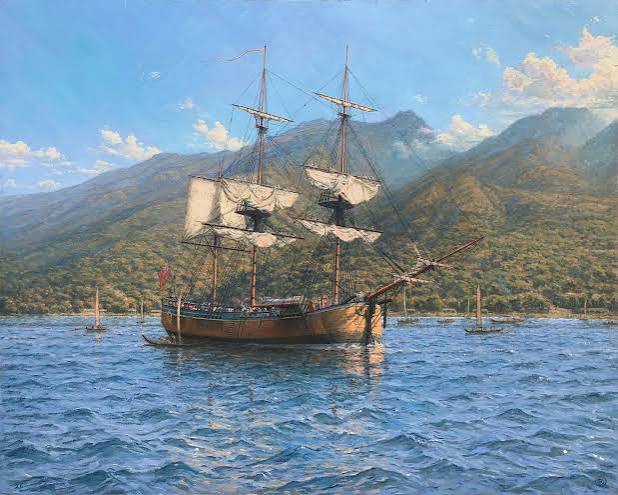
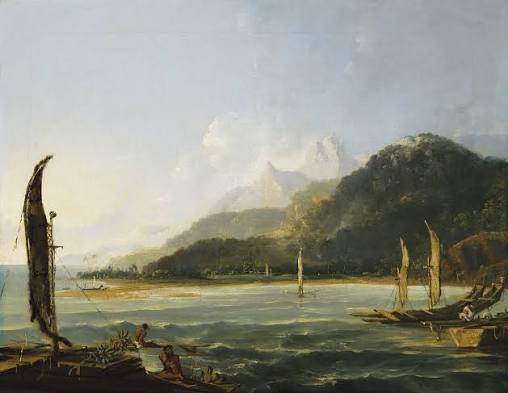
The send-off afforded the Endeavour by the villagers at first light the following day was decidedly subdued. Word had spread of the harsh punishment of one of their own the previous afternoon, and that had cast a pall over the bark’s final hours in Matavai Bay.

A dozen canoes and their occupants accompanied the Endeavour as far as the reef, but the mood of the villagers aboard them seemed restrained as did the disposition of those on shore. Hercules was conspicuously nowhere to be seen.

Nicholas guessed the huge rangatira was pleased to see the back of them given what had happened.

And especially pleased to see the back of me no doubt.

Nicholas had mixed feelings about leaving Tahiti. He studied the villagers in the canoes, hoping to sight one or both of the women who had captured his heart.

Damn…there’s no sign of them.

Turning his attention to shore, he couldn’t see either of them there either, not even with the aid of the telescope he’d borrowed from one of the officers. For one brief moment he considered diving overboard and swimming ashore, but the moment passed.

As the Endeavour eased through the gap in the reef to the open sea beyond, he felt the deck move beneath his feet and his mood changed. The bark seemed to feel it, too, and, now suddenly free of the reef, she surged ahead.

Nicholas rejoiced as he felt the wind in his hair and saltwater spray in his face; the disappointment he’d felt at leaving behind the two wahines who had brought him so much pleasure quickly faded. The discovery of the Great Southern Continent awaited him and his crewmates.

#

On a hilltop overlooking Matavai Bay, a queen and her servant girl watched the tall ship disappear over the horizon. One of them was pregnant although she wasn’t yet aware of that. The hearts of both went out to the young white god who had entered their lives and who had all too quickly departed.

#

Over the next five weeks, the Endeavour circumnavigated Tahiti and its neighbouring islands, stopping off at various places. In that time Tupaia proved his worth many times over as an interpreter and navigator, assisting Cook and his officers at every opportunity. The irrepressible Tahitian was rapidly gaining acceptance as a valued member of the bark’s company. Even the older, more sceptical seamen were getting used to the idea of having him on board.

On the eve of departing the islands for southern lands, Cook decided Tupaia’s addition to the bark’s roster warranted a mention as he prepared to summarise the day’s highlights in his journal. Earlier that day the interpreter had conveyed to him his desire to remain with the Endeavour until she returned to England.

Cook wrote:

July 11th, 1769: As it was thought that he must be of use to us in our future discoveries, we resolved to bring away a Tahitian whose name is Tupaia, a priest and navigator. This man had been with us most of the time on the island, and that gave us the opportunity to get to know him: we found him to be a very intelligent person and to know more of the geography of the islands, their produce and the religion, laws and customs of the inhabitants than anyone we had met with.

Looking ahead, Cook hoped Tupaia would earn his keep when they encountered indigenous people in the southern land Captain Abel Tasman had discovered – the land which he, Cook, intended to claim for Mother England.

In his quarters close by, Joseph Banks was at that very moment updating his diary, and he, too, was writing about the Tahitian. As it turned out, the botanist was an even bigger admirer.

Banks wrote:

Tupaia had renewed his resolve to accompany us to England, which gives me much satisfaction.  He is certainly a most proper man, skilled in the mysteries of the Tahitians’ religion, but what makes him especially desirable is his knowledge of the islands in these seas. The amusement I shall have in conversing with him will I think fully repay me.

And so Tupaia had two of the best supporters he could have hoped for in his corner aboard ship. It was something he was aware of, and he believed it augured well for his future.

Meanwhile, the men of the Endeavour adjusted to the prospect of more long days and weeks at sea. In the sickbay the surgeon and his assistant were too busy tending crewmembers’ ailments to dwell on that. Influenza was doing the rounds again and the clap remained a problem with many of the men affected. Even so, Nicholas’s thoughts frequently strayed to the days and nights of lovemaking he shared with Queen Obadia and Tara. How he wished he could have brought one of them with him.

Or both of them perhaps.

Which one he missed most he couldn’t say. He found it increasingly difficult to think of one without thinking of the other, and the days and nights of lust he shared with each of them were becoming blurred.

The twenty-strong group Apera led from the Te Arawa encampment to their enemies’ coastal pa bore a passing resemblance to the Ngati Porou hunters who had been captured earlier that evening. Under cover of darkness the resemblance was convincing, right down to the primitive coverings the warriors wore and the carrion they carried. Even so, Apera, who was fully satiated after his latest brief but memorable union with Emere, was thankful for the heavy cloud cover, which kept the moonlight at bay…

Nicholas’s sojourn in paradise ended as abruptly as it began. Early on the morning of the transit of Venus, Captain Cook’s servant Will Howson arrived at the village to pass on the captain’s orders: the surgeon’s assistant was to make haste to the observatory. More sobering was the news they’d be sailing the next day.

Nicholas had almost forgotten the reason he and his crewmates were here. The two wahines in his life had kept him so busy of late that the scheduled observation of the transit had all but escaped his mind. He looked up at the sky and was relieved to see not a cloud in sight.

The captain will be pleased.

“I’ll accompany ye to the fort,” Will said.

Nicholas shook his head. “No, you go ahead. I have some matters to attend to first.”

“See ye there.”

As Will set off toward the beach, Nicholas immediately sought out Tara and her queen to bid them farewell. He found Tara outside the bure she shared with other servant girls, and, using a simple form of sign language they’d developed, he conveyed to her that he was soon to depart. Kissing her one last time, he murmured, “I will never forget you, my beautiful island girl.”

Tara tried to hide her disappointment behind a smile, but Nicholas wasn’t fooled. For one moment he considered hiding on the island and spending the remainder of his days with her and her queen, but the moment passed as he thought of the adventures and new horizons that lay ahead.

Nicholas then went in search of Queen Obadia, but she was nowhere to be found. Disappointed, he headed for Fort Venus just as the longboat arrived from the Endeavour with officers on board. Tupaia was among them, but there was no sign of Cook. He imagined the captain was already in the observatory preparing for the day’s event.

Tupaia spotted Nicholas in the distance and waited for him to join him. The Tahitian smiled as soon as his young friend was within earshot. “Hello, Nicholas.”

“Good morning, Tupaia.” Nicholas noticed he seemed even more cheerful than usual. “What are you so happy about?”

The Tahitian raised his hands to the sky. “I happy captain has…ah…beautiful day to view heavens…above”

Nicholas suspected his friend wasn’t being entirely truthful, but he let it go.

Tupaia was hiding something. Cook had just the previous evening granted his request to join the Endeavour as his official interpreter for the remainder of the voyage. He’d ordered the new recruit not to mention it to anyone until he had broken the news to his officers.

Entering the fort, Tupaia glanced at his young companion. “Did you enter paradise, my friend?” he asked slyly.

Nicholas smiled, but said nothing.

The Tahitian had no difficulty translating that answer.

#

Tupaia wasn’t the only one in a good mood that morning. After a sleepless night, an anxious Cook had risen well before dawn to greet the new day. After days of indifferent weather, no-one had been more delighted than him to see the sun rise in a cloudless sky.

The captain had rejoiced, announcing to all aboard ship there would be an extra rum ration dispensed.

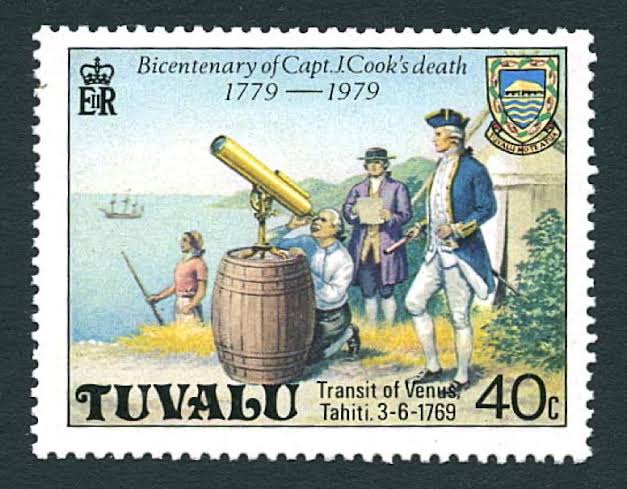
The start of the transit was now only an hour away, and Nicholas noticed Cook was making final adjustments to one of the large telescopes he and astronomer Charles Green would be using. Although it was still only eight o’clock, the observatory was buzzing with activity. An air of expectancy was building.

Nicholas felt himself caught up in the excitement even if he didn’t fully understand the significance of the event. The astronomical clock, with its gridiron pendulum, occupied pride of place in the centre of the tent. A few paces opposite stood the astronomical quadrant and journeyman clock. The telescopes themselves were the reflecting type, each with a focus of two feet, and Nicholas couldn’t help being impressed by their size.

Cook spent the next hour pacing while studying the sky. He was becoming noticeably anxious even though there was nary a single cloud in sight.

As the time approached, all chatter ceased and the fort became deathly quiet. The only sounds were the squawks of gulls overhead and the laughter of children playing further along the beach.

When the transit began, Nicholas watched intrigued as Cook and Green manned the telescopes.

“Damnation!” Cook cursed, startling the onlookers. Still peering through his scope, he said, “There’s cloud up there.” He looked around at Green who nodded, indicating he concurred.

Glancing up at the clear blue sky, Nicholas wondered what the captain was talking about. The expressions on his fellow crewmates’ faces indicated they were similarly bemused.

“Venus has its own atmosphere,” Cook explained as if he’d read the minds of his men. Still peering into the scope, he said, “The planet’s rim is obscured.”

Nicholas now understood that conditions on the surface of Venus were not as clear as they were in Matavai Bay. He marvelled that such an observation could be made of a planet so far away. Exactly how far, he didn’t know.

More than a few thousand miles if I had to bet.

For the next twenty-five minutes, the men watched the captain and the assistant astronomer go about their work. As each minute passed, discussions between the pair signalled that weather conditions on the planet’s surface were steadily improving.

Nicholas could see that both men were becoming increasingly excited. Glancing at the pendulum clock that sat on a table between the two scopes, he saw it was still not quite nine-thirty.

“That’s it!” Cook said excitedly. Still peering into his scope, he added, “That’s an accurate fix, Mister Green.”

“Aye, Captain,” Green agreed. “It’s a fix.”

A triumphant Cook glanced at the clock and then wrote an entry in an open diary. Nicholas thought the captain had never seemed more alive or animated than he was at that moment.

Total immersion followed nineteen minutes later, and Cook invited the milling onlookers to take turns to look through one of the telescopes.

Nicholas was thrilled to see for himself the small black dot of Venus as it moved across the face of the sun. As soon as his turn finished, he queued for another look at the astronomical phenomenon. While he waited, Cook’s earlier words came back to him, reminding him of the importance of what he was witnessing.

It has become a matter of international prestige, lad. Calculating the distances between Earth and the sun and between Earth and Venus are the first requirements for accurately mapping the solar system. Navigation depends on such knowledge.

#

Several hours later, a relieved Cook proudly announced that despite the hazy atmosphere around the planet, the observation was a success. The captain might not have been so confident if he’d known the learned gents of the Royal Society would be disappointed, complaining that data and drawings of the transit were inconsistent. Most of the blame for this would be apportioned to Green, although it would be acknowledged that the hazy conditions made it difficult to accurately record times and that observers at other locations around the world experienced similar problems.

Now that the first part of the Admiralty’s orders had been executed, the captain was keen to embark on the next stage of the voyage. He immediately issued orders to disassemble the observatory and the fort, and to transfer everything back to the bark. At the same time, he announced that Tupaia would remain on board as interpreter and navigator.

News of Tupaia’s promotion was well received by most for they’d come to like him. However, some diehard veterans privately questioned the wisdom of recruiting a Tahitian for the remainder of the voyage, one of them even suggesting, “The savage best watch out or we’ll use him as shark bait.”

Cook’s good mood soured when he discovered his pocket telescope, which he usually carried around on his person, had been stolen. Too small to be used to observe the transit, he’d removed it from his belt and left it on a chair just outside the fort. His men reported seeing a Tahitian youth uplift it. Attempts to prevent the thief’s escape had failed.

For Cook, this was the last straw. He had an intense dislike of thieving and it was a constant source of irritation to him that the peoples of Tahiti, and other Pacific islands, too, had no qualms about taking what wasn’t theirs to take. He was ready to make good on his promise to make an example of the next thief he caught.

The captain dispatched five marines to catch the culprit. This they did in surprisingly short order. A concerned Hercules had assisted them. The big rangatira was keen to stay on good terms with the visitors for he’d benefitted from trading with them – and he’d witnessed the power of their muskets.

The thief, who was scarcely older than Nicholas, was delivered by canoe to the Endeavour where he was paraded on deck in front of the crew. Cook insisted that every crewmember on board be present to witness the offender’s punishment. Hercules and his entourage were also in attendance courtesy of an invitation from the captain.

Nicholas noted the young thief was smiling, seemingly unaware he’d transgressed. Like all the Islanders, he held to the view what’s yours is mine and mine is yours. It had always been that way.

Using Tupaia as interpreter, Cook advised the assembled Tahitians neither he nor the master of any other English vessel in their waters would countenance thieving. After a barely discernible nod from the captain, Jamie Flogger Andrews stepped forward from the ranks. Flogger was so-named because he carried out the floggings when Cook decreed a crewman should be lashed. The hard-nosed, hard-drinking Scotsman made no secret of the fact he enjoyed his work. He was known as a man not to cross.

Cook’s punishment was quick, but it forever changed the way Nicholas and the others would view the captain.

Andrews tied the still-smiling offender’s hands behind his back, stepped behind him and then, with two practised flicks of a sharp razor, cut off both his ears. Blood spurted from the wounds on either side of the victim’s head, splattering the deck. The youth stared in disbelief at his bloodied ears, now both lying at his feet, before letting out a scream of agony.

“Get him off the ship!” Cook shouted above the victim’s wailing. “And let that be a lesson to these savages!” Turning to his bosun, he said, “Send the natives on their way and ready the vessel for tomorrow’s departure, Mister Molyneaux.”

“Aye, Captain,” the bosun said, hurrying to carry out his orders.

The captain strode off to his cabin, satisfied he’d dispensed a valuable lesson to the Tahitians – and to his men.

As Molyneaux ushered Hercules and the other Tahitians to the rope ladders leading down to their waiting canoe, Nicholas felt sick. He had just seen a side of Cook he’d never seen before. Glancing around, he noted the departing Tahitians seemed stunned. It was evident they weren’t entirely sure what grave sin the youth had committed to warrant such punishment.

#

In his cabin, Cook had already forgotten about the incident topside. His mind was on his next logbook entry. It would be his most important entry to date, and possibly the most important one for the entire voyage. He’d been crafting it in his mind ever since returning to the Endeavour, and he couldn’t wait to commit it to paper.

The familiar sounds of crewmen preparing the Endeavour for tomorrow’s departure and the next stage of her voyage carried to him as he sat down at his desk. Above deck the faint shouts of riggers could be heard as they inspected the bark’s masts and sails; below deck the sound of full water barrels could also be heard as they were rolled into the storeroom and stacked alongside crates of salted beef, smoked fish, fresh fruit and vegetables, and other victuals.

Cook inked his quill and began writing:

June 3rd, 1769: The day proved as favourable to our purpose as we could wish. Not a cloud was to be seen and the air was perfectly clear so that we had every advantage we could desire in observing the whole of the passage of the planet Venus over the Sun’s disk: we distinctly saw an atmosphere or dusky shade round the body of the planet, which very much disturbed the times of the contacts, particularly the two internal ones. 

The captain paused in his deliberations to trim his quill with a pair of scissors. Before he resumed writing he wondered how the report would be received by his masters in London.

The send-off afforded the Endeavour by the villagers at first light the following day was decidedly subdued. Word had spread of the harsh punishment of one of their own the previous afternoon, and that had cast a pall over the bark’s final hours in Matavai Bay.

A dozen canoes and their occupants accompanied the Endeavour as far as…

The late thirteenth century had seen the advent of the pa, the fortified village that served as a stronghold for iwis under siege in Aotearoa. By the early 1500’s, those fortifications were becoming remarkably sophisticated. Nowhere was this better demonstrated than on the rocky headland at the southern end of the bay occupied by the Ngati Porou iwi. Like pa sites elsewhere, the iwi had made best use of the available terrain.

The headland that accommodated the pa extended some distance out into the Pacific and overlooked the entire bay as well as miles of coastline to the north and south. Cleared of bush, the only vegetation left was a line of pohutukawa trees that ran along the clifftops. The steep, white cliffs ensured that access was only possible from the land. Anyone who tried to attack from the sea could easily be repelled. A few boys throwing rocks would suffice.

The pa’s main defences were concentrated on protecting its entrance. Two lines of trenches had been dug from one side of the narrow headland to the other to help repel any raiders who chose to attack on foot. These same trenches could be turned into killing fields when enemies tried to cross them. Each was surmounted by a stockade to doubly protect the defenders, and underground tunnels enabled them to retreat if they were in danger of being over-run. This clever design, used by the Ngati Porou and increasingly by Maori everywhere, was surprisingly advanced and effective – as British troops would discover to their cost one day.

The pa itself comprised sturdy timber ramparts surmounted by wooden lookout towers and fighting platforms. These were the last line of defence should the trenches not do the job they were designed to do.

Behind the ramparts, an entire kainga [village] had been constructed. It comprised whares, storage houses, kumara pits and gardens, and most prominent of all a wharenui, or meeting house. It was here the eight hundred villagers would live if attacked.

The pa’s one drawback was that the headland it occupied had no stream or other source of freshwater, which explained why the iwi had opted to establish its permanent settlement on a riverbank half a mile inland. Iwi members only relocated to their coastal pa when there was risk of an attack – as was the case now.

Mahanga, the ageing rangatira of the Ngati Porou, paused in his early morning inspection of the fortifications to stare at a hill, which stood like a sentinel at the northern end of the bay that the pa overlooked. Kaiti Hill was the ancestral site of the Ngati Oneone hapu, a sub-tribe whose marae was located at the base of the hill. From the hill’s summit they had uninterrupted views north to the eastern cape where Mahanga knew the Te Arawa war party was preparing to launch its attack. He’d learned this from the enemy scout his men had captured and tortured several days earlier. Ngati Oneone residents would alert their Ngati Porou neighbours of any approaching threat as the two peoples were close allies. Unless they happened to be cut off, the former would relocate to the pa on the headland in the event of an attack.

Before dying, the Te Arawa scout had proven talkative after having had his feet held to the flames of a cooking fire. The information he’d imparted had given Mahanga a couple of sleepless nights.

Yawning as he continued his inspection tour, he reviewed what he’d learned. By all accounts the enemy’s rangatira, Apera, had three hundred battle-hardened warriors and numerous wakas, including those they’d taken possession of at Tokomaru Bay. More disturbingly, it was evident he was intent on invading the Ngati Porou pa.

The number of warriors the Te Arawa had didn’t concern Mahanga. He had that many and more, and he didn’t think the wakas would be of use to his enemies because any attack from the sea would be futile. If they didn’t already realise that, he thought, they soon would. What did concern the rangatira was the Te Arawa warriors were by all accounts battle-hardened, having prevailed in numerous conflicts with coastal iwis during their journey south from Maketu, a place Mahanga had never heard of. While his own warriors had been tested, having repelled half a dozen attacks on the pa by southern war parties in recent years, they could hardly be described as battle-hardened. The pa’s impressive fortifications had so far rebuffed any attacks, and his warriors had not yet had to engage in any serious hand-to-hand fighting. Such was the advantage those fortifications provided. The Te Arawa warriors might present an altogether different proposition. 

What most concerned Mahanga, however, was the pa’s lack of fresh water. Water had to be carried to the site in wooden calabashes and poured into purpose-built, rocky ponds, which had been designed to catch rainwater and act as reservoirs in times of need. However, even when full the ponds would only sustain the iwi’s eight hundred people for seven to ten days at most during dry periods. As luck would have it, the present winter was one of the driest in living memory, and there was no sign of rain on the horizon. In the event of a siege, someone would have to descend the cliffs in darkness, fill calabashes with water from one of the streams that emptied into the bay and return unnoticed. That he realised would be quite a challenge as any self-respecting enemy would be on guard against such attempts.

The rangatira’s thoughts turned to his Te Arawa counterpart as he stopped to observe half a dozen men who were replacing rotting timbers on either side of the pa’s entrance. He’d never heard of Apera, but thought he sounded like someone to be reckoned with even if only half what the captured scout had told him was true. The scout said the ancestors of Apera and his people had travelled to Aotearoa aboard the Arawa waka. Pondering that fact, Mahanga looked north again. As he did he subconsciously massaged the stub of an extra small finger on his left hand – a family trait his late father and great grandfather had also been born with. He remained unaware that Apera shared the same trait or that they were both descended from Hotu who had first journeyed to Aotearoa aboard the Ronui – the very waka which had landed on the same beach he now surveyed.

Since the arrival of Mahanga’s ancestors on these shores, his people had flourished. The land and sea had provided all they needed, and any inter-tribal disputes had generally been settled quickly and peacefully. Change was afoot unfortunately. Iwis were now at war throughout Aotearoa. And war was coming Mahanga’s way. Of that he was sure. 

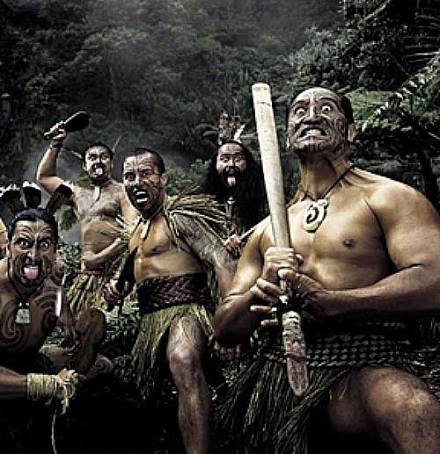
The rangatira was distracted by the sounds of sticks clashing to the accompaniment of grunts of exertion. He looked around and saw his daughter-in-law Anahera sparring with a teenage boy nearby. The pair each wielded a wooden taiaha, or close-quarters staff, a weapon favoured by Maori everywhere. Useful for short, sharp strikes and stabbing thrusts, its use required superior hand-speed, deft footwork and considerable skill.

Mahanga’s daughter-in-law was, he thought, well named. Anahera in Maori folklore stood for Majestic and Powerful Angel. And that she was. Anahera’s sculpted body turned heads wherever she went, and although much lighter than the bulky teenager she sparred with, she was giving him a painful lesson. That was no surprise to the rangatira or to any of the other spectators who had gathered to watch the training session. The young wahine was after all a blooded warrior who had proved herself in battle. Wahines like her – and there were more than a few – often fought alongside their men with distinction.

The bulky teenager grunted in pain as his skillful tutor delivered a blow to an unprotected shin.

“Protect your legs!” Anahera said as she switched her grip on the taiaha and whacked the teenager across one shoulder with it, prompting another grunt from her victim.

“Protect your shoulders, too!” a spectator yelled, causing mirth amongst others watching and causing the teenager no small amount of embarrassment.

“Ignore them,” Anahera said to her bloodied and bruised student. “They can’t fight to save themselves.”

As the training session continued, Mahanga noticed one of his scouts jogging toward him through the pa’s entrance.

“The Te Arawa dogs are coming!” the scout shouted.

“Overland?” Mahanga asked as the breathless scout stopped in front of him.

“Ae…Overland…They will arrive in two days…Three at most.”

“How many?”

“We counted at least two hundred and fifty warriors.”

Mahanga pondered this as villagers began crowding around, keen to hear what the scout had to report. Anahera and her teenage sparring partner were among them.

Pushing through the crowd, Anahera stood before the scout. “Only two hundred and fifty warriors?” she asked. “The Te Arawa prisoner told us they had at least three hundred.” She knew that to be a fact as she was one of those who had held the captive’s feet to the fire before he died.

The scout didn’t like being questioned by a wahine, not even one related by marriage to Mahanga, and he glanced at the rangatira who nodded almost imperceptibly. “They left about forty warriors behind at Tokomaru to guard their slaves and wakas,” the scout mumbled.

Mahanga placed one hand on the scout’s shoulder. “You did well. Eat and rest, and then inform the others I want regular reports on our enemies’ progress.” The others he referred to were the other twelve scouts patrolling overland approaches to the pa.

The scout nodded and jogged off, leaving Mahanga to decide on the best course of action. He turned to Anahera. “Inform your husband of this news,” he said, referring to Nikau, his oldest son. “Bring him to the meeting house.”

Anahera hurried off to find Nikau while her father-in-law walked back to the quarters he shared with his three wives and their extended family. He wanted to check on them before he held a council of war with his headmen.

War was coming and he wanted his people to be ready.

Mahanga had good reason to be concerned: his Te Arawa counterpart, Apera, was at that moment leading a two hundred and sixty-strong raiding party north from Tokomaru Bay, their destination the Ngati Porou pa. They would present the biggest challenge his people had ever faced.

The Te Arawa raiders had set out on foot at first light from Tokomaru Bay. Their number included six slaves. Forty warriors remained behind to guard the remaining slaves, wakas and other plunder they’d acquired…

Time passed ever so slowly – excruciatingly slowly for Nicholas. The lad noticed the bure he’d been allocated was only yards from the rear entrance to the royal quarters. He wondered if that had any significance. Curious, he entered his new temporary home.

Inside, he found the bure was typical of others on the island. Constructed of bamboo, bark, palm tree fronds, ferns and pandanus leaves, it looked comfortable enough. There was only one small window opening, set into the far wall, but its location opposite the open doorway ensured that sea breezes would pass through, providing welcome relief from the oppressive heat and humidity. Fronds covered the grassy floor, and a flax bed-mat lay atop a mattress of ferns beneath the window.

The morning sun gave way to the afternoon, and still there was no sign of Tupaia or the queen. To occupy himself, Nicholas went for a stroll round the village. He discovered most of the villagers were inside their bures or sitting in the shade of palm trees to escape the sun. A few playful children scampered around between the dwellings. Everyone who saw the handsome young European smiled or waved at him. He responded in kind, but further communication was impossible without Tupaia being present to translate.

Hot and thirsty, he returned to his bure to discover someone had kindly left food and water in separate wooden bowls just inside the doorway. He greedily satisfied his hunger and thirst. Suddenly tired, he lay down on the bed-mat and let his mind wander. He found himself wondering what Queen Obadia could possibly want with him. And he recalled that fleeting instant their eyes locked the first time he’d seen her, but he dared not read anything into that.

I probably imagined it.

His eyes grew heavy and he was asleep before he knew it.

#

Nicholas didn’t know how long he’d been sleeping when he was roused from his slumber by Tupaia. “What…what took you so long?” he asked, yawning.

 “That not important my friend.” The Tahitian didn’t reveal that he’d spent the day reassuring Queen Obadia that she was doing the right thing and that the surgeon’s boy had been sent to her by the gods. “What is important is…queen now ready to meet you.”

This news both elated and alarmed Nicholas.

“Come,” Tupaia commanded, heading for the doorway.

A nervous Nicholas followed. Outside, he discovered the afternoon shadows had lengthened considerably since he’d fallen asleep.

Tupaia stopped in front of the main entrance to the royal quarters and indicated to the younger man that he should enter the queen’s residence.

“Are you not coming with me?” Nicholas asked.

“Queen say she want to see you…alone.”

“I surely need you to translate.”

“Queen Obadia speak English. Not good as me, of course, but good enough to understand.” Tupaia strode off, smiling to himself.

Watching his escort depart, Nicholas wondered if this new development had anything to do with the engaging interpreter. He dismissed the thought as quickly as it occurred because he couldn’t imagine how his good fortune could possibly benefit Tupaia.

Inside the royal quarters it took his eyes a minute or two to adjust to the darkness. He suddenly tensed. Seated against the dwelling’s far wall was the shadowy but unmistakable outline of Hercules. The hulking rangatira sat as motionless as a giant statue.

Slowly, Hercules came to life. The Buddha-like figure uncrossed his tree-trunk legs, and, grunting with the exertion, pushed himself to his feet. Nothing was said. There was no word of greeting or even any acknowledgment of the visitor’s presence.

In the drawn-out silence, Nicholas couldn’t help but notice the rangatira now seemed to be scowling at him. The lad looked around for some sign of the queen. She was nowhere to be seen.

“Queen Obadia…she join us soon,” Hercules said in broken English, his deep voice disturbing the silence and causing Nicholas to jump for the second time in as many minutes. 

Another strained silence followed.

Now that his eyes had adjusted to the darkness, the disconcerted visitor was alarmed to see Hercules was still glaring at him.

What’s his problem?

It seemed the rangatira was fully aware of the lust he had for his queen.

Can he read my mind?

Hercules had seen many young men – some from other ships – receive the queen’s royal summons. He knew she desperately wanted a child above all else and was devastated when he, the mighty rangatira of her people, couldn’t give her what she wanted. Consequently, he’d long-since been banished from the marital bed-mat. Hercules knew the problem was not his for he’d fathered many children through his surrogate wives who were scattered all round the island. It had always been immensely damaging to his pride that so great a rangatira did not have any legitimate wives. He was from another island and local custom did not permit an outsider such as him to take a Tahitian wife. Although widely known that he had many children by other women, that could never be publicly acknowledged and that was a constant source of grief to him as he had no official successor.

The queen’s obsession with bedding younger men in her desperate attempts to conceive was another blow to Hercules’ esteem in the eyes of his people. It was as though she was trumpeting to one and all that she needed to be mounted by younger, more virile lovers. This had been noted far beyond Matavai Bay, and rival rangatiras and enemies alike had long-delighted in reminding him of it.

Hercules thought his queen had given up on her aspirations to have a child. As far as he knew, she hadn’t had relations with anyone since the Dolphin visited these shores. On that occasion, she’d enjoyed some wild nights of passion with a young lieutenant from that tall ship. The rangatira scowled at the memory, and Nicholas cringed involuntarily, thinking the scowl was meant for him.

After what seemed an eternity, Queen Obadia made her entrance. She was accompanied by an armed warrior and two servant girls. The warrior was carrying a flaming torch, which lit up the room to reveal the dwelling was similar to Nicholas’s own bure in its construction. That was where any similarity ended, however. Many times larger than his temporary quarters, its sandy floor was almost completely covered by a huge carpet that featured a woven image of the reigning French king, Louis XV. It evidently came from one of the French ships that visited Tahiti and was complemented by an original gold-framed portrait of the same monarch, which hung on one wall. The young visitor recognised King Louis immediately because he’d seen paintings of him before. Displayed as they were beneath the bure’s thatched roof, the combined effect of the carpet and the painting struck him as incongruous.

Nicholas’s attention was grabbed by a flash of light reflected from a sword hanging on the facing wall. At first he thought it was the sword presented to the rangatira by Cook, but closer scrutiny revealed it was Warrant Officer Wilkinson’s stolen ceremonial sword. It was still in its jewel-encrusted scabbard. He could only imagine what the officer would say when he learned his beloved sword occupied pride of place in the royal quarters.

Safer if I say nothing perhaps.

Nicholas forgot all about the sword when Queen Obadia stepped out of the shadows. Time stood still while he marvelled at the magnificent sight before him. The queen was even more stunning than he remembered.

As she had the first time he’d seen her, she let her exquisite almond eyes rest on his face. This time she held his gaze.

Nicholas was drowning in his own desire beneath beautiful Queen Obadia’s all-knowing gaze as she approached. He feared he might collapse. His legs nearly gave way beneath him and he realised he was having trouble breathing…