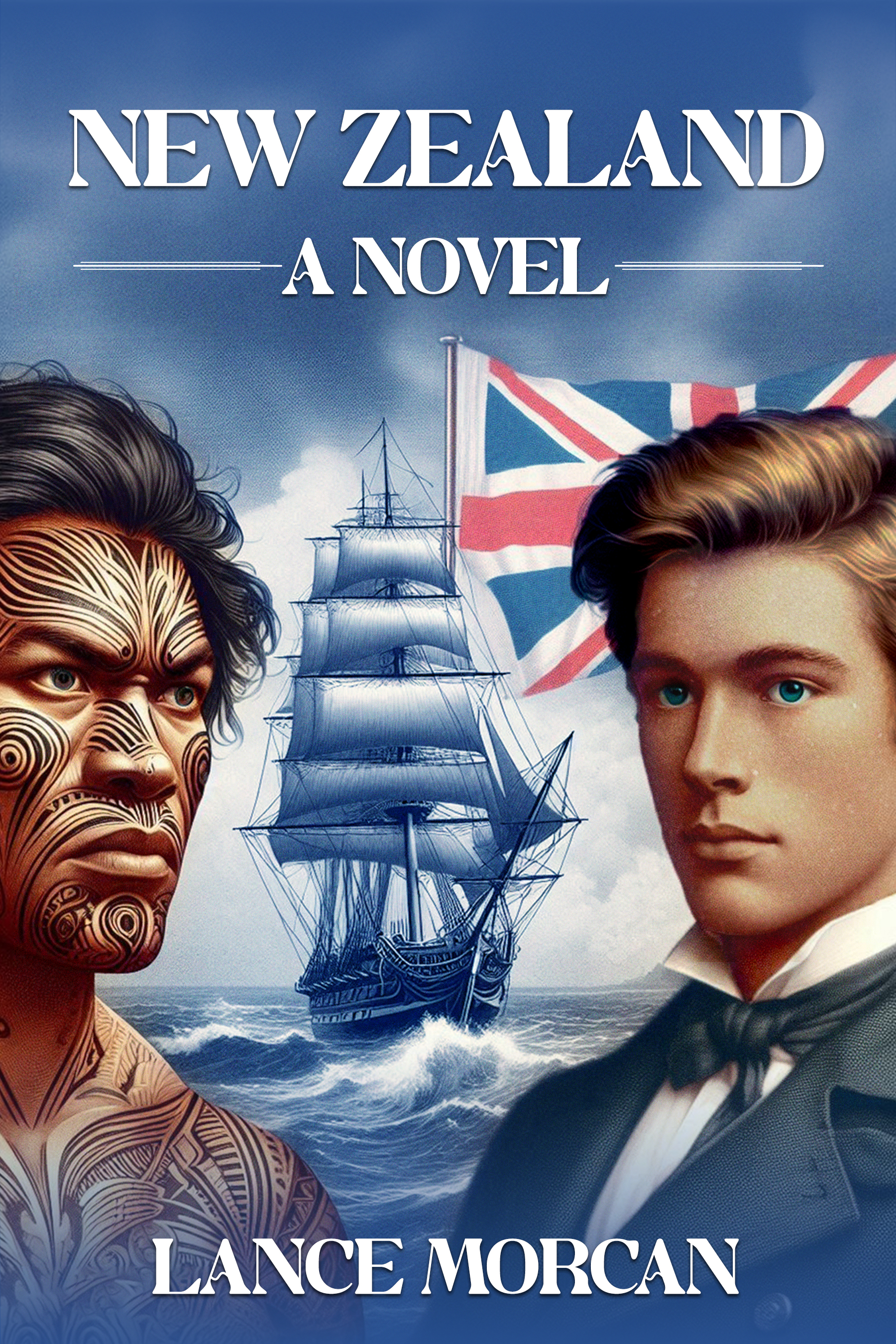
Spanning five centuries, New Zealand: A Novel is a sweeping tale of discovery, destiny, and forbidden love in which the old and new worlds collide. While this novel may not always convey exactly what happened during the discovery and settlement of New Zealand, first by Pacific Islanders and later by Europeans, I believe it captures the spirit of those sometimes romantic, always fascinating and often bloody times. –Lance Morcan (Author)
CHAPTER 9
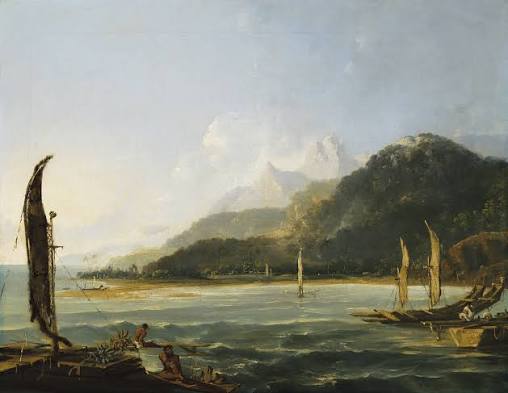
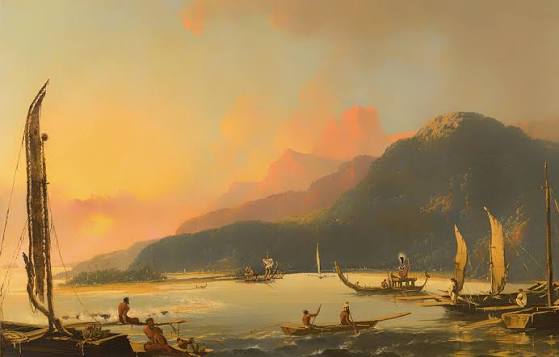
Matavai Bay, Tahiti, April 14, 1769
The morning after the Endeavour’s arrival at Matavai Bay dawned bright and sunny, a welcome change from the recent foul weather.
Even before the crew had finished breakfasting in the mess, a cry went up that a canoe was approaching. Nicholas and several other crewmen hurried topside and saw two paddlers propelling the canoe toward them across the calm waters of the lagoon. Behind the paddlers sat an impressive-looking Tahitian resplendent in a fine black cloak. His handsome head was adorned by a head-dress of colourful feathers. It was obvious from his appearance, and from the ornate carvings on the bow of his canoe, he was someone of importance.
Aboard the Endeavour, the bosun gave the order to prepare for the arrival of the mystery visitor. A ladder was thrown over the starboard rail as the canoe arrived and two sailors leaned over the side to help the Tahitian on board.
Nicholas noted the visitor appeared to be in his mid-twenties. He possessed an engaging smile, which he flashed frequently, and, to everyone’s surprise, he spoke passably-good English and even better French – a legacy of earlier visits by other ships, and a testimony also to his intelligence and penchant for foreign languages.
“Bonjour mes amis,” the visitor announced grandly, “je suis Tupaia.” Switching to English, he added, “Tupaia is your trustworthy guide and…ah…interpreter for time you stay Matavai Bay.”
Nicholas and the others were astounded to hear someone they considered a savage speaking both French and English so far from Europe and Mother England.
The visitor seemed amused by their reaction. “You wonder how I know your language,” he said perceptively. His smile widened, revealing a set of pearly white teeth. “You not first white men I seen.”
Bosun Robert Molyneaux, as taken aback as the rest by the confidence of the multilingual fop standing before them, muttered, “Looks like we’ve got ourselves a real fucking charmer here.” Turning to a sailor, he said, “Fetch the captain.”
The sailor hurried off and the ever-smiling Tupaia waited patiently, seemingly unbothered by the inquisitive looks he was attracting.
Several minutes later, Cook appeared on deck. “Greetings, Mister Tupaia,” the captain said, having been alerted to the visitor’s name.
“Good day, Captain,” Tupaia beamed as he clasped Cook’s hand between both of his hands.
Cook took an immediate liking to the visitor. He judged him to be a confident chap with an intelligent air. A charming savage, he told himself.
As the two men sized each other up, Nicholas and the other onlookers made their own evaluations. Like most Tahitians, Tupaia cut a fine figure. Yet he was very different to his countrymen. Slender of build and more refined than most, he seemed thoughtful and inquisitive, his sparkling eyes forever moving from one white face to the next as he assessed the strangers around him.
It was Tupaia who spoke next. “Captain, as I, ah, tell your people…I am guide and interpreter…for rest of your stay.” It was a statement, not a request. “Make your time here easy for you.”
Cook looked at him shrewdly. He was sure the Tahitian’s services would be useful, and he was in no doubt the man would expect to be well paid for those services.
As if reading his mind, Tupaia continued smoothly, “Captain, I also high priest and very good navigator. It give me great, ah, happy…to be of service.”
Delighting in the other’s charm, Cook dropped his reserve and clapped the Tahitian on the shoulder. “By thunder, Mister Tupaia, I can see ye will be an asset to this vessel and all who sail aboard her!” Turning to the bosun, he said, “Mister Molyneaux, bring our visitor to the quarterdeck.”
“Aye, Captain,” the bosun said.
With that, Cook turned heel and strode off, leaving Molyneaux to escort Tupaia to the quarterdeck.
Intrigued, Nicholas followed at a discreet distance. At the foot of the ladder leading to the deck, he invented an imaginary cleaning task to attend to. From there he could just make out the gist of the conversation.
“I was priest at Raiatea,” Nicholas heard Tupaia saying, “not far from here, when we…invaded by cannibals…from Bora Bora. I lucky to escape and end here…at mercy of beautiful Queen Obadia.”
On the quarterdeck, the mention of a queen caught Cook’s attention. He guessed she belonged to the big rangatira they’d met the previous day – the man his crew referred to as Hercules. “How many other ships have visited here?”
“Three other tall ships.”
Cook looked up sharply. He knew the English frigate, the Dolphin, had visited Tahiti two years earlier – in 1767. It was her charts he was using now. The Royal Navy had suspicions that the Spanish had visited since. This new information would seem to confirm it. “Do ye recall what flag they sailed under?” he asked.
Tupaia looked puzzled.
“What nationality were they?” Cook asked.
“First was from your country. The Dolphin… I think. I learn my good English, ah, from men on Dolphin.”
“Ye obviously had fine teachers,” Cook said sincerely.
Tupaia beamed.
“And the other two?” Cook prompted.
“They both from France.”
“From France?”
The Tahitian nodded. He could see he had Cook’s full attention now.
“Ye are sure?” the captain persisted.
“Oui, Monsieur,” Tupaia said, switching to fluent French. In that same tongue, he added, “That is why my French is, how you say, first class.”
“How long since they were here?”
Switching back to English, Tupaia said, “First not long after Dolphin go…and second only, um, two full moons ago.”
Cook made a note to record the facts in his logbook. The Lords of the Admiralty would be interested to learn of these developments. The race between nations to add new lands to their ever-expanding empires was now truly underway. Confirmation of France’s interest in these far-flung territories would add to the concerns England already had over Spain’s aggressive expansionist policies.
Tupaia’s information confirmed for Cook he’d be more than useful as a guide and interpreter for the duration of the Endeavour’s stay. After some robust negotiation, a deal was struck between the two men.
From his post, Nicholas learned the charming interpreter would receive payment in the form of European cloth, garments and other items as well as having full use of cramped but private quarters aboard ship.
Tupaia was enthusiastic in his thanks. As something of a ladies’ man, he knew the white man’s clothes would make him even more desirable to Matavai Bay’s wahines.
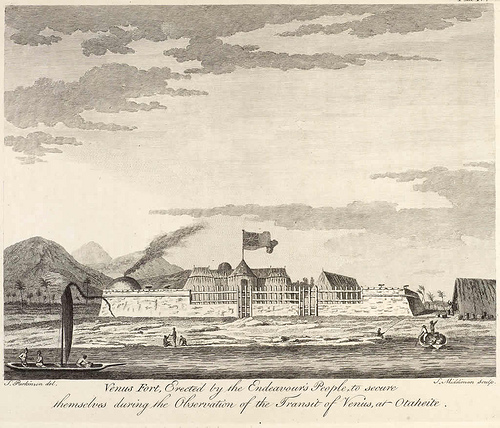
For his part, Cook thought he’d gotten the best of the deal. He was sure the English-speaking popinjay would be valuable to him in the weeks ahead. His sole concern, apart from the safety of ship and crew, was to complete a successful observation of the transit of Venus, now less than seven weeks away. To facilitate this, he knew he’d need to have the goodwill of the local villagers, and he was confident Tupaia would help smooth the way. The very thought of having to contend with warring natives while trying to carry out so precise an astronomical assignment was too awful to contemplate.
Yes, Cook thought, Tupaia would indeed be useful.
Before leaving, the Tahitian extended an invitation on behalf of Queen Obadia for Cook and his entire company to attend a feast in their honour the following day. The captain readily accepted the invitation then he and his crewmen watched as Tupaia descended the ladder to the waiting canoe and was paddled back to the beach.
For the entire return trip, the smiling Tahitian sat about-face at the stern, waving at his newfound friends aboard the Endeavour. Tupaia was excited that after tomorrow’s feast he would take up temporary lodgings aboard the white man’s vessel. He hoped those lodgings might become permanent for he longed to see for himself what lay beyond Tahiti’s shores.
#
The following day dawned hot and humid in Tahiti. “Good feckin drinking weather,” Cook’s men decreed aboard the Endeavour.
Two of the bark’s longboats were used to ferry the captain and some eighty-five men – officers, marines and crew – to shore where they would be guests of the island’s queen at the feast she’d planned. Several return trips were needed to complete the exercise.
Nicholas counted himself lucky to be among those chosen to go ashore. An armed guard of nine men, including two marines, remained on board to protect the bark.
On shore, the visitors were greeted by a crowd of several hundred friendly villagers. Nicholas was once again struck by the physical presence of these people. The wahines were as fetching and beguiling as any man could imagine, and the men were tall and upright of stature with strong, athletic physiques.
To the fore was the ever-smiling Tupaia who appeared to have taken it upon himself to direct proceedings. The English-speaking priest looked markedly different today, dressed as he was from head to foot in European garments he’d acquired the previous day as advance payment for his services. Those garments included a gentleman’s gold-embroidered waistcoat, knee breeches and white stockings, an over-the-head white shirt with ruffled sleeve-ends displaying ornamental buttons, a cravat-like neck cloth, and a tricorn, or cocked hat, with folded brim. The fop’s outfit was spoiled only by his heeled, leather shoes, which were obviously too small and which caused him to limp noticeably.
While Tupaia attracted amused looks and comments from the visitors, Nicholas noticed he also drew admiring glances from the wahines and looks of envy from the Tahitian men. He couldn’t help liking the interpreter and promised himself he’d engage the man in conversation at the earliest opportunity.
Before the visitors could object, they were individually hoisted onto the shoulders of their hosts and carried up well-worn pathways leading to the village, which was situated among palm trees on a rise overlooking the beach and the reef beyond it. Special treatment was afforded Cook who was transported in the queen’s own covered litter, which was supported on bamboo poles and was carried by six muscular warriors, all members of the queen’s personal guard.
The aromas of the feast awaiting them were detectable well before the visitors reached the village. Roast pork, barbecued turtle, fried breadfruit and a myriad of other exotic foods smelled irresistible to men who had been on ship’s rations for so long.
Upon entering the village, the visitors noted it was surrounded by a stockade constructed of sharpened bamboo poles and it accommodated several hundred bures. The dwellings provided shelter from the elements courtesy of their distinctive thatched rooves while their basic design meant they could easily be rebuilt if levelled in a cyclone.
The villagers appeared to be familiar with adversity and warfare as the signs were everywhere. Many of the males were armed or had their primitive weapons close by, and sun-bleached human skulls adorned the top of the bamboo poles along the seaward side of the stockade. Nicholas estimated some five hundred skulls were on display – grizzly mementos of past battles over many decades or perhaps centuries.
There was evidence here, too, of cannibalism. Crewmembers stumbled across a cooking pot containing the remains of some poor soul. His tattooed head, minus his eyes and tongue, together with his arms and one fleshy thigh were all that remained. The men were thankful the pot was some distance from where the feast was being prepared.
Questioned about this gruesome find, Tupaia vehemently denied any knowledge of cannibalism among his people. He did admit it was practised by their enemies – “Especially those evil, piss-drinking, shit-eating pigs from Bora Bora!” – but certainly not by his people.
Beyond Tahiti’s shores little was known of the remote island nation’s bloody history even though some mighty sea battles had taken place in these waters. One of the biggest involved some five thousand war canoes. That conflict took place when some of the village elders were young boys. Those same elders claimed the bloodshed turned the waters of Matavai Bay red.
Cook had heard reports from reliable sources of epic sea battles between warring parties here and also further north, in Hawaii. Apparently, some war canoes could accommodate over a hundred warriors, and, from specially-constructed fighting platforms, they would hurl spears and rocks down at their enemies.
The captain didn’t underestimate his hosts. Despite their hospitality and friendly nature, it was clear these were a people capable of extreme violence. Turning to Second Lieutenant Hicks, he said, “Ensure your men remain vigilant, Mister Hicks!” Shouting to make himself heard above the hullabaloo around them, he added, “They’re to have muskets at the ready at all times.”
“Aye, Captain,” Hicks said. The officer dropped back to ensure the marines under his command were ready for trouble. As a professional fighting man, he shared his captain’s cautious attitude – as did his subordinate Sergeant Edgecumbe.
At the same time, Cook decided their first task once the festivities were over would be the construction of a sturdy fort near the beachhead. He was aware they’d need a secure land base from which to operate in the weeks ahead. It was as though he’d had a premonition. His misgivings were well-placed for it would be on another Pacific island as captain of another vessel that natives like these would take his life. But that was nearly ten years away and Cook would cross more oceans before then.
#
Any concerns about how the day would go were soon dispelled. The Tahitians turned out to be generous hosts. Europeans were still a novelty here even if they didn’t engender the excitement crews of earlier ships had. Those visitors had been greeted as white gods who had been delivered to these shores on the backs of giant seabirds – a belief fostered by the billowing sails first seen when the ships were still far out at sea. The Tahitians knew better now. Even so, the visitors from the Endeavour were treated like royalty for the villagers lusted after the sparkling beads, fancy garments, modern tools and other trade items they’d brought with them.
In the village centre, the guests sat with their hosts on grass mats, which had been laid out in a semi-circle. They were waited on by smiling wahines bearing generous servings of the juice of some exotic fruit served in the husks of hollowed-out coconuts.
Never having been exposed to such beauty and generosity before, Nicholas looked on wide-eyed. He wasn’t alone. Even those crewmen who were hardened sailors lapped up the attention being lavished upon them.
Soon the hubbub of chatter and laughter ceased. Only the small children, naked and oblivious to the politics of the occasion, continued making a noise as they played nearby.
Tupaia made sure he sat next to Cook in order to provide his new master with a running commentary of the proceedings. “We await, ah, arrival of Queen Obadia and her, um, consort,” he informed the captain.
Cook nodded. The captain was eager to meet the queen. If he could forge good relations with the island’s ruler, his stay would be so much easier.
The minutes dragged by. In the oppressive heat and humidity the men of the Endeavour grew restless. Some grumbled that valuable drinking time was going to waste. Scowling, Cook and his lieutenants shot furious glances at the main culprits.
A sudden fanfare heralded the arrival of the royal party. Two trumpeters had begun blowing into conches. The haunting sound the large seashells produced quietened even the children for a few moments.
Nicholas, seated near the front just behind Tupaia, had already decided Tahiti was everything he’d dreamed it would be, surrounded as he was by beautiful wahines. Already one or two of them had caught his eye. Any thoughts he had for them vanished the second he laid eyes on Queen Obadia. She emerged from a cluster of large bures that comprised the royal living quarters. At her side, but always one step behind, was her consort Hercules. The massive rangatira towered over her, but everyone had eyes only for the queen.
At the sight of Queen Obadia, the air was driven from Nicholas’s lungs. It was as if Hercules himself had punched him in the gut.
She’s beautiful!
Nicholas fought for breath as he took in every feature of the royal figurehead who was now standing only a few paces from him. He knew there wasn’t a more exquisite creature on the face of the planet. Others around him were equally impressed. Despite the fact that she was probably nearer forty than thirty, her radiance and beauty outshone that of the prettiest wahine. Statuesque, her golden skin was unblemished, and beneath the colourful cape that hung from her graceful shoulders her body was, in Nicholas’s opinion, perfection personified. When she moved she glided gracefully, like the dancer she once was. High cheek bones gave her face a rare and exotic beauty, but her most riveting feature was her almond eyes. Large and hypnotic, they roamed over the faces of the visitors seated before her, settling for one magical instant on Nicholas’s face. In that split-second he thought he saw something register in the queen’s eyes. Then it was gone as she turned her attention to others.
In the few moments since Queen Obadia’s appearance the villagers had prostrated themselves before her, arms outstretched and foreheads touching the grass. She gestured to them to rise then sat down regally on a throne-like chair that her servants had placed behind her. The chair had been fashioned from driftwood and was covered in colourful cloaks.
Nicholas had noted the ever-present Hercules was the only villager who remained standing while the others bowed down before their queen. Knowing he was the queen’s consort repelled him. He couldn’t imagine so beautiful a woman sharing her bed mat with such a grotesque hulk.
As if on cue, the hulk stepped forward and launched into a welcoming speech in his native tongue – a speech that seemed to go on forever. When he finally finished, he stepped back and nodded to Tupaia. At this pre-arranged signal, the priest who doubled as an interpreter jumped to his feet and delivered a mercifully-shortened translation of the rangatira’s speech. It wasn’t without humour – thanks largely to Tupaia’s somewhat creative interpretation and theatrical delivery.
A traditional exchange of gifts followed. With the assistance once more of Tupaia as interpreter, Cook presented Queen Obadia with an expensive blue robe made of pure silk. The queen accepted it gracefully.
To Hercules, Cook presented a ceremonial sword, not dissimilar to the one stolen from Warrant Officer Wilkinson’s cabin two days earlier. The queen’s consort beamed his appreciation as he accepted the sword. Looking on, the still-miffed Wilkinson wondered if his stolen sword was occupying pride of place in Hercules’s bure. For sure, he thought, the big lump would have commandeered his most prized possession. The same thought had apparently crossed Cook’s mind and he shot a wry glance at his grim-faced officer.
Queen Obadia and Hercules reciprocated, producing gifts of their own, which servants distributed to Cook. Their offerings included a litter of six young piglets for the captain’s crewmembers to take back with them to the Endeavour. A murmur of appreciation immediately went up from the seamen. Not since Rio had pork been on the menu.
The feast that followed was worth the wait. Served on trays fashioned from the bark of trees, it included all manner of exotic fruit, fresh crayfish, prawns and oysters, and roasted pork and turtle meat topped with coconut cream. The food was served with generous quantities of kava, which, despite being an acquired taste, was well received by most of the visitors.
Throughout proceedings Nicholas tried in vain to catch another glimpse of the queen – his queen, for that’s how he thought of her now. He was aware from the first second he laid eyes on her he’d fallen hopelessly in love. She was his first true love. Unfortunately, he never saw more than a fleeting glimpse of her again that day as she remained surrounded and largely hidden from view by throngs of her admiring subjects.
Nicholas’s reaction to the queen’s stunning beauty hadn’t been lost on his crewmates who, to his everlasting embarrassment, began ribbing him mercilessly. It had also been noted by Tupaia. He’d seen the surgeon boy’s star-struck reaction to the queen’s appearance. It didn’t surprise him. Over the years, he’d seen many others come under her spell – himself included.
More significantly, however, Tupaia had noted his queen’s reaction upon seeing the lad. It had only been a fleeting one, barely lasting a second, but Tupaia recognised it. She’d once looked at him like that. His loins tingled at the memory of the solitary night of passion that had followed. It was a memory he nurtured and would carry with him to the grave.
Ever the schemer, Tupaia filed his astute observations in his ever-active brain.
By now the celebrations were in full swing and many of the visitors were becoming intoxicated. Some of the worst-affected of the Endeavour’s company lay in a stupor on the ground while those still sober or partly sober participated in the trading now underway; others took advantage of the comforts offered by friendly wahines. Many of the womenfolk were either married or betrothed yet their promiscuity seldom caused arguments. The Tahitians’ unconstrained attitude to sex and, indeed, to life itself, was as far from European ways as Tahiti was from England.
Unfortunately, venereal disease would soon sweep through the Endeavour’s crew, affecting thirty-two sailors and six of the marines – an unfortunate development that would surprise Cook. Surgeon Monkhouse had assured him his men were not poxed before they reached Tahiti, and the Dolphin’s medical records confirmed that the clap had not been a problem during her visit to these same shores. This could only mean the French were the culprits as their ships had been the only vessels to anchor in Matavai Bay since the Dolphin’s historic visit.
#
The afternoon shadows were lengthening before the last of the shore party were ferried back to the Endeavour. Cook was satisfied the feast had helped establish good relations with Queen Obadia and her people; the crewmembers were happy about the hospitality they’d enjoyed – especially those who had been entertained by the wahines; and Nicholas was more than happy he’d set eyes on the beautiful queen. His beautiful queen.
CHAPTER 10
Aotearoa, Spring, 1303 AD
A few full moons shy of two years after arriving in Aotearoa, Hotu was ready to honour his promise to return for those he’d left behind in Hawaiki. The rangatira had vowed he’d return for them. Now he planned to make good on that.
Sitting on the same beach Ronui had delivered him to, he reflected on his time in the land of Kupe. The migration had proven to be an inspired move, and, after a difficult period of adjustment, the new land…
>>> NEW ZEALAND: A NOVEL continues next week.
*
This novel is available via Amazon as a hardcover, paperback, audiobook and Kindle ebook… https://www.amazon.com/New-Zealand-Novel-Lance-Morcan/dp/0473728524/
***************************************************************