
“I was impressed with how much painstaking research by the author has gone into this book. Not only history, but science and nature too, encompassing events like the Transit of Venus and the extinction of the moa. I highly recommend this book. An epic read.” -Amazon Reviews
CHAPTER 18
Tokomaru Bay, Early 1500s
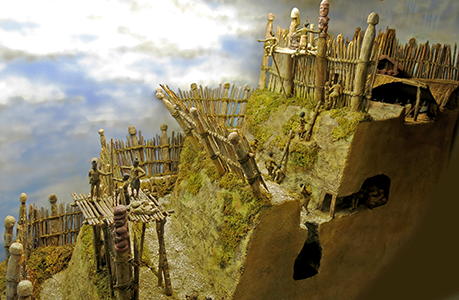
The Te Arawa raiders had set out on foot at first light from Tokomaru Bay. Their number included six slaves. Forty warriors remained behind to guard the remaining slaves, wakas and other plunder they’d acquired.
The new day brought with it strong winds, black clouds and the threat of a violent storm on Aotearoa’s east coast, and the heavy rain that seemed certain to arrive that morning would be the first rain the region had received in some time.
Apera had debated whether to abandon his plan to attack the enemy’s pa atop the headland on foot. The rangatira had decided to heed the advice of others who insisted it was impregnable from the sea. He was now convinced his best bet was to launch a surprise night-time attack on foot. Whether it would actually come as a surprise to the Ngati Porou remained to be seen. He didn’t doubt they would have their own scouts on the lookout for enemies in their territory – especially now that the presence of his raiding party was known.
Guided by a male slave who bore the marks of a savage beating he’d suffered, the warriors followed a partly overgrown, seldom-used track that would lead them to the coast. They had at least three full days’ trekking ahead of them as it was a roundabout route that would take them some distance inland. The rugged terrain was bush-covered and dissected by rivers and deep, rocky gorges. Even with the help of slaves it was hard going, laden down as the raiders were by their weapons and supplies.
Apera was near the front of the column. His latest conquest, Emere, followed close behind. To the bemusement of the other warriors, the recently widowed wahine seemed a willing accomplice who dutifully followed the man responsible for the deaths of her husband and children. They could see she was now as much under Apera’s spell as he was under hers.
Emere was a fatalist and a realist. Though the man who now possessed her had taken her nearest and dearest from her, and had shattered the peaceful life she’d lived these past twenty-three years, he now controlled her destiny. That was her new reality, and she accepted it. To resist, she knew, would be futile, and so, with some difficulty and more than a little guilt, she put her past behind her and mentally prepared herself for a new life with this new man. Her future was easier to accept than it might have been because she sensed that in Apera she had a man, a rangatira, who was all-powerful and who would look after her. It didn’t hurt either that she was physically attracted to him like she had been to no other man.
#
The rain that had been threatening arrived early the following day, reducing the trail the raiders followed to a muddy quagmire and slowing their progress considerably. The slaves accompanying them had to work especially hard, lugging many of the supplies and extra weapons. All large men, they were also a useful food source for raiders who didn’t have time to hunt or gather food whilst trekking cross-country. This accounted for the fact that their number had been reduced to four overnight: two of them had been killed, cooked and eaten the previous evening. The surviving slaves, who remained tethered together by a strong cord that encircled the neck of each, were resigned to their fate and to the fact they were unlikely to see Tokomaru Bay again.
Throughout the day, scouts regularly reported back to Apera, advising him on the best route they should take and whether the way ahead was clear. One advised that the Ngati Porou had completely abandoned their inland pa and relocated to their stronghold on the coastal headland. That told Apera that the Te Arawa scout their enemies had captured earlier had revealed what his fellow raiders were planning.
#
The raiders reached the coast four days after departing Tokomaru Bay. Their trek had taken a day longer than expected as progress had been slowed by driving rain, and by mud slides necessitating several course corrections.
Dusk was descending as Apera and three of his warriors observed the Ngati Porou’s coastal pa from a bush clearing on a nearby hilltop. The rangatira had left his main strike force a mile or so inland to lessen the chance they’d be seen by enemy scouts or hunters. He wanted to maintain some degree of surprise in the attack he was planning.
Studying the pa from just two hundred yards distant, it was immediately obvious that the Ngati Porou were expecting an attack. Sentries manned the pa’s ramparts and lookout towers, and a dozen armed warriors could be seen patrolling all approaches to the pa. Most of the latter carried torches, but the flames flickered precariously and in some cases didn’t fire at all in the howling wind. The earlier torrential rain had stopped, but the gale-force southerly annoyingly persisted.
Apera could see the information he’d received was correct: the pa was virtually impregnable from the sea. “A frontal attack is the only way,” he murmured.
The warrior closest to him, a scarred veteran of innumerable clashes, grunted his agreement. “Ae, it is the only way,” he concurred.
Apera could tell a frontal attack would be no easy undertaking either. The rangatira was impressed by the pa’s formidable fortifications, and, if his informants were correct, the enemy’s fighting force equalled or perhaps exceeded his in size. He was thankful for the heavy cloud cover. The extra darkness it afforded would help conceal his warriors from the enemy despite the sentries’ flickering torches. Even so, he thought it probable they’d be seen well before they reached the pa’s outer fortifications because all the approaches had been cleared of boulders, bush, shrubs and anything else that might conceal an enemy. “We attack tonight under cover of darkness,” he said. Having seen enough, he and his companions jogged back to join the others.
It was dark by the time they reached their encampment. They arrived to discover the other warriors had ambushed and captured a twenty-strong party of Ngati Porou hunters. All but two of the hunters had been killed, their bodies left in a heap nearby. Many of the deceased were young, some barely into their teens.
Apera saw at a glance the surviving hunters, who both appeared to be in their mid-twenties, were tethered together alongside a roaring fire. In the light of the flames, they appeared downcast and fearful. Both displayed injuries as a result of wounds they’d received. They were being interrogated by Kaihautu who stood over them, firing questions at them and striking them if they were slow to respond.
“Who are these dogs?” the rangatira asked his brother.
“They are Ngati Porou hunters,” Kaihautu said, kicking the nearest captive whose answer to his latest question had displeased him. “They were returning to their pa with their kills.” He pointed to a pile of carcasses, which had been lined up in rows nearby ready for cooking. They included freshwater crayfish and eels, native ducks, bush pigeons and a variety of other birds.
“Why did you spare these two?” Apera asked, looking at the captives.
“Because they were more talkative than the others…and they revealed some interesting truths.”
“Such as?”
“They told us the headland their pa sits on has no lake or river or other source of fresh water.”
Apera realised this meant his strike force could possibly besiege the pa until the defenders surrendered or died of thirst. “I am sure they would have dug ponds on the headland and those ponds will be full after the recent heavy rain.”
Frowning, Kaihautu kicked the nearest captive who appeared to be the more frightened of the two. “Is he correct? Are there ponds on the headland?”
The captive nodded furiously. “Ae, it is as he says. There are four deep ponds and they will be full by now.”
“How long could your people last if there is no more rain?” Apera asked.
“Maybe…ten days.”
“Only ten days?” a disbelieving Kaihautu asked, shaping up to kick the captive again.
“There are eight hundred of us at the pa and the ponds drain quickly!” the captive hurriedly explained, cowering from his interrogator’s raised foot.
“What about food?” Apera asked, aware that his enemies’ water supplies wouldn’t be a factor if the rain continued.
“There is enough food for maybe seven days.”
It was the other captive who spoke. He seemed more composed than his companion even though he’d received the worse beating of the two. Mumbling through swollen, bleeding lips, he sullenly added, “Maybe enough for six days now that you have our latest kills.” He glanced at the fire where the birds and other creatures he and his fellow hunters had killed were ready to be roasted.
Thinking aloud, Apera said, “So, even if it rains every day and our enemies are able to quench their thirst, we could camp at the pa’s entrance and wait for them to starve.”
“We could,” Kaihautu agreed, “but he” – the warrior pointed at the more fearful of the two captives – “told us there is a lightly guarded entrance to their pa on the southern side of the ramparts.”
Realising his interrogator was pointing at him, the captive concerned nodded vigorously yet again, indicating there was indeed a lightly guarded entrance. “It cannot be seen from the approaches to the main entrance,” he said. “It is the gate we are…” Choosing his words more carefully, he said, “It is the gate we would have used when we returned.” He ignored the scathing glance his companion flashed his way.
The glance was noticed by Apera, which confirmed to his satisfaction the more talkative captive was telling the truth. Turning back to Kaihautu, he asked, “So you think that is our way in?”
“That is our way in, brother.”
Apera thought it a good idea except for one major complication. “They would see us before we were halfway to the outer stockade… even without moonlight. Their guards patrol all the approaches with flaming torches in hand.”
“I expected as much. That will be of no matter if the guards believe we are the returning hunters.” Smiling, Kaihautu glanced at the bodies of the slaughtered hunters.
Apera didn’t need it spelled out for him. He understood at once what his brother had in mind. The more he thought about it, the more he thought it could work. “Untie them,” he said, pointing at the two captives. “And select sixteen of our best warriors.”
Kaihautu hurried to carry out his brother’s orders.
A sudden change in wind direction caused the fire to crackle and spark, and it was then Apera noticed Emere. She sat alone, away from the other slaves, on the far side of the fire. Her beautiful face was illuminated by the flames, and Apera could see she was staring directly at him.
The flames quickly settled and her face was cast in shadow again, but in that brief moment the message Emere had conveyed was unmistakable: she wanted him.
Apera’s distraction was noticed by Kaihautu. “We must go now, brother,” he said.
“Give me one moment.” Apera strode off to satisfy his sudden lust for the wahine who so captivated him.
CHAPTER 19
Matavai Bay, Tahiti, June 3, 1769
Nicholas’s sojourn in paradise ended as abruptly as it began. Early on the morning of the transit of Venus, Captain Cook’s servant Will Howson arrived at the village to pass on the captain’s orders: the surgeon’s assistant was to make haste to the observatory. More sobering was the news they’d be sailing the next day…
>>> NEW ZEALAND: A NOVEL continues next week.
**********************************************************************

