Posts Tagged ‘historical novels’

Our historical adventure novel WORLD ODYSSEY (The World Duology, #1)  is now available as a paperback – a move prompted by the popularity of the Kindle ebook version on Amazon. After 30 reviews the book has a rating of 4.7 out of 5 stars.


???????????????????

World Odyssey  paperback is available via Amazon at: https://www.amazon.com/World-Odyssey-Duology-1/dp/0473363739


Historical Novel Reviews calls the book “A totally engaging epic!” / “Recommended for globe-trotting adventure fans,” according to Jason Letts, author of The Inevitable Trilogy. / Historian Remy Benoit, author of Peace, Now, suggest readers “Get ready to sail the high seas.” / And J.B. DiNizo, author of Comings and Goings, calls it “Highly readable and thoroughly enjoyable.”


Set in the Nineteenth Century, World Odyssey  follows the fortunes of three young travelers as each embarks on an epic journey.

Ambitious American adventurer Nathan Johnson’s journey begins when he runs away to sea to escape a violent father. After surviving a shipwreck and enslavement by one of the indigenous tribes of America’s northwest, his stocks rise and he becomes a successful trader. When Nathan decides to visit Fiji to trade muskets to the natives, he doesn’t know it but his fortunes are about to change again.

Sheltered English missionary Susannah Drake’s journey begins after she agrees to accompany her clergyman father to Fiji to help him run a mission station there. They endure a nightmare voyage they’re lucky to survive. When Susannah finds herself sexually attracted to a young crewmember, she is forced to choose between her forbidden desires and the life her father has mapped out for her.

Irrepressible Cockney Jack Halliday’s journey begins when he steals hemp from an unscrupulous employer who owes him outstanding wages. For this he’s sentenced to seven years’ hard labor in the British penal colony of New South Wales. Jack escapes to Fiji only to be tracked down by a bounty hunter employed by the British Government to round up escaped convicts.

After traveling thousands of miles and experiencing the best and worst that life can offer, these three disparate individuals eventually end up in the remote archipelago of Fiji, in the South Pacific, where their lives intersect.

The intrepid trio’s adventures continue in Fiji: A Novel, book two in The World Duology.


*************************************


A free copy of our new release paperback Into the Americas (A novel based on a true story)  goes to the winner of a giveaway competition now running on the literary site Goodreads.com.


Into the Americas (A novel based on a true story)

Be in to win…a free copy.


Into the Americas  is a gritty, real-life adventure based on one of history’s greatest survival stories.

Nineteen year-old blacksmith John Jewitt is one of only two survivors after his crewmates clash with the fierce Mowachaht tribe in the Pacific Northwest. A life of slavery awaits John and his fellow survivor, a belligerent American sailmaker, in a village ruled by the iron fist of Maquina, the all-powerful chief. Desperate to taste freedom again, they make several doomed escape attempts over mountains and sea. Only their value to the tribe and John’s relationship with Maquina prevents their captors from killing them.

As the seasons pass, John ‘goes Indian’ after falling in love with Eu-stochee, a beautiful maiden. This further alienates him from his fellow captive whose defiance leads to violent consequences. In the bloodshed that follows, John discovers another side to himself – a side he never knew existed and a side he detests. His desire to be reunited with the family and friends he left behind returns even stronger than before.

The stakes rise when John learns Eu-stochee is pregnant. When a final opportunity to escape arises, he must choose between returning to civilization or staying with Eu-stochee and their newborn son.


To enter the Goodreads Giveaway competition go to: https://www.goodreads.com/book/show/25600921-into-the-americas


**************************************

INTO THE AMERICAS (A novel based on a true story)  has entered Amazon’s bestseller lists in three categories this week – namely Action & Adventure (two) and Historical Fiction (one).

Book reviewers are resonating with the novel, giving it a 4.7 (out of 5 stars) rating on Amazon.


Examples of what reviewers are saying follow:

★★★★★ “I absolutely loved this book.”

★★★★    “Really good informative historical fiction”

★★★★★ “A fantastic story. One of the best historical novels i’ve read.”

★★★★★ “I thought it was something special.”

★★★★     “Before anyone visits Vancouver they should read this book!”

★★★★★  “Loved this book Very thought provoking.”

★★★★★  “Want a great historical fiction read? Here it is!”

★★★★★  “Must Read for Fans of this Genre.”

★★★★★  “Five Stars. A real page-turner.”

★★★★★  “I could not put the book down.”

★★★★★  “Of all the Morcan novels, this is by far my favourite.”


Into the Americas (A novel based on a true story)

A gritty, real-life adventure based on one of history’s greatest survival stories. It was inspired by the diary entries of young English blacksmith John Jewitt during his time aboard the brigantine The Boston and also during his sojourn at Nootka Sound, on North America’s western seaboard, from 1802 to 1805. 


INTO THE AMERICAS (A novel based on a true story)  is available exclusively via Amazon: http://www.amazon.com/Into-Americas-novel-based-story-ebook/dp/B00YJKM51E/


*****************************

The top rating historical adventure INTO THE AMERICAS (A novel based on a true story)  is rising up Amazon’s rankings and is currently available at the special Kindle promo price of 99cents.

Into the Americas (A novel based on a true story)

Into the Americas  is a gritty, real-life adventure based on one of history’s greatest survival stories. It was inspired by the diary entries of young English blacksmith John Jewitt during his time aboard the brigantine The Boston and also during his sojourn at Nootka Sound, on North America’s western seaboard, from 1802 to 1805.

Nineteen year-old blacksmith John Jewitt is one of only two survivors after his crewmates clash with the fierce Mowachaht tribe in the Pacific Northwest. A life of slavery awaits John and his fellow survivor, a belligerent American sailmaker, in a village ruled by the iron fist of Maquina, the all-powerful chief. Desperate to taste freedom again, they make several doomed escape attempts over mountains and sea. Only their value to the tribe and John’s relationship with Maquina prevents their captors from killing them.

As the seasons pass, John ‘goes Indian’ after falling in love with Eu-stochee, a beautiful maiden. This further alienates him from his fellow captive whose defiance leads to violent consequences. In the bloodshed that follows, John discovers another side to himself – a side he never knew existed and a side he detests. His desire to be reunited with the family and friends he left behind returns even stronger than before.

The stakes rise when John learns Eu-stochee is pregnant. When a final opportunity to escape arises, he must choose between returning to civilization or staying with Eu-stochee and their newborn son.


Into the Americas  is available exclusively via Amazon: http://www.amazon.com/Into-Americas-novel-based-story-ebook/dp/B00YJKM51E/


*****************************************

In the following excerpt from our historical adventure INTO THE AMERICAS (A novel based on a true story)  young English seaman John Jewitt and American sailmaker Jonathan Thompson are pursued by Mowachaht savages as they cross Vancouver Island’s snow-covered mountain ranges in their attempt to reach the Strait of Georgia.

Anxious to catch sight of the escapees before nightfall, Maquina was keen to resume the chase. To his eyes, it was obvious their quarry had descended to the stream at the foot of the hill and then waded upstream, or possibly downstream, so as to leave no tracks. However, Katlahtik suspected otherwise. The tracker motioned to Maquina to study the false tracks more closely.

Mowachaht chief Maquina

Joining Katlahtik, the chief immediately saw what his tracker had noticed: on close inspection it was evident the borders of some of the tracks overlapped, signaling that whoever had made the tracks had stepped into the same tracks again.

Maquina smiled to himself. “The White-Faces have learnt much from us,” he said, looking eastward, “yet they still have much to learn.”

The chief set off after the escapees, his warriors in tow. They moved quickly now.

#

John and Thompson fought their way through dense undergrowth as they entered the timberline of the mountain range they’d just crossed. Aware they’d soon run out of daylight, they made haste, anxious to find a place to overnight before darkness finally descended.

Englishman John Jewitt…in later life.

The escapees were unaware they’d entered the territory of the Ehattesaht tribe, a warlike people whose violent history of interaction with whites would not have brought the pair any joy had they been aware of it. Right now, the Ehattesahts were the least of their problems. Hungry and exhausted, they were resigned to spending at least one more night in the mountains before they reached their destination.

“We gotta find shelter,” Thompson gasped, stating the obvious.

John nodded. He was very aware of the dangers a night in the open presented. Even though they’d reached the shelter of trees, there was still snow underfoot and the temperature was close to freezing. Unless they kept moving, he doubted they’d survive a night in the open.

They descended via a forest trail carved out by generations of elk and other animals of the region. Steep in places, it caused them to slip and slide their way down the mountainside.

Thompson tripped and John hurried to help him to his feet. When they looked up, a cougar appeared on the trail barely thirty yards ahead of them.

“Holy shit!” Thompson muttered.

The escapees froze. So, too did the cougar. She stood looking at the pair through huge eyes that seemed to glow almost orange in the semi-dark of the forest.

John’s first thought was for the musket he’d lost in the ravine. Next to him, Thompson was already unshouldering his musket.

“Easy!” John whispered, anxious that his companion made no sudden movement that could prompt the cougar to attack.

Thompson didn’t need any such warning. He moved so slowly it took him an age to unshoulder his musket. As he did, the cougar bared her fangs and growled. It was a long, low growl that was barely audible, but it sent shivers through the pair. Both were convinced the feline was viewing them as dinner.

Still the cougar made no move. Which was just as well as Thompson had yet to prime his musket. A task he could normally perform in a few seconds took him another age – by which time both he and John were sweating profusely despite the cold.

Anxious not to spook the cougar, John resisted the temptation to ask Thompson whether he was loading a musket ball or shot into the musket. He prayed it was the latter as firing pellets required less accuracy than did firing a solitary musket ball.

The cougar suddenly emitted a bone-chilling scream and pounced, her charge so quick Thompson barely had time to raise his musket and pull the trigger.

Strait of Georgia…the escapees’ intended destination.

Thompson’s aim was true, and the musket ball he’d just loaded struck the cougar between the eyes, killing her instantly. She hit the ground hard just ten yards from them, rolling over and over until she stopped almost at their feet.

“Great shot!” John rejoiced, the relief evident in his voice.

Thompson was momentarily speechless. He looked down at his hands and saw they were trembling violently. Then he started laughing.

John joined in the laughter. Their delight was unrestrained. Neither thought it odd. It seemed a natural way of expressing their huge relief, and neither gave any thought to the possibility others may have heard the shot.

Finally, Thompson said, “Well, fuck me! I thought we were gonners.”

As their laughter subsided, John said, “At least we have meat on tonight’s menu.”

Thompson looked down at the cougar and smiled as he pictured himself tucking into a meal of barbecued cougar rump.


You have been reading an excerpt from Into the Americas — available exclusively via Amazon: http://www.amazon.com/Into-Americas-novel-based-story-ebook/dp/B00YJKM51E/

IntoTheAmericas ebook cover

***********************************************************

The following excerpt from our historical adventure INTO THE AMERICAS (A novel based on a true story)  is set in the slaves’ quarters in the village of the Mowachahts, in Nootka Sound, Vancouver Island, the night of the massacre of the crew of the brig The Boston. Two survivors of that violent event – young English blacksmith John Jewitt and grizzly American sailmaker Jonathan Thompson – adapt as best they can to their new surroundings.

Into the Americas (A novel based on a true story)

John and Thompson found themselves in the company of forty or more male slaves whose ages ranged from young to middle-aged. The slaves’ physical characteristics were noticeably different to the Mowachahts, signaling they were all from other tribes. Their number included several with Mohawk-type hairstyles, three whose heads were clean-shaven, two whose distinctly Asian features resembled the Inuits who lived much further north, a couple whose foreheads sloped back at a sharp angle, and several stocky individuals who seemed almost as wide as they were tall.

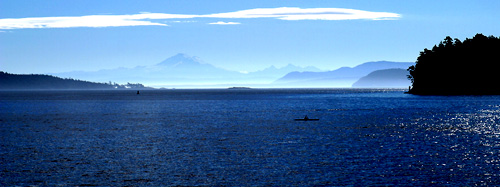
Nootka Sound, Vancouver Island…where it all took place.

If there was one characteristic they shared it was that they were all underweight and in poor physical condition. Their raggedy clothes hung off their spare frames and their faces were gaunt, as if they hadn’t had a good meal in months.

The newcomers weren’t to know their fellow slaves were the last to eat when food rations were in short supply. Even the villagers suffered deprivations over the long winter months, but for the slaves – male and female – it was especially tough as they had to rely on the generosity of their Mowachaht masters for any scraps of leftover food. Often, they had to forage for themselves if they wanted to eat. The pickings were slim in winter, and it was common for at least a few slaves to die of starvation over those cold, dark months.

Among the slaves was one with only one eye. He and the others stared at the whites menacingly.

The threatening reception didn’t go down well with Thompson who immediately bristled. Glaring directly at the one-eyed slave, he said, “What the fuck are you lookin’ at, One-Eye?”

“Thompson!” John hissed just loud enough for his belligerent companion to hear. “You’ll get us killed!”

“Ha!” the older man retorted. “I’ll throttle every last one of these sorry sons o’ bitches if they try anything.”

John’s concern grew as the slaves talked heatedly amongst themselves. They were obviously discussing the new arrivals – in particular the sailmaker who they now stared at malevolently.

The minutes passed and, to John’s relief, nothing happened. The other slaves went back to whatever it was they’d been doing. Some were greedily helping themselves to the contents of a large cooking pot that sizzled over the flames of an open fire. They used clam shells to scoop a porridge-like stew out of the pot into cedar calabashes that resembled crude soup bowls. That done, most dispensed with the shells and used their fingers to transfer the stew into their mouths. So hot was the food, they had to blow on their fingers to cool them between mouthfuls.

Nootka Sound…as it was in the days of the trading ships.

Smoke from the fire curled up through the larger of several holes in the roof. Not all the smoke escaped, so the atmosphere inside was quite smoky, which no doubt explained why some of the slaves appeared to have permanent coughs.

John and Thompson surveyed their new surroundings without enthusiasm. Besides half a dozen wooden apple boxes that served as chairs, there were no furnishings; the lodge’s dirt floor was reduced a muddy quagmire whenever it rained – as was the case right now. The rain had just returned with a vengeance. Where water had dripped down moments earlier, now it cascaded down and gushed through the holes in the roof, adding to everyone’s discomfort.

Most alarming was there weren’t enough bed mats to go round. As a result, half the slaves had to sleep on mats they’d fashioned out of palm fronds and leafy branches. There weren’t enough blankets to go round either, and some of the slaves used palm fronds and other vegetation as substitute blankets.

John and Thompson turned their attention to the large communal cooking pot in the center of the lodge. Those slaves who hadn’t yet eaten were now dipping their hands into a vile-looking stew and shoveling it into their mouths. Hungry though they were, the new arrivals resisted the urge to join their inhospitable companions. The pair sat down just inside the entrance, away from the others.

Thompson looked at John. “You alright, Jewitt?”

John nodded unconvincingly.

Thompson wasn’t fooled. He knew his young companion was going through his own private hell. The Philadelphian looked over at the other slaves. They were all staring at the two whites, and openly talking about them in their native tongue.

“The White-Faces smell like pigs,” One-Eye said to a bald slave.

The bald slave nodded. “They look like pigs, too.”

The others laughed aloud.

Thompson sneered at them. “Filthy animals. I’ll flatten these whale-fuckers if I get ‘alf a chance.” He spat in One-Eye’s direction.

“We can’t afford to make enemies of them!” John said with some urgency. “They’re slaves, too.”

Thompson bristled. “I told you, Jewitt. I’m no man’s slave.”

John wanted to make the older man see sense, but he didn’t have the energy. “I need to sleep,” he mumbled.

“Me too.”

Nootka Sound…in more recent times.

The two men crawled to the driest section of floor they could find close by then lay down and prepared to sleep. Thompson didn’t trust the other slaves, so he tried to sleep with one eye open, but that didn’t work. All the while, water dripped down onto them, keeping them both awake.

After an hour of tossing and turning, John turned to the dark shape lying next to him. “You awake?”

“Of course I’m bloody awake.”

His back turned to the others, John unbuttoned his shirt to reveal the two pistols he’d recovered from The Boston’s armory. The shiny, silver weapons were just visible to Thompson in the dim, flickering light of the fading fire.

The sailmaker’s eyes widened at the site of the pistols. “Where’d ya get those?” he whispered.

“From the armory.”

Thompson glanced around to ensure they weren’t being observed. He needn’t have bothered. The others were fast asleep. “You got ammunition for them?” he asked.

Embarrassed, John shook his head.

“What use are pistols without ammo?” an incredulous Thompson asked.

“You just never know.”

Thompson looked askance at John. “Christ, I’m gonna go insane here.” He turned his back on his companion, annoyed by the young man’s naivety.

Undeterred, John wrapped the pistols in a handkerchief and surreptitiously deposited them behind a loose board in the near wall.

 

You have been reading an excerpt from INTO THE AMERICAS (A novel based on a true story). The book is available exclusively on Amazon: http://www.amazon.com/Into-Americas-novel-based-story-ebook/dp/B00YJKM51E/


Product Details


************************************

The historical adventure-romance novel Fiji  is set in the early 1800’s in one of the most exotic and isolated places on earth. Variously described as “poignant and romantic,” it’s also true-to-life, bloody and reflective of an era long since gone. As one reviewer says, “Fiji: A Novel is not for the faint-hearted!”

Fiji: A Novel (The World Duology Book 2)

The blurb for Fiji  follows:

As the pharaohs of ancient Egypt build their mighty pyramids, and Chinese civilization evolves under the Shang Dynasty, adventurous seafarers from South East Asia begin to settle the far-flung islands of the South Pacific. The exotic archipelago of Fiji is one of the last island groups to be discovered and will remain hidden from the outside world for many centuries to come.

By the mid-1800’s, Fiji has become a melting pot of cannibals, warring native tribes, sailors, traders, prostitutes, escaped convicts and all manner of foreign undesirables. It’s in this hostile environment an innocent young Englishwoman and a worldly American adventurer find themselves.

Susannah Drake, a missionary, questions her calling to spread God’s Word as she’s torn between her spiritual and sexual selves. As her forbidden desires intensify, she turns to the scriptures and prayer to quash the sinful thoughts – without success.

Nathan Johnson arrives to trade muskets to the Fijians and immediately finds himself at odds with Susannah. She despises him for introducing the white man’s weapons to the very people she is trying to convert and he pities her for her naivety. Despite their differences, there’s an undeniable chemistry between them.

When their lives are suddenly endangered by marauding cannibals, Susannah and Nathan are forced to rely on each other for their very survival.


  Here’s an excerpt from Fiji:

The guilt Susannah had felt moments earlier suddenly returned tenfold as she remembered the erotic dream she’d had. She quickly nodded, to indicate she’d slept well before diverting her eyes from Nathan’s and looking toward the shore. It was then she noticed giant sand dunes along the shoreline. She gasped at the sight of them. They seemed to be reaching for the sky.

Noting the object of her interest, Nathan said, “Those are the famous sand dunes of Sigatoka.” He added, “I saw them on my arrival in Fiji.”

“How wonderful,” Susannah enthused, momentarily forgetting her antagonism toward Nathan.

Susannah wasn’t the only one fascinated by the mighty dunes. The Italian artist was frantically setting up his easel further along the deck, anxious to capture the scene on canvas before it disappeared from view.


As the passengers admired the dunes, a deserted Fijian village came into view. Its bure huts had recently been smashed and burned to the ground. Smoke rose from the still-smoldering ruins, and there was no sign of life.

A Welsh deckhand sidled up to the young couple. He nodded toward the village. “That’ll be the handiwork of Rambuka,” he proffered with some certainty.

Susannah studied the distant village then glanced at the Welshman. “Rambuka?”

“Aye. His warriors are the scourge of this coastline. They call them the outcasts.” The deckhand pointed toward Viti Levu’s distant highlands. “They live up there somewhere.” Nathan and Susannah studied the highlands. Dark storm clouds hung ominously over them. “Cannibals, all of ‘em,” the deckhand added before wandering off.


Alone again, Nathan smiled at Susannah. In her usual haughty manner, she gave him a quick glance before looking back at the shoreline. Nathan asked himself why he was persisting with such a young woman who, he could see, was clearly on a different planet to himself. Try as he may, he couldn’t come up with a sensible answer.

“I do not envy the task you and your father have set yourselves here in Fiji,” Nathan said probingly. Susannah looked at him sharply. Pleased to see he had her attention, he continued. “I fear you may be facing an uphill battle.”

“Oh? And why is that?”

“Well,” Nathan paused, thinking on his feet as he went. “Fiji ain’t called the Cannibal Isles for nothing. From what I’ve seen, these Fijians are some of the most savage people on earth.”


Fiji: A Novel (The World Duology, #2)  is available via Amazon as a kindle ebook and trade paperback. For more information go to: http://www.amazon.com/dp/B0057YCZM0/

***********************************************

In our true-life adventure novel Into the Americas, we relate how young Englishman John Jewitt and his fellow hostage Jonathan Thompson accompany their Mowachaht captors on a raid into the territory of the fierce Haachaht tribe of the Northwest Pacific.

Nootka Sound…Home to the proud Mowachaht tribe of Vancouver Island.

In the following excerpt from our novel, the Mowachaht raiders are ambushed by the Haachahts as they paddle up a river:

Callicum, the Haachaht chief, and three hundred of his warriors waited in ambush in the trees on the far bank. Most wore the distinctive and frightening wolf’s brow-mask, and all carried bows, spears, tomahawks and other traditional weapons. There wasn’t a musket in sight. However, what they lacked in fire-power they made up for in manpower and ingenuity.

On the near bank, directly opposite Callicum and his men, another hundred Haachahts waited. They, too, wore brow-masks and were similarly armed. Within their ranks, two strong, well-built bowmen stood some twenty yards apart. Each held a bow almost as long as himself. Their arrows resembled slim spears and were close to six foot long. A line trailed from each of their shafts. The lines were tied to the front edge of a huge, reinforced fishing net, which lay spread out on the ground between the two bowmen.

Both groups of Haachahts were visible to each other, but the dense undergrowth and foliage still hid them from the raiders even though their canoes were almost level with them.

At a signal from Callicum, the two bowmen opposite lay down on their backs, their knees bent and their moccasined feet raised skyward. After positioning their feet against the inside of their bows, they each loaded a long arrow and prepared to loose it toward the opposite bank. Even though they each used both hands to draw the mighty bows, the tremendous effort required caused their muscular arms to tremble. Their eyes were focused on a headman who stood midway between them and whose eyes, in turn, were focused on Callicum on the opposite bank.

The Haachaht chief now had his tomahawk raised high above his head. As the lead canoe drew level with his position, Callicum brought his tomahawk down.

At a nod from the headman opposite, the two bowmen gratefully released their long arrows in synch. Nearby, two more bowmen prepared to send a second net toward their enemies.

In the lead canoe, John and his fellow paddlers looked up as the huge net sailed above them, trailing behind the two spear-like arrows. The arrows buried themselves in the ground on the opposite bank and the net slowly floated down. It narrowly missed the lead canoe, settling over the one following and entangling its occupants.

Terrifying Haachaht war cries shattered the silence, and arrows and spears rained down on the Mowachahts. Most of those entangled in the net were quickly struck down as they struggled to disentangle themselves. Several scrambled overboard and tried to swim downstream, but they were quickly picked off by well-placed arrows. The canoe’s captain, Quasoot, was among the casualties.

The Mowachahts’ first thought was to use their muskets to fight off their enemies. They instinctively discarded their paddles and frantically began priming their muskets. As a result, the canoes bumped into each other and began drifting aimlessly in the current, their surprised occupants sitting targets.

Callicum had anticipated this and urged his bowmen to pick the disorganized Mowachahts off before they could wreak havoc with their muskets.

Maquina saw the danger immediately and exhorted his warriors to forget about their muskets for the moment and to paddle to the left bank where Callicum and his warriors happened to be. They responded straight away, retrieving their paddles and paddling furiously.

At the same time, another net sailed over the river and settled on a second canoe – this one captained by Toowin. Fortunately for Toowin and his fellow paddlers, one of the two arrows used had been misdirected, and so the net didn’t completely envelope the craft. Even so, the disruption it caused resulted in at least half the canoe’s occupants being killed or wounded. Toowin himself suffered a flesh wound when an arrow creased his chest.

As the remaining canoes closed with the far bank, they were met by a hailstorm of spears and arrows. Callicum’s warriors were trying to finish their enemies off before they could reach the shore. Mowachaht casualties mounted. Some of those who had been killed floated off downstream with arrows, and in one case a spear, protruding from them. Blood stained the water around them.

For one long moment, Maquina’s eyes locked with Callicum’s. The Mowachaht chief stood upright in the prow of his canoe. Ignoring the arrows that flew around him, he cursed his opposite. “Callicum, you treacherous dog!” he shouted. “I will personally cut out your heart!”

Callicum shouted something unintelligible back at his opposite.

Maquina was first to disembark. With no apparent concern for his own safety, he ran directly at Callicum, musket in one hand and club in the other. He used the latter weapon to effortlessly swat aside two Haachahts who made the mistake of not getting out of his way.

John and Thompson were among the next to disembark. As they scrambled up the bank, they fired their muskets at near point-blank range at the nearest Haachahts. Their hands were a blur as they primed their muskets and fired again. Identifying their enemy was made easy by the wolf brow-masks most of the Haachahts wore.

In anticipation of close-quarter fighting, Maquina had wisely ordered his fellow raiders to use shot, or pellets, as opposed to musket balls. John and Thompson were thankful for that as they loosed shot after shot at their enemies: each shot felled two or more Haachahts, so tightly were they congregated and so effective were the deadly pellets directed their way.

The whites were quickly joined by their fellow raiders who brought their own muskets into play. More Haachahts were struck down.

Chaos reigned. War cries, musket shots, curses, agonized screams, shouted orders and insults mingled in one deafening cacophony of sound; smoke from the constant discharge of muskets hung in the air, its acrid smell instantly recognizable; spears, arrows, tomahawks, axes and knives flew through the air as warriors grappled with their enemies in the woods, along the riverbank and even in the river; and all the while bodies piled up along the bank and in the shallows, and still more floated downriver.

You have been reading an excerpt from INTO THE AMERICAS (A novel based on a true story). The book is available on Amazon: http://www.amazon.com/Into-Americas-novel-based-story-ebook/dp/B00YJKM51E/

Into the Americas (A novel based on a true story)


*********************************

Young English seaman John Jewitt was one of only two survivors after the crew of the brigantine The Boston was attacked by Mowachaht warriors in Nootka Sound, Vancouver Island, one fateful day in 1803.

Jewitt after the massacre…years later.

We capture the horror of that bloody massacre in the following excerpt from our true-life novel Into the Americas. (Keep in mind what’s not shown in this excerpt is the provocation the Mowachahts had received from European traders prior to this awful event):

As Toowin related what happened, Peshwar and the other warriors gathered around. They grew increasingly angry, glaring at the crewmen concerned, as they learned what had transpired ashore. Jostling broke out between the warriors and some of the crew.

Those crewmen who were armed brandished their muskets threateningly.

“Hold your fire, men!” Delouissa ordered. He didn’t want some trigger-happy sailor sparking a pitched battle on deck.

Maquina and his warriors were now highly agitated. Peshwar in particular wanted blood. He approached the crewmen who formed a protective wall in front of Brown and Waters.

Seventeen-year-old, fresh-faced English sailor Thomas Newton happened to be closest to the fierce headman. Newton visibly shook as Peshwar stopped in front of him. Sweating profusely, the youth’s finger tightened around the trigger of his musket.

“Steady lad,” Delouissa cautioned.

Looking on, Salter and Maquina were equally concerned that events were escalating out of control.

“Do not let them provoke us!” Maquina shouted to his warriors. “We are here to trade. Not fight.”

Peshwar ignored the chief and continued to eyeball Newton. The young sailor pissed his breeches, so fearful was he.

Maquina pulled Peshwar back just as Newton fired his musket. The musket ball meant for the headman struck a warrior standing behind him, killing him instantly.

The Mowachahts and Salter’s men couldn’t believe what had just happened. Time seemed to stand still as they stared at the dead warrior.

Still fearing for his life, Newton frantically began to prime his musket. His actions sparked the others to life. Armed crewmen prepared to use their weapons.

Angered by the death of one of their own, the Mowachahts drew clubs, knives and tomahawks from beneath their capes. Their chilling war cries filled the air, causing the crewmen to open fire. Several warriors went down in that first volley.

“Stop shooting!” Salter shouted. His order was lost in the chaos.

Crewmen fired at point-blank range and several more warriors went down. Incensed, the remaining warriors, with Maquina and Peshwar leading the way, flailed at their attackers with their weapons. Dorthy and three crewmates were hacked to death before they could even react.

Newton dived over the brig’s side into the water where he was clubbed to death by one of a dozen more warriors who had just arrived alongside The Boston by canoe. The canoe’s occupants, most of whom carried muskets, scaled the brig’s side. As they poured over the rail, The Boston’s remaining crew found themselves fighting for their lives. 

Brown and Waters fled as Toowin made straight for them. The chief’s son threw his tomahawk, which lodged dead center in Brown’s back, felling him. He then drew his hunting knife and threw it at Waters with equal effect. It struck the young steward between the shoulder blades, causing him to sink to his knees, badly wounded. Toowin hurried over to Waters, retrieved his knife then used it to unceremoniously cut the young man’s throat.

Delouissa shot dead a Mowachaht headman. The chief mate turned around too late to avoid a spinning tomahawk, which lodged between his eyes, catapulting him overboard.

A tall warrior with knife in hand lunged at the unarmed rigger Kelly. The poetic Englishman evaded the flashing blade and scrambled up the nearest mast. His attacker put the blade between his teeth and climbed after him.

Jupiter Senegal ran to intercept the tall warrior. An arrow thudded into Jupiter’s chest, killing him instantly. Around him, crewmates were bludgeoned and shot as still more Mowachahts arrived on The Boston’s deck.

Drawn by the sounds of conflict, John had hurried topside to investigate. A quick glance through an open hatch had told him all he needed to know. A full-scale battle was under way. Realizing he wasn’t armed, the horrified young man returned below to grab a musket. He returned moments later, having located and primed a new musket from the armory.

The brig The Boston.

His heart beating wildly, John cautiously poked his head through the same open hatch. Unfortunately for him, Peshwar happened by at that exact moment. The headman grabbed John by the hair and raised his tomahawk. Just as he brought the weapon down, he lost his grip on the young Englishman’s hair. The tomahawk’s cutting edge clipped John’s forehead. It was only a glancing blow, but it sent him crashing down the steps.

John lay, unmoving, down in the steerage. Blood flowed freely from an ugly head wound.

Peshwar prepared to go down the steps after him, but was prevented by Maquina who lowered a heavy hatch cover and locked it to seal John in. The headman looked strangely at the chief, as if seeking an explanation.

“We need him,” Maquina said simply.

Peshwar was about to argue when he was distracted by the fighting around them. He and Maquina rejoined the fray.

Further along the deck, a desperate Salter tried to rally his remaining crew. “To me!” he shouted. “Form a circle!”

The surviving crewmen fought their way to reach their captain. Not all made it. Those who did, formed a tight circle and faced outward with their muskets and pistols ready.

Salter did a quick headcount. He estimated not a dozen of his men remained alive. Only half a dozen had made it to his side, and those who hadn’t were rapidly being overcome by the Mowachahts’ superior numbers.

At the bow, riggers Wood and Burton tried to keep half a dozen warriors at bay. The pair were armed only with knives, which they used to good effect. Each felled a warrior with deft thrusts of their blades before the inevitable happened and they went down beneath swinging tomahawks and clubs.

Toward the stern, John’s friend William Ingraham flailed at two warriors with a grappling hook he’d managed to grab as he’d been chased along the deck. Blood from a head wound flowed freely, nearly blinding him.

One of William’s assailants was Keno, the warrior whose musket had malfunctioned on shore. Keno threw a tomahawk at the young American’s legs. Its blade lodged in William’s right kneecap, felling him. The second mate rolled around on deck, screaming in agony, as Keno prepared to finish him off. Rather than finishing him quickly, Keno retrieved his tomahawk and, using his foot, pushed his victim through the railing into the sea where waiting sharks tore into him. The sharks had been attracted by the blood of others who had gone overboard.

As they had with the other crewmen who had ended up in the water, warriors in one of the waiting canoes pulled William into their craft before he could be completely devoured. His lifeless body was heaped on top of the others. The victims’ blood turned seawater in the bottom of the canoe red.

Above deck, Kelly was still being pursued up the mast by the tall warrior. Now high in the rigging, Kelly looked down as his pursuer lashed out at his legs with his knife. The rigger lifted his knees to his chest to narrowly avoid the flashing blade then continued climbing for all he was worth.

When he’d climbed as far as he could, he lifted his knees up once more then brought both feet down hard on his pursuer’s head. The tall warrior fell to his death.

From his vantage point, Kelly could only watch as still more warriors swarmed over The Boston’s sides. Arrows, tomahawks and musket-fire struck down more of his crewmates.

By now, only Salter and three of his crew remained alive on deck. They fought with the desperation of men who knew they were about to die.

Salter was the first to fall, an arrow through his throat. He lay rolling about the deck as he struggled to breath. One of the boatswains was next. He went down beneath a flailing club, leaving only Norwegian sailor Peter Alstrom and Irish sailor James McClay still on their feet. A well placed musket ball finished off McClay.

Maquina charged at Alstrom and decapitated him with one swing of his tomahawk. The Mowachaht chief held his victim’s head triumphantly aloft, and his warriors howled war cries at the sight.

Not to be outdone, Peshwar stood over Salter who was still alive although now obviously breathing his last. The headman swung his tomahawk, decapitating the captain. Peshwar then kicked Salter’s head, sending it rolling along the deck to the accompaniment of more war cries. The head came to a rest against the same mast that Kelly had scaled.

Only now did the Mowachahts turn their attention to the wounded English rigger high above them. Two warriors fired arrows at him. One landed in Kelly’s chest, another in his right thigh. Blood flowed freely from both wounds and Kelly had to fight against feelings of faintness.


You have been reading an excerpt from INTO THE AMERICAS (A novel based on a true story). The book is available on Amazon: http://www.amazon.com/Into-Americas-novel-based-story-ebook/dp/B00YJKM51E/

Into the Americas (A novel based on a true story)


*********************************

The courage of the First Nations people of North America is highlighted in our new release historical adventure novel Into the Americas. In particular, we focus on the hardy Mowachahts, of Nootka Sound, Vancouver Island, and their powerful chief Maquina.

Nootka village, the traditional home of the Mowachaht tribe…as it once was.

The following excerpt from the novel describes a whale hunt, which was an annual event for the Mowachahts and other Nuu-chah-nulth peoples of the Pacific Northwest. This passage describes the Mowachahts’ first whale hunt of the season. (The year is 1803; the setting is the chilly waters off Nootka Sound):

“Big fish!” the cry went up from a warrior in the stern of the lead canoe.

Maquina looked directly ahead. A mile distant, water spouts revealed the presence of a pod of humpbacks. The chief stood up and, pointing at the whales, rubbed his stomach theatrically. “Tonight, we fill our bellies until we burst!” he declared.

Maquina’s men paddled with more urgency now. The times they and their families had gone hungry over the long winter months were still fresh in the minds of each. A successful kill would provide sufficient food to feed them and, indeed, all the villagers for many weeks to come.

The paddlers were breathing hard by the time they reached their prey. A few final strokes and Maquina’s canoe was alongside the huge creatures of the deep. The other two canoes arrived moments later.

All powerful Mowachaht chief Maquina.

Maquina had already established there were seven whales in the pod, including a calf that swam leisurely beside his mother. Their sonar-like calls echoed hauntingly in the morning air.

At a signal from the chief, the three canoes suddenly darted in amongst the whales. Still the creatures showed no concern over the new arrivals in their midst.

Standing up in the prow of his canoe, Maquina drove his harpoon into the mother whale, which happened to be the nearest, then two warriors threw spears into her back. Lines tied to the spears were attached to sealskin floats.

The spiked tip of Maquina’s harpoon had lodged firmly in the whale’s head, prompting the mighty mammal to thrash her tail about. Maquina and his men had to hold on for dear life as the whale’s gyrations threatened to overturn their canoe. Blood appeared in the water all around them, attracting the tell-tale fins of sharks.

Only now did the whale’s calf realize something was wrong. The calf darted left and right in the water, but wouldn’t leave his mother’s side.

As expected, the wounded whale dived deep, taking the floats with her. The rope connecting the harpoon to the canoe’s bowsprit rapidly uncoiled and once again everyone aboard the canoe held on tight. The calf followed his mother, responding to the cries of distress that came from her.

When the whale took up the last of the rope’s slack, Maquina’s canoe was abruptly jerked forward at a steep downwards angle as the whale continued her dive.

“She is ours!” Maquina cried triumphantly.

The rope suddenly slackened. Mystified, Maquina started pulling it in. He eventually retrieved the harpoon and saw its iron spike was missing. Furious, he threw his broken harpoon into the bottom of the canoe.

Those in the other canoes fared no better. Peshwar’s experience was identical to Maquina’s, and Toowin’s harpoon snapped as soon as it struck the intended target. Three strikes and three broken harpoons. It was an all too common result.

Maquina cursed their luck as he motioned to his men to return home. They paddled in silence. Behind them, the wounded whale and her calf surfaced and quickly swam away to rejoin the others in their pod.

#

You have been reading an excerpt from INTO THE AMERICAS (A novel based on a true story). To read more go to: http://www.amazon.com/Into-Americas-novel-based-story-ebook/dp/B00YJKM51E/

Into the Americas (A novel based on a true story)

★★★★★ “Wow…never a dull moment.” –Tony Parsons –Amazon reviewer


***************************************