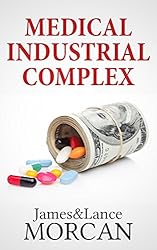
Posts Tagged ‘Medical Industrial Complex’

**************************************************************************

The eight books in our bestselling, somewhat contentious ‘Underground Knowledge Series’ cover details, concepts and little-known events not usually reported in mainstream media or mainstream academia, or if they are, they’re underreported for various reasons.

For the most part, we (the authors) have written about subjects that can be backed with facts. These facts include evidence substantiated in court cases, declassified government files, MSM reports and well-documented quotes from respected leaders in their fields. Wherever we do briefly deviate into pure speculation, we try to point that out so the dividing line between fact and rumor is always clear.

Many of the books have been regular visitors to Amazon’s bestseller lists in their categories.

Our entire ‘Underground Knowledge Series’ is available via Amazon.

The individual books (with Amazon links) are listed below:

Book 1: GENIUS INTELLIGENCE: Secret Techniques and Technologies to Increase IQ
https://lnkd.in/gfA9K4Bg

Book 2: ANTIGRAVITY PROPULSION: Human or Alien Technologies?
https://lnkd.in/gWH6Muyh

Book 3: MEDICAL INDUSTRIAL COMPLEX: The $ickness Industry, Big Pharma and Suppressed Cures
https://lnkd.in/gwFYBGJu

Book 4: The Catcher in the Rye Enigma: J.D. Salinger’s Mind Control Triggering Device or a Coincidental Literary Obsession of Criminals?
https://lnkd.in/gbYBZmQg

Book 5: INTERNATIONAL BANKSTER$: The Global Banking Elite Exposed and the Case for Restructuring Capitalism
https://lnkd.in/g9yzwQU

Book 6: BANKRUPTING THE THIRD WORLD: How the Global Elite Drown Poor Nations in a Sea of Debt
https://lnkd.in/ez5W7uY

Book 7: UNDERGROUND BASES: Subterranean Military Facilities and the Cities Beneath Our Feet
https://lnkd.in/gY9E6cd

Book 8: VACCINE SCIENCE REVISITED: Are Childhood Immunizations As Safe As Claimed?
https://lnkd.in/grZuaS6F

*****************************************************************

MEDICAL INDUSTRIAL COMPLEX: The $ickness Industry, Big Pharma and Suppressed Cures (The Underground Knowledge Series Book 3) by [Morcan, James, Morcan, Lance]

Book 3 in The Underground Knowledge Series is a no-holds barred critique of mainstream medicine and the various players who make up one of the largest and most profitable industries on the planet. This explosive book explores the contention that Big Pharma and other participants in the healthcare sector put profits ahead of patients’ wellbeing and dollars ahead of lives. It leaves no doubt that something has run a mock in the medical field, and what should be the noblest profession has been severely compromised by the various conflicting interests. 


“Great read for anyone engaging with the Health Care system and especially Health Care providers who are numb to the subtle corrosive influence of Big-Pharma corruption. A broad and insightful overview of the corrupting culture of corporate Medicine, and the unenviable situation the medical establishment finds itself. Totally dependent upon Big Pharma and its mates in the Food Chain system. Sobering, and not new. We all need a shake up.” –Dr. Kevin Coleman, MB.BS. MPH. MasterGP Psychiatry, FRACGP


Medical Industrial Complex  is available exclusively via Amazon: http://www.amazon.com/MEDICAL-INDUSTRIAL-COMPLEX-Suppressed-Underground-ebook/dp/B00Y8Y3TUM/


**********************************************

“The vast majority of curricula that are taught in medical schools in this country (USA) were put together by organizations that were founded by, or are funded by, pharmaceutical companies,” according to natural health expert T.C. Hale.

That provocative quote kicks off a chapter headed ‘Kickbacks for doctors’ in our book MEDICAL INDUSTRIAL COMPLEX: The $ickness Industry, Big Pharma and Suppressed Cures.

In the same chapter we quote Cicero, who said, “In nothing do men more nearly approach the gods than in giving health to men.” Certainly, the medical profession, in its purest form, is a noble one. And doctors are clearly at the apex of the profession.

We have no wish to denigrate doctors, or to denigrate anyone who devotes their life to helping fellow man. However, it would be remiss of us not to bring your attention to some, shall we say, gaps in the system – gaps that allow doctors to abuse their position if they are so inclined.

And we stress that those who do (abuse their position) are very much in the minority. That said, the number of doctors who have brought their profession into disrepute, worldwide, is staggeringly high. Certainly far too many for so noble a profession, we would argue.

___________________________________________________________

“An apple a day, if well aimed, keeps the doctor away.” –P.G. Wodehouse

___________________________________________________________

In Medical Industrial Complex, we list proven and shocking examples of kickbacks to doctors.

One study found that doctors in the US receiving payments from pharma companies were twice as likely to prescribe their drugs.

We quote a detailed 61-page report compiled by the University of California, San Diego (UCSD), which starts out with the comment that “While rent-seeking behavior may not be surprising generally, that financial conflicts of interest could influence physicians’ advice might be less expected. For one, doctors are highly paid, with most falling in the top 5% of the income distribution within the US”.

The UCSD report continues, “When drug companies have financial relationships with physicians, medical decisions may be influenced by pecuniary motives not directly related to patient health…”

The report’s conclusion is that “Using data from twelve drug companies, more than 330,000 physicians and nearly one billion prescriptions, we find that when a drug company pays a doctor he is more likely to prescribe that company’s drug.”

A US Federal Government report, detailing 4.4 million payments made to doctors and teaching hospitals by pharmaceutical and medical device companies sheds more light on the vexing kickbacks issue…

We conclude the chapter by saying, ‘Hopefully, this insight into doctors’ kickbacks from the likes of Big Pharma and the medical equipment suppliers hasn’t destroyed your faith in your family doctor. We stress that those who succumb to the temptations on offer are in the minority and so, statistically speaking, we’d like to think there’s a very small chance your doctor is one of the culprits.’


MEDICAL INDUSTRIAL COMPLEX: The $ickness Industry, Big Pharma and Suppressed Cures (The Underground Knowledge Series Book 3) by [Morcan, James, Morcan, Lance]


MEDICAL INDUSTRIAL COMPLEX: The $ickness Industry, Big Pharma and Suppressed Cures  is available via Amazon: http://www.amazon.com/MEDICAL-INDUSTRIAL-COMPLEX-Suppressed-Underground-ebook/dp/B00Y8Y3TUM/


*******************************************

There’s no doubt good nutrition and healthy diets have been compromised by the advent of GMO’s, or genetically modified organisms. GMOs – those organisms whose genetic material has been altered using genetic engineering techniques – are the source of genetically modified foods and are also widely used in scientific research and to produce goods other than food.


Image result for genetically modified food


We address the contentious GMO issue in our book MEDICAL INDUSTRIAL COMPLEX: The $ickness Industry, Big Pharma and Suppressed Cures – in a chapter titled “When did your doctor last talk to you about your diet?” to be exact.

A relevant excerpt from the book follows:

Now we can’t blame the Medical Industrial Complex for the advent of genetically modified foods, but there are some parallels as you’ll see. For the sake of this little exercise, replace the term Big Pharma with the equally emotive term Big Brother and you’ll get the picture.

Genetic modification has been around, in its modern form, since the 1970’s – and has sparked a major debate ever since. Advocacy groups and opponents of GMO have long claimed that genetically modified food presents potential dangers to the very future of Mankind’s health.

The debate is no less fierce amongst members of our ‘Underground Knowledge’ discussion group on Goodreads.com. It was prompted by one member who asked, “What’s the deal with GMO’s? Why are they banned in Europe and not in the USA? If there is nothing wrong with them then why is the government NOT requiring that food be labeled as containing GMOed items? Why is Monsanto so adamant that labeling NOT be required or permitted? Who are these people anyway? It should be my decision as to what I put in my body!”

Random samples of members’ responses follow. (Names withheld):

“Yep, the whole GM thing is scary- just like tales of chemtrails or tap water poisoning us- but, yeah, we should be able to know the truth about what GM products are in what foods, and I’ve read stuff before about even with labels, there can still sometimes be a GM product ‘through a loop hole’.”

“It’s a worrying state of affairs when we don’t know if our meat is cow or horse, and we’re digesting more and more GM products, and there never seems to be any straight answers as to who to trust with these kinds of subjects.”

“Food should just be food! Why did ‘they’ have to go mess with nature? If they could restructure the air and make a buck out of it, they would!”

“My wife and I have stopped eating anything processed and only eat organic as much as possible.”

“I saw an interesting program on TV this morning. They were talking about fortified breakfast cereal. The man ground up some of the flakes and mixed it with some liquid in a breaker and dropped in a magnetic stirrer. After a few moments he removed the stirrer and gently rinsed it off. Guess what was all over it? Iron filings! Apparently they are supposed to be in the cereal.”

You may be asking what genetically modified foods have to do with medicine. Well, technically speaking, not much. However, the point is if some of the food supply has been poisoned or otherwise become toxic and therefore is partially responsible for the dramatic recent increases of certain diseases (such as autoimmune disorders), then surely doctors would be amongst those who’d recognize this fact. But is that a fair assumption given most doctors do not seem to commonly believe what we put into our bodies matters that much?

#

Returning to our original question – When did your doctor last talk to you about your diet? If the answer to that is Never, perhaps it’s time you did. Talk to him/her, that is. Be it to address high cholesterol, an excess weight problem, a heart condition, cancer or high blood pressure, perhaps it’s time to have that little chat.

If doctors are aware their patients are diet-conscious and if they’re constantly reminded nutrition is important to them, perhaps they’ll fall into line and give it (nutrition) the importance it deserves when it comes to treating people.

Hopefully, this chapter has provided you with some ammunition to fire their way.

________________________________________________________

“I actually like how doctors talk. I like the sound of science. I like how words you don’t understand explain things you can’t understand.” –American author (Ms.) R.J. Palacio

________________________________________________________

We must add a little footnote here and acknowledge that the inference that doctors are not nutrition-minded or, for that matter, not supportive of alternative health measures is very much a generalization; we are aware there’s a growing number of physicians (and other health providers) in mainstream medicine who are very knowledgeable about nutrition and alternative health, and who incorporate this knowledge into their everyday practice.

Unfortunately, they are very much in the minority.


MEDICAL INDUSTRIAL COMPLEX: The $ickness Industry, Big Pharma and Suppressed Cures  is Book #3 in The Underground Knowledge Series  and is available exclusively via Amazon: http://www.amazon.com/MEDICAL-INDUSTRIAL-COMPLEX-Suppressed-Underground-ebook/dp/B00Y8Y3TUM/


MEDICAL INDUSTRIAL COMPLEX: The $ickness Industry, Big Pharma and Suppressed Cures (The Underground Knowledge Series Book 3)


********************************** 

The link between diet and health is well proven and, more importantly, widely acknowledged by doctors, for ailments such as diabetes and heart disease, but are roundly ignored by them in treating other human conditions – cancer being one of those. We address this in our book Medical Industrial Complex, and we ask why mainstream (Western) medicine seems to go out of its way to discourage cancer patients from making too much of the cancer-diet connection.


Image result for cancer diets


Further to our blog of October 28, here’s another excerpt from Medical Industrial Complex:

The good health site HoneyColony.com  neatly addresses this in an article quoting Dr. Carolyn Dean, a medical advisory board member of the nonprofit Nutritional Magnesium Association. She says, “There are many reasons why diet is not stressed in cancer treatment” and “Most of them stem from the fact that medicine does not put any emphasis on nutrition in medical school…In about 3,500 hours of typical medical school training, maybe one, two, or three hours’ worth of classes are devoted to basic nutrition”.

So now it’s only three hours of basic nutrition at most…in a five-year course! Lordy.

The cancer-diet connection is also examined by the BBC online in an article dated May 19, 2013. Presenter Sheila Dillon, herself a cancer patient, observes, “Thousands of scientific papers have been published on the link between diet and the treatment and prevention of cancer, but in practice food is still considered a marginal aspect of cancer care”.

Ms Dillon continues, “Research confirmed that in most cancer centres in the UK, diet is still seen as almost meaningless in cancer treatment and aftercare. Yet there is good science available on the subject, though not a lot of it is what medics call ‘gold standard’ science.

“There are almost no double-blinded, large scale, studies done on people because they are expensive, very hard to do and there is no financial incentive. Who would make serious profit out of the discovery that mushrooms kill cancer cells?

“Most of the research has been done on cancer cells in the laboratory or on animals. What the best of it shows is interesting implications in a range of foods.

“One of the best-researched foods (in the US and Ireland) is the spice turmeric. Curcumin is a chemical compound found in the root of turmeric, which has a general anti-inflammatory effect and quite specific effects on several forms of cancer, including mine,” she says.

“Research has also been conducted on berries containing ellagic acid, which seems to curb cancer cells’ ability to grow their own blood supply, mushrooms (the polysaccharides), green tea, as well as the cabbage and onion families.

Ms Dillon concludes, “From my experience as a cancer patient I think many people fear that they are being ungrateful for the medical care they have had by bringing up issues such as diet”.

______________________________________________________

“First the doctor told me the good news: I was going to have a disease named after me.” –Steve Martin

______________________________________________________

Still in the UK, if a report published by the British Psychological Society is correct, “too many people with eating disorders are being dismissed by doctors as simply having peculiar habits with food”.

The report, dated February 25, 2014, is based on the findings of Cosmopolitan UK  magazine and the charity Beat which warned that “around 1.6 million people currently have an eating disorder in Britain, half of whom have being diagnosed with an EDNOS (eating disorder not otherwise specified) that is separate from anorexia or bulimia”.

The article continues, “However, many of these patients could be left waiting up to two years for treatment in the form of cognitive behavioural therapy because GPs do not view their symptoms as sufficiently serious to warrant urgent investigation”.

By now it should be clear there’s a serious disconnect between (most) doctors and the role of nutrition in their patients’ health. Whether you blame those who set the already crowded curricula at medical schools or whether you blame the tunnel vision mainstream medicine has regarding diet, the fact remains there’s a problem. And in many independent medical researchers’ eyes it’s a big problemo.

TBC


MEDICAL INDUSTRIAL COMPLEX: The $ickness Industry, Big Pharma and Suppressed Cures  is Book #3 in The Underground Knowledge Series  and is available exclusively via Amazon: http://www.amazon.com/MEDICAL-INDUSTRIAL-COMPLEX-Suppressed-Underground-ebook/dp/B00Y8Y3TUM/


MEDICAL INDUSTRIAL COMPLEX: The $ickness Industry, Big Pharma and Suppressed Cures (The Underground Knowledge Series Book 3)


********************************** 


When did your doctor last talk to you about your diet? We ask that very question in our no-holds-barred book MEDICAL INDUSTRIAL COMPLEX: The $ickness Industry, Big Pharma and Suppressed Cures.


Image result for overeating


Most are aware of the old adage, You are what you eat. It seems to us, though, that many members of the medical profession aren’t aware – or, if they are, they consider it an old wives’ tale.

In Medical Industrial Complex  we devote a whole chapter to this vexing issue. Here’s an excerpt:

We suspect that, more often than not, doctors only deign to discuss diet when a patient dares to raise the subject. And then, if your experience is like ours, you’ll be greeted with a frosty stare or, at best, a few mumbled banalities about not over-eating or the importance of a balanced diet or cut down on fats.

Which leads to more (related) questions: How long do doctors-in-training spend studying nutrition at medical school? And why isn’t nutrition on the curriculum alongside biochemistry, pathology, physiology and the like?  

These questions and more are raised in a very appropriate discussion thread on the ResearchGate.net site. A random selection of comments from that thread follows:

  • “We need clinicians to remember to consider nutrition when seeing/treating a patient rather than being a full nutritional expert. However they should know basics such as basic nutritional needs and guidelines, calculating and interpreting BMI, when to give nutritional support and be aware of the importance of using nutritional screening tools to see if referral to a dietitian is required.”
  • “I would be a staunch supporter of making nutrition a major field of study in a medical doctors pursuit of their degree.”
  • “Before health care providers can get into…details about individual response to nutrients and talk about personal nutrition, they need to establish their nutrition knowledge and clinical skills foundation. For physicians this needs to happen in medical school and requires a serious effort.”
  • “Considering the importance of nutrition for a patient’s recovery from disease and maintenance of health it is surprising that nutrition isn’t a bigger part of conventional medical school education.”
  • “It should be within the core responsibilities of doctors to address nutrition in patient care and it is essential that all doctors know the appropriate time to make a dietitian referral.”
  • “Why is it so hard to understand that robust familiarity with nutrition is equally or even more important (than surgery training)?”

To add some balance to the discussion, one contributor (from the University of Jordan) to the above thread observes that nutrition is “a specialized field and huge in its content.” He adds, “Medical students (are) overwhelmed by texts, labs, and courses. It requires an evolutionary plan to incorporate nutrition with medicine curricula”.

Medical educators at least pay lip service to the importance of nutrition, and they appear to be in general agreement that there’s not enough instruction on this topic in today’s medical schools.

For example, the American Academy of Family Physicians (AAFP) addresses this via its official online site AAFP News. In an article dated May 17, 2010, the writer reports that although most medical schools (in the US) offer some form of nutrition education, only one-quarter require a dedicated nutrition course.

The article continues, “In fact, the amount of nutrition education that medical students receive is so ‘inadequate’ that ‘medical school graduates feel unprepared to intervene in their patients’ care with regard to nutrition,’ according to the UNC preliminary survey results”.

_____________________________________________

“I actually like how doctors talk. I like the sound of science. I like how words you don’t understand explain things you can’t understand.” –American author (Ms.) R.J. Palacio

_____________________________________________

Another 2010 report – this one published by the US National Library of Medicine in conjunction with the National Institutes of Health – concludes that “The amount of nutrition education that medical students receive continues to be inadequate”.

That report summarizes a survey of 109 medical schools, which revealed that “most (103) required some form of nutrition education” of their students. The most disturbing revelation, however, is that “Overall, medical students received 19.6 contact hours of nutrition instruction during their medical school careers”.

19.6 contact hours of nutrition instruction? During a med school course that takes, what, four or five years at least?

Let’s face it, sensible eating is probably the best single thing we can do to help ensure a healthy future as food governs the functions of our organs and figures prominently in both the contracting of illness and disease, and in our recovery from those ailments.

T.B.C.


Medical Industrial Complex  is Book #3 in The Underground Knowledge Series  and is available exclusively via Amazon: http://www.amazon.com/MEDICAL-INDUSTRIAL-COMPLEX-Suppressed-Underground-ebook/dp/B00Y8Y3TUM/


MEDICAL INDUSTRIAL COMPLEX: The $ickness Industry, Big Pharma and Suppressed Cures (The Underground Knowledge Series Book 3)


**********************************