
This novel is dedicated to those brave Pacific Islanders who discovered and settled New Zealand, and to the daring European explorers and settlers who followed them; it is also dedicated to my wife and soulmate Diane and to our beloved children Dana and Jamie.
AUTHOR’S NOTE:
New Zealand: A Novel is, as the title conveys, a novel and therefore a work of fiction, albeit historical fiction. In the interests of telling a good story I have dramatised events and deviated from Maori and European history in places. Examples of such divergences are listed in the Historical Notes section at the end of this book.
While this novel may not always convey exactly what happened during the discovery and settlement of New Zealand, first by Pacific Islanders and later by Europeans, I believe it captures the spirit of those sometimes romantic, always fascinating and often bloody times.
PROLOGUE
Hawaiki, South Pacific, Spring, 1299 AD
The pull of the southern land was strong now. Stronger than ever. Almost as strong as the offshore currents that swept past Hawaiki, the South Pacific island nation hidden away in one of the world’s most isolated regions. Hotu had experienced this pull before, but never like today.
Ever since boyhood, he had dreamed of the mysterious place his ancestors had discovered far to the south centuries earlier. A direct descendant of the great Polynesian explorer Kupe, Hotu shared many of his famous forefather’s traits. Like Kupe and, indeed, like most Hawaikans, he was a born sailor. He had that uncanny ability to safely cross huge tracts of ocean, using only the sun and stars as his compass. But he was something else too: he was a rangatira, or chief, and as such he was the one his people looked to in times of trouble.
This was one of those times.
Nuku Hiva, the largest of Hawaiki’s islands, had been attacked yet again by its traditional enemies from an island nation far to the west. The Hawaikans referred to them as Dogfaces because of their penchant for wearing the pelts and sometimes the heads of the fierce hunting dogs they bred. Every few years for as long as Hotu could remember these tattooed marauders had appeared over the horizon aboard their huge double voyaging canoes. Sometimes they sailed on by if unfavourable tides or currents wouldn’t permit their craft through the dangerous tropical reef that ringed Hawaiki, protecting it from the open sea. Not on this occasion, however.
At dawn, the Dogfaces had successfully negotiated the tricky passage through the reef and had attacked in great numbers. Hotu had counted nine craft, each manned by at least fifty warriors. His people’s resistance had been ferocious, but short-lived. They’d been overwhelmed by the invaders’ superior numbers. Only a disciplined fighting retreat from the beach to the sanctuary of caves in the nearby jungle-covered hills had saved them from total annihilation.
The attack had taken a terrible toll – worse even than the oldest villager could remember. Three-quarters of Hotu’s fighting force had been destroyed, scores of wahines [women] and children slaughtered and the entire village laid to waste. The element of surprise had been complete: the enemy war canoes had arrived while the villagers still slept, and they’d speared through the narrow opening in the reef like the barracootas that abound in these tropical waters.
Nuku Hiva village had been totally ransacked, its bures [huts] and meeting house burned to the ground. Flames still flickered in places and smoke curled into the cloudless sky, casting shadows along the entire length of the black-sand beach.
Hotu had been the first to return to the village after the Dogfaces departed. The scene awaiting him was one of total death and destruction. All around him the bodies of his kinsmen lay broken and bleeding like slaughtered pigs at some island feast. Some lay piled on top of each other in and around the smouldering remains of the bures. Others floated face-down in the nearby lagoon, their mutilated bodies already attracting the attention of blacktip reef sharks drawn by the smell of blood while the mortally wounded could only pray to their island gods that death would come quickly.
As was the custom of the day, the eyes of the dead and dying had been gouged out by the invaders. Victorious warriors prevented their enemies from making the final journey to their spiritual homeland by gouging out the victims’ eyes so their spirits couldn’t find their way home. This ensured they would never rest in peace. Some of the victims’ limbs and internal organs were missing also. Like most Islanders, the invaders resorted to cannibalism to supplement their rations on lengthy ocean voyages. Even uncooked, a human kidney or liver, or the flesh from a man’s shoulder or a wahine’s thigh was a delicacy for those who hadn’t eaten for a while.
More disturbing to Hotu was the number of wahines who were missing. A head count would later reveal that thirteen, every one young and healthy, had been taken. Relatives would mourn them as if they were dead for they knew their loved-ones faced a life of sexual slavery. That was if they survived the abuse they’d be subjected to. If their captors tired of them during the homeward voyage, they’d be killed and eaten or fed to the sharks.
The rangatira had more reason than some to bereave the loss of those who had been taken. His first-born, Obadia, had been abducted by raiders seven years earlier, and not a day went by that he and his oldest wife, Obadia’s mother, didn’t think about her.
So bereft was Hotu as he surveyed the desolate scene before him, he was oblivious to wounds he’d suffered. Blood flowed from a nasty head wound and he had to blink constantly to clear his vision. Like many of his fellow Hawaikans he was a big man, and, as befitting a rangatira, a fearsome warrior. However, for all his size and fighting ability, he had been powerless to resist the invaders.
The rangatira counted over two hundred bodies before grief and exhaustion overtook him and he collapsed face-down on the black sand. He wasn’t sure how long he’d been lying there when he regained his senses. As he looked around, he gradually became aware other survivors were returning. They stumbled about blindly, dazed and barely able to comprehend what had happened. The quiet was interrupted by tormented wailing as family members identified slaughtered kin.
Hotu was hopeful his wives and children hadn’t been harmed. He had helped them escape to the safety of the jungle before the invaders could reach them. His elderly parents were safe, too, as they were staying with relatives at another village. Even so, the grief was no less real for him than it was for the kinfolk of the dead. Tribal life was like an extended family: every villager felt like one of his own. When misfortune struck any, it affected him. That was the Hawaikan way.
Hotu’s grief was so intense he was only vaguely aware of the stinging in his eyes as blood poured from his wound. Still dazed, he limped to the water’s edge, knelt down and splashed saltwater over his face and over the deep gash. He shook his head to clear his senses and forced himself to focus his thoughts. His people needed a leader at this time. Their enemies would return. Maybe not this year or next, but return they always did. Next time his people might not survive.
A flock of long-tailed cuckoos flying out to sea caught his attention. He watched the distinctive birds until they disappeared over the southern horizon. They departed Hawaiki every spring, and logic told him their destination was some distant land mass for they were essentially land birds. Their annual migration served as a further reminder of the land that awaited them to the south.
“Papa!”
A small voice interrupted his thoughts.
Hotu turned and smiled. It was his oldest son. A roar of emotion erupted from his chest. “Kafoa!” He scooped the five-year-old up in his arms, clasping him to his bare chest in a vice-like grip. It meant everything to him that Kafoa had survived. In his son, he saw his people’s future.
“Papa, I cannot breathe!”
Hotu relaxed his grip. “My son, thank the spirits you are safe.” Looking around, he asked, “Where is your mother…and the others?”
Looking at the steep, jungle-clad hills behind the village, Kafoa said, “They are still hiding in the caves, papa.”
Hotu was thankful for that. The rangatira didn’t want his other children, or any of his kin for that matter, to see the wretched state of the village. Not before the dead had been collected and the wounded cared for. He lowered his son onto the sand and together they walked hand in hand along the beach. As they proceeded, the groans of the dying and the cries of bereaved villagers carried to them on the faint breeze.
“Papa, why do the Dogfaces keep coming?” Kafoa asked at length.
Hotu looked down at the boy. “Because the spirits have ordained that it be so.”
“Why?”
“Many seasons ago, Tua, a Hawaikan rangatira, angered the spirits, so they placed a curse on our island.”
“What kind of curse, papa?”
“They decreed that warriors would attack us from the west every second or third migration of the long-tailed cuckoo.” Hotu explained how the cuckoos flew south every spring.
“How can we end this curse, papa?”
Hotu didn’t answer.
“Papa?” Kafoa tugged his father’s hand. Still there was no response.
Hotu removed his hand from Kafoa’s and rubbed the stub of an extra middle finger he’d been born with. The inch-long stub, on his right hand, was a trait randomly passed down to males in his family tree – random because it sometimes missed whole generations. In Hotu’s lifetime, only two others had inherited the same trait: his paternal grandfather and his oldest son. In Kafoa’s case, the stub had materialised as an extra small finger, as yet only half an inch long, on his left hand. The unusual disfigurements bothered neither of them.
Still rubbing the stub, Hotu’s eyes searched the southern horizon. Again he felt drawn by the pull of the land Kupe had discovered.
There had long been debate among his people as to whether Kupe’s discovery was true. Some argued it was true only in the spirit world, but Hotu knew differently. His grandfather had told him the great Kupe had not only found the southern land but had returned to Hawaiki to tell his people of it.
“Papa!” Kafoa tugged his hand again.
Hotu remained lost in thought. He scanned the horizon as if trying to see beyond it – to see a land he knew existed.
Suddenly the answer to his son’s question about the curse became clear. Kupe’s discovery provided the solution: the southern land was where they had to go to escape the curse of the spirits.
*
CHAPTER 1 follows next Saturday 27th June NZT.
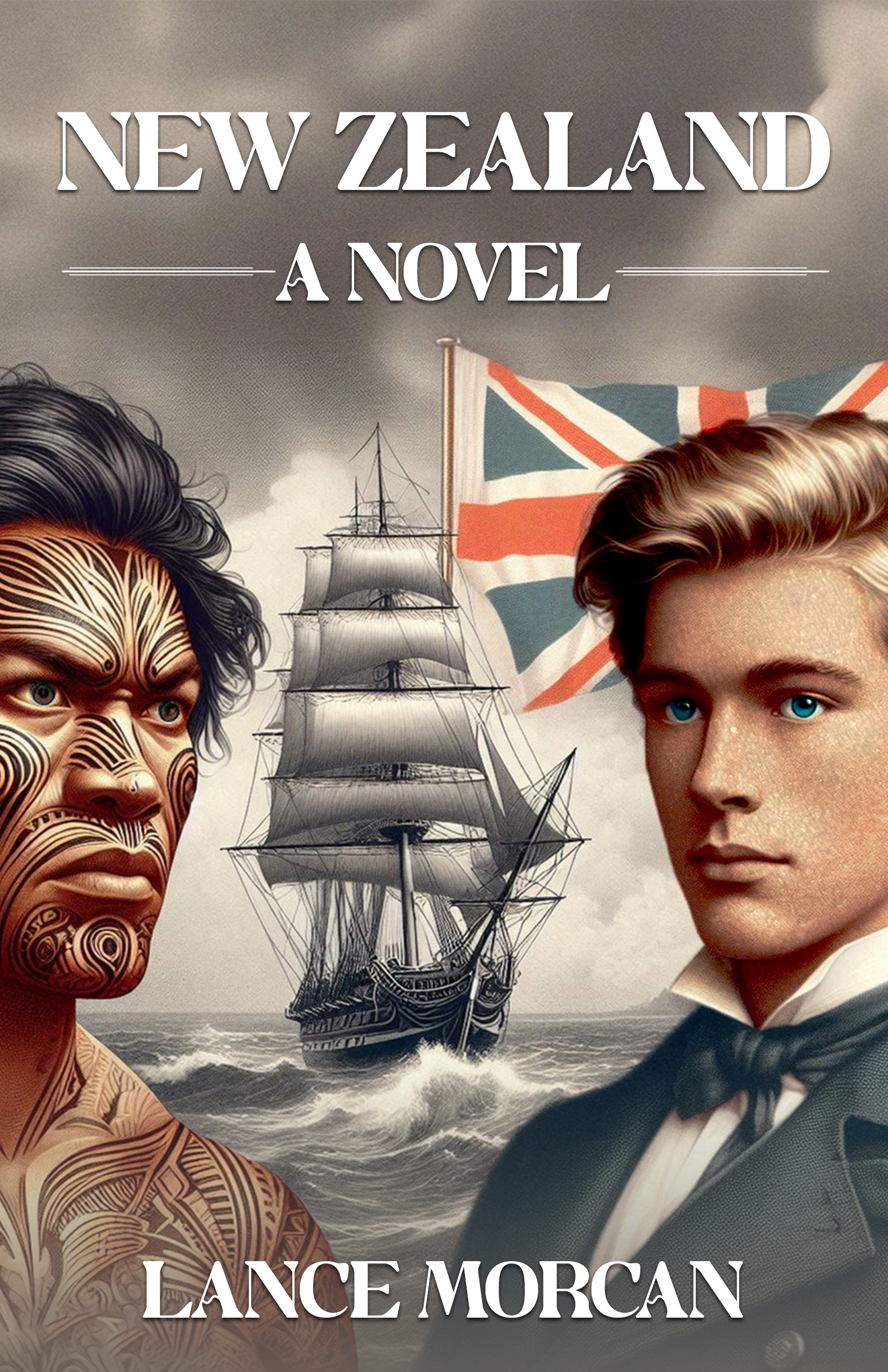
New Zealand: A Novel audiobook is available via Amazon’s Audible Audiobooks initiative. (Listening time: 11hrs. 25mins.).
The paperback version is available from Harvard Book Store, Mighty Ape NZ, Waterstones UK & Europe bookstores, Barnes & Noble, Kete Books NZ, Amazon and via public libraries.
Amazon link: https://www.amazon.com/New-Zealand-Novel-Lance-Morcan/dp/0473728524/
********************************************************


A thoroughly good book by an authentic NZ author who has lived in this nation for many generations.