
Spanning five centuries, New Zealand: A Novel is a sweeping tale of discovery, destiny, and forbidden love in which the old and new worlds collide. While this novel may not always convey exactly what happened during the discovery and settlement of New Zealand, first by Pacific Islanders and later by Europeans, I believe it captures the spirit of those sometimes romantic, always fascinating and often bloody times. –Lance Morcan (Author)
CHAPTER 2
Hawaiki, Winter, 1301 AD
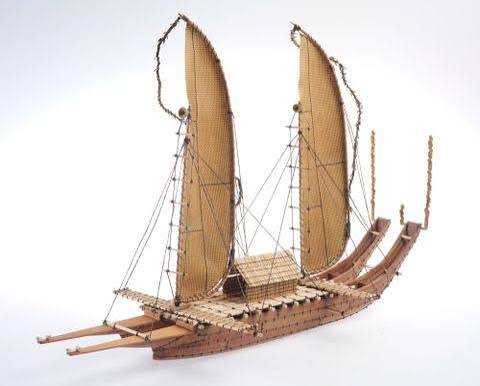
Hotu’s twin-hulled canoe was the biggest of all the double voyaging canoes ever seen in Hawaiki – bigger even than the giant catamarans favoured by their enemies. The rangatira knew he needed a special canoe if he was to lead an expedition into unknown waters in search of Kupe’s land. So he built the Ronui, his name for the huge craft that would carry eighty hand-picked villagers to a new life across the sea. Named after one of the mountain peaks that towered above his village, Ronui made an impressive sight at her lagoon anchorage.
Building such a canoe had been no easy task given the limitations of tools he and his team of builders had at their disposal. Support for the venture trickled in slowly as Hawaikans remained divided over its merits. As the monster vessel took shape, word quickly spread around Nuku Hiva and neighbouring islands, and the trickle of volunteers increased.
The project gathered pace when Hotu’s friend Ra and several other rangatiras eventually gave their support and supplied much-needed manpower. Enthusiasm for the project was contagious and finally the elders and priests gave it their unanimous blessing. Their zeal soon spread and the entire island took on a carnival atmosphere. Before long, there were a number of giant canoes under construction at various villages. Ra’s village was among those, and Ra named his canoe Tautira after the other mountain peak that dominated the landscape in their corner of the island.
The peace and quiet of usually-lazy days was shattered by the sounds of axes felling trees that had stood tall for generations. The sounds of hard labour continued from dawn till dusk. It became a race to see which village would finish building their canoe first.
Two crop-planting seasons had passed since the Dogfaces last attacked.
#
The great migration to Kupe’s land took on some urgency as winter seamlessly slid into spring. Hotu and captains of the fleet’s other voyaging canoes – nine in all – wanted to begin their journey before the start of the mid-summer cyclone season. Already the long-tailed cuckoos had begun their southern migration, and every day the sun seemed hotter and higher in the sky.
It was fast becoming a race against time. The weather during sea voyages at this time of the year was usually the sailors’ friend. Much later and it could be their mortal enemy. Islanders were very aware of the dangers. Oftentimes canoes did not return from a voyage, and every family had lost loved-ones to the angry ocean gods at some time.
Hotu’s buoyant mood was rapidly giving way to a feeling of unease. His son, Kafoa, ever-aware of his moods, asked, “What is wrong, papa?”
Father and son sat down in the shade and looked hard at each other as they usually did when there were important things to say. Hotu explained the need to leave the island before the onset of the cyclone season. Kafoa understood. He’d seen their village levelled twice already by the terrifying winds that brought with them death and destruction.
One question led to another. “Papa, what if you are wrong about the cuckoos? Could we get lost at sea?”
“That is always a risk, son,” the rangatira replied honestly. “But it is not likely.” Hotu advised Kafoa of all the other signs provided by nature for the benefit of seafarers. He told of the stars that gave navigators a path to follow, the ocean currents that sped the great canoes across the water as fast as schools of flying fish, the ocean swells that changed shape and the birds that appeared as land was neared – and about the reflection of land in the clouds, which could be seen long before the land itself was sighted. “Our people have learned to read these and other signs over many years of exploration.”
The explanation satisfied Kafoa and he ran off to play, leaving his father deep in thought.
Hotu’s responsibilities weighed heavily upon him. On the one hand, he knew he was doing the right thing leading his people to the sanctuary of a new land. On the other hand, he feared for their safety if they couldn’t leave before the cyclone season struck. And strike it would. It came every year without fail.
There was something else, too. As rangatira, he was responsible for all his people, not only those sailing with him. He was keenly aware that most of the villagers would be left behind. He vowed then and there he’d return for them once he had found Kupe’s land. Deep down, he knew that would be in the hands of the gods. The prevailing winds would speed the fleet to the southern land, but those same winds would put up an almost insurmountable barrier against any return trip. Somehow, Kupe had overcome this barrier, but Hotu wasn’t sure he could match his ancestor’s seamanship. Something deep inside him told him this would in all probability be a one-way journey.
The Ronui and Tautira were within days of completion. Hotu and Ra were keen to set sail. So it was agreed, after sometimes heated discussion, the fleet would be split. Ronui and Tautira would depart as soon as they could be provisioned. The other seven canoes – Tainui, Te Arawa, Mātaatua, Kurahaupō, Tokomaru, Aotea and Tākitimu – would follow a week or two later and hopefully before the onset of the cyclone season. History would later refer to those seven canoes as The Great Fleet.
Ra’s canoe, an exact replica of Hotu’s, had been launched several days earlier and was now moored in the lagoon close to the village. Built in the style favoured by blue water seafarers of the day, each craft was actually two canoes joined by planked decking, which supported several thatched shelters. Wide planks had been lashed together with V-shaped inserted ribs. These were caulked with breadfruit sap. The distinctive triangular sails, made of pandanus mat, were of the fore and aft variety while the rigging was made from coconut fibre and the keel carved from a solid log.
The carrying capacity of these eighty foot-long sea monsters was impressive. Food and stores on board could last up to three months. The food would be cooked in ceramic cooking pots lashed to the deck; fresh water would be carried in gourds and in hollow bamboo lengths; and rainwater would be collected in the sails themselves. In the event of water shortages, the voyagers would drain the blood of any fish they caught into empty coconut husks and then drink it to help quench their thirst.
Capable of speeds of eight knots in good conditions, such voyaging craft could average up to one hundred and fifty nautical miles a day, or thousands of miles in a month, and could survive all but the fiercest storms. That was the hope at least.
#
Word of the impending departure of Ronui and Tautira quickly spread around Nuku Hiva and the neighbouring islands. Within two days thousands of Hawaikans had descended on Hotu’s village to bid farewell to the voyagers. They arrived laden down with gifts ranging from coconuts, taro, breadfruit and preserved fish to blankets, grass mats, live pigs and dogs. Everything that could be accommodated was loaded onto the craft.
Hotu and Ra personally supervised the provisioning of their respective vessels. The former approved the half-dozen or so island dogs donated to the crew of Ronui. The dogs would prove useful hunters in the new land, but he drew the line at two pigs. He was confident they’d find many more pigs for the cooking fire when they reached their destination. Until then he was not prepared to put up with any more than two of the smelly, snorting beasts. Ra took a similar stance and approved the loading of one pig only. They would both regret their decisions later.
The venture was primarily an exercise in logistics. This problem was simple compared with choosing who could go. It was easy at first: only Hotu and a few adventurous followers had wanted to take the risk. As time passed and support for the venture grew, there were many more volunteers than there were places available. In most cases, the passengers and crewmembers were young, fit and healthy; it was accepted the rigours of lengthy ocean voyages were too much for the elderly or unfit to survive.
In all, there were eighty places allocated on each vessel. A few babies still being nursed by their mothers weren’t counted. The nursing mothers and their infants would have first use of the thatched shelters on board.
The day before sailing, with provisioning almost completed, the Hawaikans enjoyed what surely must have been the biggest feast in the island nation’s history. Kava, the traditional drink of the islands, flowed as hundreds of pigs were roasted over makeshift spits. As was the custom, giant sea turtles were barbecued alive until they ceased writhing and their succulent white flesh peeled off them.
Those villagers soon to depart weren’t to know this would be their last decent meal for more than six weeks – the time it would take to sail the sixteen hundred miles from Hawaiki to Kupe’s land.
At the height of the celebrations, Ra noticed Hotu sitting by himself at the entrance to the latter’s bure overlooking the lagoon, and so went to join him.
“It is good to see you, my brother,” Hotu said by way of customary greeting when he noticed his friend approach.
“It is good to see you also, my brother,” Ra responded in kind.
Hotu motioned to Ra to sit next to him then turned to a slave boy nearby and ordered him to prepare a bowl of kava. The two rangatiras sat in companionable silence. A short while later the slave boy reappeared holding a bowl, which contained a liquid that might resemble ditchwater to a casual observer. His hand was shaking. He was very aware that more than one slave had been put to death for serving ill-prepared kava to a rangatira. Hotu nodded to the boy who handed the bowl to him. He drank greedily from it before sharing its contents with Ra.
The potent island drink soon worked its magic. First came the tingling in the lips and then the warm glow that starts in the stomach and spreads deliciously to the brain.
Hotu felt immensely satisfied – and not just because of the effects of the kava. The rangatira knew he was about to realise the dream of a lifetime. He closed his eyes and whispered a silent prayer of thanks to the spirits of his ancestors.
From their vantage point, the rangatiras had a clear view of the reef beyond the lagoon and of the sparkling ocean beyond that. Hotu could feel the pull of the southern land again. He could hardly contain his excitement at the prospect of emulating the great voyaging feats of Kupe.
The pair proceeded to drain the kava bowl, their speech becoming increasingly incoherent as they discussed what would surely be the journey of a lifetime. When the kava ran out, fermented coconut milk miraculously materialised, courtesy of the slave boy, with equally potent results.
On unsteady legs, the pair meandered down to join the other villagers who were now enjoying a feast to end feasts. It would include the sweet flesh of a teenage virgin girl soon to be sacrificed to the sea gods. After suffocation at the hands of two strapping junior priests, the naked girl – a volunteer from Hotu’s village – would be baked over a cooking fire, and morsels of her flesh would be distributed to the assembled tribal rangatiras and elders in a ceremony almost as old as Hawaiki itself.
This age-old practice was followed throughout many of the occupied islands of the South Pacific. It was necessary to appease the gods.
***
CHAPTER 3
London, June 1, 1768
Nicholas Young had rarely visited the seaside before and had never been aboard a ship or boat of any kind. Born the youngest in a family of five children, he’d seldom been beyond the borders of his home county of Derbyshire, in…
NOVEL CONTINUES NEXT WEEK…
*************************************************************

