Hi
Welcome to Morcan Books & Films, the blog devoted to providing a unique perspective and intelligent commentary on books and films. It includes commentary on our own books and films – i.e. novels and screenplays co-written by the Morcans, and feature films produced by, or in development with, Morcan Motion Pictures.
Lance & James
Attention lovers of books and films…If you subscribe to, or are already a subscriber, of Morcan Books and Films blog and wish to receive an ARC pdf of my soon-to-be-released historical adventure novel, D.M. me or email me at sterlinggatebooks@gmail.com and I’ll forward a pdf of the manuscript to you immediately.
This epic novel will appeal to lovers of historical fiction, historical romance and lovers of adventure novels. It spans almost 500 years and covers the respective discoveries of New Zealand by Maori and European. It starts in the 1300’s with the departure of Pacific Islanders from Hawaiki in search of land far to the south.
The Kindle ebook and paperback versions of the novel will be published on Amazon before Christmas. Hardcover and audio versions will follow in the New Year.
ARC offer ends December 8th.
–Lance Morcan – Co-author of Into the Americas, White Spirit, The Ninth Orphan and Fiji: A Novel.
For the first time, the hills and shores of Aotearoa echoed to the sounds of war. As competition for land and food resources increased, inter-tribal fighting became the norm. The inevitable result was war on a scale never before seen in Kupe’s land. Fighting was hand-to-hand, vicious and bloody.
One ugly side-effect of the conflict was cannibalism.
Eating the flesh of enemies provided a new source of meat as well as having symbolic significance for the victors. Cannibalism quickly became part of Maori culture, just as it had throughout the islands of the South Pacific. The losers in warfare accepted they would end their days in slavery or on the cooking fire, or probably both. Slaves provided labour for hard manual work and were a source of food when their meat-starved captors were hungry.
Feuds erupted between iwis which had previously lived side by side in peace. As rivalries intensified, bloodshed followed. Given the Maori preoccupation with mana [prestige] any slight was an invitation to violent retribution. The concept of mercy was unknown and the cycle of revenge that resulted was known as utu, or blood vengeance.
Utu would become the law by which Maori lived. It would survive, indeed flourish, until well into the nineteenth century.
Apera’s Te Arawa iwi had consolidated their tribal base at Rotorua, the inland whakatikatikatanga [settlement] located on the shores of the same thermal lake where they’d resided since relocating from coastal Maketu. But like most tribes of the day they needed more land for their ever-expanding population. It was because of this their rangatira decided to lead a sizeable war party down the east coast in search of slaves and new territory.
The decision to make war was not taken lightly. The Te Arawa had long been insulated from the feuding that was now common amongst coastal tribes. Increasing demand for new territory had recently seen their own tribal lands come under threat. Fortunately, their superior numbers had enabled them to repel any invaders. However, this was not enough to ensure their survival. More land, slaves and riches were needed.
Winter was always the worst time to travel or to make war. The land was cold, and food was at its scarcest, but the Te Arawa warriors chose to make their move in the middle of winter when their enemies would likely be least prepared.
*
The paperback and Kindle ebook versions of ‘New Zealand: A Novel’ will be published on Amazon before Christmas; the hardcover and audiobook versions will follow in the New Year.
Aboard his flagship, the Heemskerck, Captain Abel Tasman (pictured) was feeling every one of his thirty-nine years as his vessel ploughed eastwards through heavy seas in the Southern Ocean and yet another squall left him soaked to the skin.
It was December 13, 1642. Nine days had passed – nine long days and sleepless nights – since the Heemskerck and her smaller companion ship the Zeehaen, an armed hauler vessel, departed an island he’d named Van Diemen’s Land. The Dutch master mariner had no way of knowing the ocean he now sailed would one day be known as the Tasman Sea.
Tasman stood on the Heemskerck’s quarterdeck, riding the rolling motion with the ease of a man who had spent all his working life at sea, and praying he’d sight land soon. He thought he glimpsed land directly ahead.
A cry went up from the ship’s crow’s nest, confirming he hadn’t imagined it. “Turn to port!” the captain shouted to his bosun. He had just sighted waves crashing onto a rocky shoreline, a scary sight even for an experienced seaman.
“Ja, Kapitein!” the bosun responded before relaying Tasman’s orders to his subordinates.
The Heemskerck responded slowly in the heavy seas and several tense minutes passed before she was safely sailing north and parallel to the coast. At the same time, the squall eased, and the clouds and mist lifted to reveal a rugged, forbidding coastline. Dark, green, bush-covered hills rose steeply beyond the rocky shore, and beyond them fleeting glimpses of majestic alps could be seen through breaks in the cloud. There was summer snow on some of the higher peaks.
Tasman was immediately struck by the majesty of the new land he’d discovered. It seemed prehistoric, but beautiful at the same time.
It was some moments before it dawned on Tasman that he had achieved his expedition’s main goal: he’d discovered the Great Southern Continent, or so he believed, for he was convinced the shoreline he was now looking at was that continent’s western edge. The realisation almost brought him to tears, and thoughts of great reserves of gold and other treasures flashed through his mind. He wondered whether the land was inhabited. First impressions were that this was virginal land, uninhabited and unoccupied. If he was right that would mean Holland would have unobstructed and unrivalled access to its resources.
Looking at the coastline beyond the starboard rail, he murmured, “I name this new land Nieuw Zeeland.”
Tasman would soon learn – to his cost – that the land he’d discovered was occupied by warlike peoples who called themselves Maoris. However, he would go to his deathbed mistakenly believing the new land was the Great Southern Continent. It would be well into the following century before his countrymen learned Nieuw Zeeland was an island nation roughly the size of England.
*
The paperback and Kindle ebook versions of ‘New Zealand: A Novel’ will be published on Amazon before Christmas; the hardcover and audiobook versions will follow in the New Year.
Shrouded in cloud at the bottom of the world, this was the land that time forgot: the last sizeable piece of undiscovered land on Earth. Two hundred million years after breaking away from the vast southern continent of Gondwana, Man had yet to leave his footprints on this prehistoric place.
Mythology would have it the land was fished up out of the ocean. In fact, earthquakes and volcanic activity forced it to literally erupt from the seabed. This violent birth left it with a majestic ruggedness that would always reflect its former turbulence.
Over time, its features softened. Scenes of beauty emerged out of the mists. There was a haunting stillness about the land. It was a place of mystery – of magical forests and sparkling lakes and rivers. And the sea surrounded it like some huge tidal moat.
Its isolation ensured it wouldn’t be until well into the First Millennium AD that Man would step foot on these shores. The hardy, brown-skinned people who arrived here called themselves Maori and they called their new home Aotearoa – land of the long, white cloud.
Not until its rediscovery centuries later by European explorers would the land receive the name by which it is known today: New Zealand. Their arrival would herald a clash of two vastly different ideologies as European civilization collided with indigenous culture.
It was a time of conflict, lust and adventure.
***
My historical adventure epic NEW ZEALAND: A NOVEL is a tale of conflict, lust and adventure. It spans almost 500 years and covers the respective discoveries of New Zealand by Pacific Islanders and Europeans. From the outset the two stories are interposed. It starts in the 1300’s with the departure of Islanders from Hawaiki in search of land far to the south.
Under ‘Historical Notes’ at the end of my soon-to-be-released historical adventure epic NEW ZEALAND: A NOVEL, I advise readers that cannibalism was widely practised by Maori and it continued until well into the 1800’s, especially during the Musket Wars of the early 1800’s when a quarter of the Maori race perished in inter-tribal warfare.
I also advise readers, my novel is a work of fiction, albeit inspired by true events, and in the interests of telling a good story I have deviated from Maori and European history in places.
Excerpts from my Historical Notes follow:
In the case of Maori history, it’s important to remember that New Zealand’s indigenous people had no written language before Europeans arrived. Theirs was an oral history, which by its very nature is inexact, and therefore many facts – such as the place of origin of the Maori people – are subject to conjecture. That place, according to Maori legend, is known as Hawaiki. I have opted for the South Pacific island nation of Marquesas as being that place even though many historians believe it more likely Maori originated from Tahiti. As an aside, I have met Cook Islanders who, to my eyes and ears, look and sound like Maoris. Then again, I’ve heard indigenous Hawaiians say they can understand much of Te Reo, the Maori language, when they hear it spoken. So, logic tells me it is quite possible Maoris originally came from any one of the aforementioned island nations.
The conflict in the early 1500’s between the Te Arawa and Ngati Porou tribes is pure fiction. However, it typifies the clashes that occurred between warring iwis, or tribes, of that time. And despite what some present-day historians might say, the descriptions of cannibalism have not been exaggerated – not if the early writings of European explorers, seafarers, adventurers, missionaries, settlers, army officers and others are to be believed. Cannibalism was widely practised by Maori.
I am aware some fans of historical fiction expect writers in this genre to stick to the facts. Some readers will be aware I have deviated, considerably in places, from what actually occurred during the respective discoveries of New Zealand, first by Pacific Islanders then by Europeans. In my defense, I would point out that prominent historical fiction authors, Bernard Cornwell included, often replace history with invention in their novels.
For a more historically accurate overview of the Endeavour’s expedition to, and circumnavigation of, New Zealand I highly recommend the Captain Cook Society’s informative website, which includes verbatim extracts from Cook’s journals; and for an intriguing insight into early New Zealand and Maoris’ ancient origins I recommend these books by two of New Zealand’s most respected historians: The Penguin History of New Zealand, by Michael King, and This Horrid Practice: the Myth and Reality of Traditional Maori Cannibalism, by Paul Moon.
Finally, while my novel may not convey exactly what happened during the discovery and settlement of New Zealand, I believe it accurately captures the spirit of those bygone days.
*
The paperback and Kindle ebook versions of ‘New Zealand: A Novel’ will be published on Amazon before Christmas; the hardcover and audiobook versions will follow in the New Year.
Kafoa scanned the ocean ahead of the double-voyaging canoe that had carried his fellow Islanders, or those of them who had survived at least, so far from their homeland in Hawaiki. Finally, he saw what it was the men had seen.
Low on the horizon, at the limit of the boy’s vision, was a large landmass resting beneath a long white cloud. Studying the distant landmass, he murmured, “Aotearoa.”
His father nodded. “Aotearoa,” Hotu agreed. “Land of the long white cloud.”
Kupe’s land now had a name.
You are reading an excerpt from an early chapter in my soon-to-be-released historical adventure epic ‘New Zealand: A Novel’.
Excerpt continues:
The excitement on board was unrestrained as the landmass now referred to by all as Aotearoa came into clear focus beneath the umbrella of cloud. Everyone who could stand was standing. The only voyagers not on their feet were those too weak to rise from where they lay.
Hotu was now manning the tiller. His heart beat fast. Here at last was Kupe’s land!
Tears filled the rangatira’s eyes and he murmured a prayer of thanks to the spirits of his Hawaikan ancestors. This land, their land, would be his people’s salvation. Of that he was sure.
From around twenty miles out, the land appeared dark and mysterious in the shadow of the cloudbank above it. Forbidding even. The sight had a sobering effect on the voyagers. All conversation ceased as they studied their new homeland.
As the canoe sailed onwards, floundering deeper than ever in the water, the land mass ahead slowly took shape. It was high – higher than the tropical islands of the Pacific – and it was covered in dense, lush, green bush.
Although still too far away to ascertain, the land appeared to be unoccupied, and some sixth sense told Hotu it was. Which meant he and his fellow survivors would be the only people on these shores. He wondered what had become of Kupe’s fellow voyagers all those centuries ago.
*
The paperback and Kindle ebook versions of ‘New Zealand: A Novel’ will be published on Amazon before Christmas; the hardcover and audiobook versions will follow in the New Year.
My thanks to the talented book cover designers at Book Publishers NZ for designing such an eye-catching cover for this soon-to-be released novel. They offer the full range of publishing services for authors as a visit to their website will testify… Book Publishers in New Zealand – Top Self-Publishing House in NZ
‘New Zealand: A Novel’ has been a labour of love for me for half a century now! I wrote a one paragraph logline for it 50 years ago and have been adding to it, a few paras at a time, ever since.
The novel spans almost 500 years and covers the respective discoveries of New Zealand by Maori and European.
It starts in the 1300’s with the departure of Pacific Islanders from Hawaiki in search of land far to the south; it ends in the 1700’s with Captain James Cook’s historic circumnavigation of that same land – a land he calls New Zealand – as seen through the eyes of young crewmember Nicholas Young aboard the bark Endeavour.
From the outset the two stories are interposed. The adventures of the descendants of the earliest Maoris are followed down through the centuries, culminating in their often violent, sometimes romantic, always fascinating interactions with the white intruders they call pakehas.
*
The paperback and Kindle ebook versions of ‘New Zealand: A Novel’ will be published on Amazon before Christmas; the hardcover and audiobook versions will follow in the New Year.
Critically-acclaimed American author Kathleen Buckley’s fans will be delighted to know her eighth historical romance novel, A Peculiar Enchantment, has been released this week – in time for Christmas book sales.
Published by The Wild Rose Press, Inc., the novel is available now via Amazon as a paperback and Kindle ebook and is sure to appeal to lovers of Georgian romances.
Ms. Buckley’s eighth Georgian romance out now!
Blurb for A Peculiar Enchantment:
What can you look forward to when your only relatives call you ugly, unbalanced, and a scandal? What would you do if your only friend was threatened? Dependent on her half-brother, the Earl of Lamburne, Adelaide knows. She wants to escape.
Gervase Ducane, invited to Lamburne’s home to court his daughter, is torn. He needs to marry well and soon but not this spiteful chit. Should he buy a commission instead? Seek a wealthy merchant’s daughter? As a marquess’s brother, he has at least a noble connection to offer an heiress apart from his good manners. And why is he only now meeting the earl’s delightful half-sister?
Ordered to stay away from the house party, Adelaide rebels. She will make her unwelcome, embarrassing presence known to avenge herself and her pet.
Sometimes when you least expect it, magic happens.
Readers resonate withA Peculiar Enchantment
The first reviews are in for Ms. Buckley’s latest novel – and, no surprises, they’re excellent!
Here’s a sample of Amazon reviewers’ comments:
★★★★★ “I really enjoyed reading this book since Kathleen Buckley put many of my favorite elements in it!… It is a story that I recommend happily and will probably read again.” –Karen M Hernandez
★★★★★ “I enjoyed this novel set in 1741 London…I thought the characters were outstanding (and) found the book to be a wonderful romance.” –Kindle Customer DVH
★★★★★ “This is an engaging, clean, historical romance occurring during an unexpected situation. After learning about the primary characters, their families, and supporting cast, the skillfful plot takes off with fervor.” -JustJeri
About the author:
Kathleen Buckley has loved writing ever since she learned to read. After a career which included light bookkeeping, working as a paralegal, and a fascinating stint as a security officer, she began to write as a second career rather than as a hobby. Her first historical romance was penned – “Or word processed at least!” – after re-reading Georgette Heyer’s Georgian/Regency romances and realizing Ms. Heyer would never be able to write another, having died some forty years earlier.
Ms. Buckley is now the author of eight Georgian romances: An Unsuitable Duchess, Most Secret, Captain Easterday’s Bargain, A Masked Earl, A Duke’s Daughter, Portia and the Merchant of London, A Westminster Wedding and A Peculiar Enchantment.
Captain Easterday’s Bargain was an Oklahoma Romance Writers of America IDA 2019 finalist, Historical Fiction category, and Most Secret was an Oklahoma Romance Writers of America IDA 2018 finalist, Historical Fiction category, and a 2019 Next Generation Indie Book Awards finalist, Romance category.
While her ninth novel, entitled By Sword and Fan, is in production, this prolific author is already writing her tenth!
Ms. Buckley warns readers that no bodices are ripped in her romance novels.
“They might be described as “powder & patch & peril” rather than Jane Austen drawing room as they contain no explicit sex. However, they do contain the occasional den of vice and mild bad language, as the situations in which my characters find themselves sometimes call for an oath a little stronger than ‘Zounds!’”
When she began writing A Peculiar Enchantment, she says she knew it was going to be different from her first seven novels.
“The usual ingredients were there, but so was a little more humor, the magic of first love, the mystery of things that are not what they seem, and a cat. And love is the most peculiar enchantment. I think it’s on track to be my most popular book yet.”
As for her future plans, Kathleen Buckley says, “I’ll continue to turn tropes on their heads whenever possible, avoid ballrooms and include characters who are not aristocratic, rich, handsome or beautiful.”
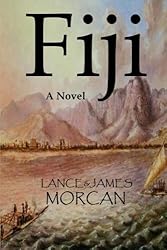
You are invited to enter our Goodreads giveaway competition to win a copy of the paperback edition of Fiji, another action-packed historical adventure novel by Lance & James Morcan, co-authors of White Spirit and Into the Americas.
By the mid-1800’s, Fiji has become a melting pot of cannibals, warring native tribes, sailors, traders, prostitutes, escaped convicts and all manner of foreign undesirables. It’s in this hostile environment an innocent young Englishwoman and a worldly American adventurer find themselves.
Susannah Drake, a missionary, questions her calling to spread God’s Word as she’s torn between her spiritual and sexual selves. As her forbidden desires intensify, she turns to the scriptures and prayer to quash the sinful thoughts – without success.
Nathan Johnson arrives to trade muskets to the Fijians and immediately finds himself at odds with Susannah. She despises him for introducing the white man’s weapons to the very people she is trying to convert and he pities her for her naivety. Despite their differences, there’s an undeniable chemistry between them.
When their lives are suddenly endangered by marauding cannibals, Susannah and Nathan are forced to rely on each other for their very survival.


 Morcan Books & Films