
Spanning five centuries, New Zealand: A Novel is a sweeping tale of discovery, destiny, and forbidden love in which the old and new worlds collide. While this novel may not always convey exactly what happened during the discovery and settlement of New Zealand, first by Pacific Islanders and later by Europeans, I believe it captures the spirit of those sometimes romantic, always fascinating and often bloody times. –Lance Morcan (Author)
CHAPTER 6
South Pacific, Summer, 1301 AD
Aboard Ronui, only Hotu remained fully alert as yet another day dawned. He sat at the stern, manning the tiller and scanning the horizon in search of land. Kafoa slept fitfully close by, his head resting on his father’s lap. Their fellow voyagers, who now numbered less than sixty, lay sprawled before them, occupying much of the free space on the craft’s deck. Many were near death and most had resigned themselves to ending up in a watery grave.
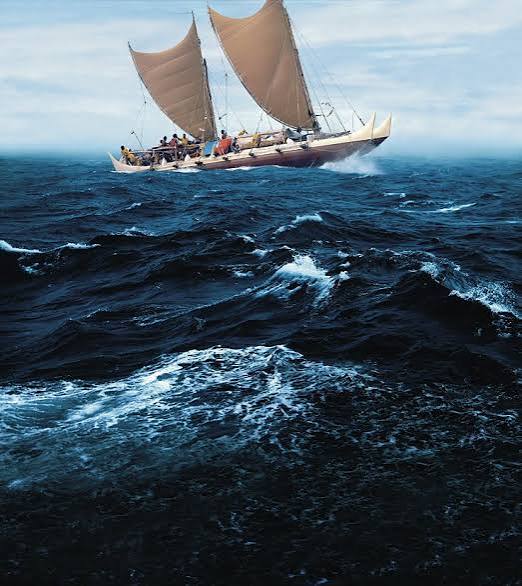
As for Ronui, the craft bore no resemblance to the proud voyaging canoe that had left Hawaiki many weeks ago. Partially submerged, it appeared to be in imminent danger of sinking, and the experienced sailors on board knew it wouldn’t survive another storm.
Hotu was thankful his wives and all but one of his children had survived the journey so far. His youngest daughter had succumbed to the cold only the previous day. Other families had suffered even greater loss, some losing all their children and in some cases spouses. In the two days since Ronui’s separation from Tautira, the last of the precious food provisions had been eaten and most of the voyagers had all but lost the will to live. Physically, the survivors resembled skeletons, and the crewmen were becoming too weak to handle the relentless demands of blue water sailing.
The rangatira remained determined to find Kupe’s land. Trance-like, he sat at the tiller, single-mindedly pointing the canoe south as the morning sun broached the horizon, lighting up the Pacific and announcing the dawn of a rare fine day. Ronui’s remaining triangular sail, fluttered in defiant shreds in the steady breeze.
Hotu clung to the fact that as the distance between Ronui and Hawaiki lengthened, the gap between the voyagers and Kupe’s land narrowed accordingly. He just hoped they would reach their destination before any more died.
Kafoa stirred. Hotu glanced down and saw the boy was waking after a night of broken sleep and bad dreams. His heart went out to him. In his oldest son he saw his future, and his people’s future, too. Pushing the hair from the boy’s eyes, he murmured, “Good morning, son.”
“Good morning, papa.” Kafoa sat up and rubbed the sleep from his eyes.
Hotu handed his son a bowl of rainwater and the boy gulped it down greedily.
Kafoa suddenly froze, the bowl still raised to his mouth. “Papa!” he said. “Are those land birds?” Squinting, he pointed east toward the rising sun.
Hotu followed his son’s gaze. Despite the sun’s glare, he could just make out two large grey-and-white-feathered birds. They were a hundred yards away, lazily gliding in the breeze. “Yes!” he roared “They are seagulls!”
The commotion roused the others on board. Some of them staggered or crawled back to join Hotu and Kafoa. Rangi, the navigator, was first to reach the pair.
“Gulls!” Rangi confirmed. He returned his gaze to the southern horizon. “Can you see land?”
“No, but it must be near!” Hotu declared.
By now everyone who could was standing or sitting upright and scanning the horizon. Gradually, as long minutes dragged by, their spirits sank. There was no land to be seen, only an endless expanse of sky and ocean.
“The ocean gods are tormenting us before we die!” one of the women wailed. Others – men and women – voiced their despair. Some crawled back to where they’d been lying, seemingly resigned to death.
Hotu, Rangi and the other experienced sailors, however, remained alert. Kafoa noticed there was an air of excitement around them. It seemed to him that they could sense land even if they couldn’t see it.
“Look at the swells,” Rangi pointed out. “They are flattening.”
Kafoa looked at them. They did seem flatter even to his inexperienced eye.
“Look!” another man shouted. “Up ahead!” He pointed to the branch of a tree floating several hundred yards ahead of the canoe. It was almost totally submerged and if it hadn’t been for its bright red flowers, it might not have been noticed. The men weren’t to know it was a branch from the pohutukawa, an iconic tree that flowered early summer – a tree that was unique to Kupe’s land.
Still at the tiller, Hotu steered toward the branch. As the canoe closed with it, one of the men reached over and pulled it aboard. The branch had large green leaves; its distinctive flowers were actually brush blossoms, consisting of a mass of bright red stamens, but no-one could identify the tree it came from. That was of no consequence, however. It was another sign that land was near.
As one, they all stared at the horizon as if willing land to appear.
Time passed excruciatingly slowly and the sun rose ever higher. Still there was no sighting of land, and Kafoa could feel the excitement of those around him beginning to wane. He asked himself if they’d misread the signs.
#
Kafoa dozed intermittently. He welcomed sleep. It provided relief from the hunger pangs that gripped him. Through the mists of sleep he could hear his father and Rangi talking nearby.
“Land is close,” Hotu said. “I can smell it.”
Kafoa tried to open his eyes, but the blinding sun was directly above him now and so he kept them closed for the moment. Lulled by the motion of the canoe in the gentle swell, he drifted back to sleep, dreaming of succulent roast pork and barbecued turtle meat.
The boy had no sooner fallen asleep than he was woken by the navigator’s shouts.
“I see land!” Rangi shouted triumphantly, leaping to his feet.
“Where?” Hotu demanded.
“There!” the excited navigator said, pointing directly southwest.
Kafoa was wide awake now. He pushed himself to his feet and squeezed between the two men, searching the horizon for a glimpse of land.
Hotu said, “Yes! I see it!”
Rangi adjusted the tiller until the canoe pointed slightly more to the west.
Others gathered around, aroused by the sudden commotion.
Kafoa strained his eyes, but could see only sky and ocean. “Where is it?” he implored. “I cannot see anything!”
Hotu smiled. “Look for the signs and you will see it.”
Kafoa scanned the horizon, looking for any one of the signs he had memorised by heart. He absentmindedly massaged the stub of the extra small finger on his left hand as he studied the sea and sky around him. Finally he saw what the men had seen. Low on the horizon, at the limit of his vision, was a large landmass resting beneath a long white cloud. Studying the distant landmass, he murmured, “Aotearoa.”
Hotu nodded. “Aotearoa,” he agreed, “land of the long white cloud.”
Kupe’s land now had a name.
#
The excitement aboard Ronui was unrestrained as the landmass now referred to by all as Aotearoa came into clear focus beneath the umbrella of cloud. Everyone who could stand was standing. The only voyagers not on their feet were those too weak to stand.
Hotu was now manning the tiller. His heart beat fast. Here at last was Kupe’s land! Tears filled his eyes and he murmured a prayer of thanks to the spirits of his Hawaikan ancestors. This land, their land, would be his people’s salvation. Of that he was sure.
From around twenty miles out, the land appeared dark and mysterious in the shadow of the cloudbank above it. Forbidding even. The sight had a sobering effect on the voyagers. All conversation ceased as they studied their new homeland.
Hotu glanced down at Kafoa who hadn’t left his side since the first sighting. Overcome with love for the boy, he reached down and ruffled his hair yet again. Kafoa looked up and smiled at the father he idolised.
As Ronui sailed onwards, floundering deeper than ever in the water, the land mass ahead slowly took shape. It was high – higher than the tropical islands of the Pacific – and it was covered in dense, lush, green bush.
Although still too far away to ascertain, the land appeared to be unoccupied, and some sixth-sense told Hotu it was. Which meant he and his fellow survivors would be the only people on these shores. He wondered what had become of Kupe’s fellow voyagers all those centuries ago.
Hotu’s mind returned to the present and he realised the bigger question was what had happened to Ra and the others aboard Tautira. He prayed they were safe.
#
By mid-afternoon, the clouds lifted and Aotearoa was bathed in brilliant sunshine.
The Hawaikans were close to shore now. They scrutinised every feature of their new land. Ahead of them breakers crashed against impressive white cliffs that rose straight out of the sea. The clifftops were fringed by trees whose distinctive flowers blazed scarlet under the summer sun. Kafoa thought it likely the branch that was recovered from the sea came from one of those very trees.
Hotu was anxious to find a suitable landing place before nightfall. It was the ever-vigilant Rangi who brought his attention to a bay slightly to the north of where they were heading.
“Over there!” the navigator said, pointing to a crescent-shaped bay.
“Uh,” Hotu confirmed, steering the canoe toward the bay. A prominent headland at the bay’s southern end guarded the entrance to it.
The rocky shoreline gave way to a white-sand surf beach. Calm water and only the faintest of breezes aided an uneventful beaching. After such a long and dramatic voyage, the landing seemed almost an anti-climax to the exhausted survivors.
Kafoa was first to disembark, jumping from the canoe into the shallows. In a few strides he was standing above the high tide mark on the beach, his hunger pangs and tiredness forgotten for the moment. One by one, the other survivors joined him.
The descendants of Kupe had come home.
Hotu prayed that Ra and the others aboard Tautira had also arrived safely. He had no way of knowing they would soon land on a similar beach several hundred miles to the north.
It would be two centuries before the descendants of these separated peoples would meet, and when they did, it would not be as friends but as mortal enemies.
***
CHAPTER 7
Plymouth, August 25, 1768
The storm Nicholas Young and his fellow crewmembers had feared arrived with a vengeance, delaying the Endeavour’s departure from Plymouth by three days. She finally put to sea at two o’clock on a windy August afternoon. The foul weather that had delayed her departure continued for several more days and many of the bark’s company were violently ill. Not Nicholas, though. He’d quickly discovered he was…
NEW ZEALAND: A NOVEL continues next week…
To see what Amazon critics are saying about this novel go to:
*************************************************************

