Archive for the ‘Books in general’ Category

The Hebrew translation rights to all our published books (fiction and non-fiction) are now available.

We are represented for these rights by Israeli literary agent Adamit Pereh, of the Adamit Pereh Agency.

Any publishers interested in acquiring the Hebrew translation rights to any of our books should contact Adamit at: adamit10@gmail.com – She and a number of our agents will be at the upcoming Frankfurt Book Fair.

* * *

Worldwide, we are now represented for the translation rights of our books by the following literary agents:

Japan: Mari Koga, of Motovun Co. Ltd., Tokyo – koga_motovun@mbd.ocn.ne.jp

Turkey: Atilla Izgi Turgut, of Akcali Ajans, Instanbul – atilla@akcalicopyright.com

China: Mina Liu, of Chengdu Rightol Media, Chengdu – mina@rightol.cn

Russia: Sergei Cheredov, of Nova Littera Ltd., Moscow – pravaru@gmail.com

Korea: Joseph Lee, of KL Management/Korean Literary Management, Seoul – josephlee705@gmail.com

India: Vidula Tokekar, of TranslationPanacea, Pune – translation@panaceabpo.co.in

Israel: Adamit Pereh, of Adamit Pereh Agency – adamit10@gmail.com

Rest of world including Europe: Maria Pinto-Peuckmann, Munich area – maria@pinto-peuckmann.de

* * *

Our eight titles (published between 2011 and 2014) are listed below:


Product Details
Product Details


****************************************************

We are pleased to announce the appointment of German based literary agent Maria Pinto-Peuckmann, of the Maria Pinto Peuckmann Literary Agency, Munich area, as our representative for the translation rights for our fiction and non-fiction book titles.

Maria Pinto-Peuckmann

Literary agent Maria Pinto-Peuckmann.

Maria represents us for all those markets in which Sterling Gate Books doesn’t already have representation. This equates to some major territories including all of Europe (minus Turkey), the Middle East, Central and South America, and a number of Asian countries.

The former international rights director has 23 years experience in licensing and copyright promotions worldwide with major German publishing houses.

Until last December, Maria was Rights Director/International Affairs with German publisher Muenchner Verlagsgruppe GmbH with responsibility for the following imprints: Riva Verlag, mvg Verlag, Redline verlag, MI-Wirtschafsbuch and Finanzbuch Verlag. Prior to that, she was Rights Director/International Affairs with another German publisher, Verlag Moderne Industrie AG & Co KG, with responsibility for the following imprints: Redline Verlag, Mi-Wirtschaftsverlag and mvg Verlag.

Educated at the School of Economics and Industry, in Portugal, Maria has strong ties with that country. She is fluent in German, Portuguese and Spanish and also speaks English, French and Russian.

Publishers interested in discussing the translation rights for our books are welcome to contact Maria directly by email. (Contact details below).

*   *   *

Worldwide, we are now represented for the translation rights of our books by the following literary agents:

Japan: Mari Koga, of Motovun Co. Ltd., Tokyo – koga_motovun@mbd.ocn.ne.jp

Turkey: Atilla Izgi Turgut, of Akcali Ajans, Instanbul – atilla@akcalicopyright.com

China: Mina Liu, of Chengdu Rightol Media, Chengdu – mina@rightol.cn

Russia: Sergei Cheredov, of Nova Littera Ltd., Moscow – pravaru@gmail.com

Korea: Joseph Lee, of KL Management/Korean Literary Management, Seoul – josephlee705@gmail.com

India: Vidula Tokekar, of TranslationPanacea, Pune –  translation@panaceabpo.co.in

Israel: Adamit Pereh, of Adamit Pereh Agency – adamit10@gmail.com

Rest of world including Europe: Maria Pinto-Peuckmann, Munich area – maria@pinto-peuckmann.de

 *   *   *

Our eight titles (published between 2011 and 2014) are listed below:


Product Details
Product Details


****************************************************


Reader popularity lists on Goodreads.com, the world’s largest site for readers and book recommendations, provide a quick reference for good books for any bookworms running low on reading material.

We are delighted that Goodreads’ latest lists feature all eight of our book titles – including our international thriller series THE ORPHAN TRILOGY and our historical adventure series THE WORLD DUOLOGY.

Here’s a snapshot of popular books in various categories ranging from Great Romance Novels to Best Violent Action Novels to Best Action-Adventure Novels and many more…


Harry Potter and the Deathly Hallows by J.K. RowlingThe Name of the Wind by Patrick RothfussThe Wise Man's Fear by Patrick RothfussClockwork Princess by Cassandra ClareA Storm of Swords by George R.R. Martin                                                   Books With a Goodreads Average Rating of Over 4.5


The Kite Runner by Khaled HosseiniA Thousand Splendid Suns by Khaled HosseiniFiji by Lance MorcanOne Hundred Years of Solitude by Gabriel Garcí­a MárquezThe Joy Luck Club by Amy Tan                                Favorite World Fiction & Literature


Fiji by Lance MorcanThe Book Thief by Markus ZusakThe Book of Occult by Simon W. ClarkMemoirs of a Geisha by Arthur GoldenCorpalism by Arun D. Ellis                                                       Around the World through Fiction


The World Duology by Lance MorcanFiji by Lance MorcanWorld Odyssey by Lance MorcanThe Mirror of Her Dreams by Stephen R. DonaldsonIn Blood There is No Honor by Judith-Victoria Douglas                                Duologies


Fiji by Lance MorcanTales of the South Pacific by James A. MichenerThe Sex Lives of Cannibals by J. Maarten TroostThe World Duology by Lance MorcanMister Pip by Lloyd Jones                                                    Best Books About the South Pacific


The Ninth Orphan by James MorcanThe Orphan Conspiracies by James MorcanThe World Duology by Lance MorcanThe Orphan Trilogy by James MorcanWorld Odyssey by Lance Morcan                                                   Books by James Morcan & Lance Morcan


Behind the Hood by Marita A. HansenPhenomena by Susan TarrThe Bone People by Keri HulmeThe Whale Rider by Witi IhimaeraMister Pip by Lloyd Jones                                                    Books By New Zealand Authors


The Ninth Orphan by James MorcanFiji by Lance MorcanThe Orphan Factory by James MorcanThe Orphan Uprising by James MorcanThe Orphan Conspiracies by James Morcan                                                        Books by Authors Who Work in Multiple Genres


Around the World in Eighty Days by Jules VerneWorld Odyssey by Lance MorcanThe World Duology by Lance MorcanThe Ninth Orphan by James MorcanThe Orphan Uprising by James Morcan                                                         Multi Country Setting


Wild Hearted by Lea BronsenAgency Rules - Never an Easy Day at the Office by Khalid MuhammadThe Infidel Soldiers by Jams N. RosesThe Orphan Uprising by James MorcanThe Meat Market by James Chalk                                                  Best violent action novels


Pride and Prejudice by Jane AustenAfter Forever Ends by Melodie RamoneOutlander by Diana GabaldonSultry with a Twist by Macy BeckettBinding Arbitration by Elizabeth Marx                                                    Great Romance Novels


Fiji by Lance MorcanThe Duke of Shadows by Meredith DuranOutlander by Diana GabaldonNot Quite a Husband by Sherry ThomasAs You Desire by Connie Brockway                                Historical Romance From Around The World


Fiji by Lance MorcanAshen Winter by Mike MullinRed Dragon by Thomas HarrisThe Silence of the Lambs by Thomas HarrisAlive by Piers Paul Read                                                               Cannibal Books


The Catcher in the Rye by J.D. SalingerTo Kill a Mockingbird by Harper LeeSecrets of the Realm by Bev StoutThe Orphan Factory by James MorcanThe Clay Lion by Amalie Jahn                                                         Great Coming-Of-Age Books


My First Travel Angelic Airline Adventures by Anna OthitisEat, Pray, Love by Elizabeth GilbertKilingiri by Janna GraySleeping People Lie by Jae De WyldeRiptide by Amber Lea Easton                                                               Best Location-Based and History-Based Books


Unthinkable Consequences by Bob RectorThe Meat Market by James ChalkThe Orphan Uprising by James MorcanPatriot Games by Tom ClancyThe Saladin Strategy by Norm Clark                                                             Best Action-Adventure Novels


Fiji by Lance MorcanAngel Evolution by David EstesDark Passage by M.L. WoolleyA Demon Made Me Do It by Penelope KingSpare Change by Bette Lee Crosby                                                     Books at Making Connections Group


The Kite Runner by Khaled HosseiniMemoirs of a Geisha by Arthur GoldenA Thousand Splendid Suns by Khaled HosseiniThe Book Thief by Markus ZusakLife of Pi by Yann Martel                                                         Foreign Lands


The Wayward Gifted by Donna K. ChildreeStill Life With Crows by Douglas PrestonThe Orphan Trilogy by James MorcanThe Orphan Conspiracies by James MorcanBeautiful Creatures by Kami Garcia                                                     Author Collaborations (Dynamic Duos)


The Orphan Conspiracies by James Morcan1984 by George OrwellThe Catcher in the Rye by J.D. SalingerCorpalism by Arun D. EllisThe Great Gatsby by F. Scott Fitzgerald                                                                 Great Book Covers


To visit Goodreads’ reader popularity lists go to: https://www.goodreads.com/list/book/20300866


Happy reading! –Lance & James


**************************************

Publishers and literary agents may be interested to know that foreign language translation rights are available for Sterling Gate Books’ top rating fiction and non-fiction books.

Most of our eight book titles have been regular visitors to Amazon’s bestseller lists. These titles include our conspiracy thriller series THE ORPHAN TRILOGY, our historical adventure series THE WORLD DUOLOGY and our first (recently released) non-fiction book THE ORPHAN CONSPIRACIES.

All have been published on Amazon as Kindle ebooks; two (THE NINTH ORPHAN and FIJI: A NOVEL) are also available as trade paperbacks; and all have been well reviewed.

While James and I will be retaining the English language rights, we do seek representation for the foreign translation rights for our books in markets throughout the world. Interested literary and rights agents (and publishers) can email us at sterlinggatebooks@gmail.com

We are now represented for translation rights in Japan, Turkey, China, Russia and Korea.

Publishers interested in securing rights for our books in the above-mentioned markets are invited to contact the following literary agents:

Japan:           Mari Koga, of Motovun Co. Ltd., Tokyo – koga_motovun@mbd.ocn.ne.jp

Turkey:          Atilla Izgi Turgut, of Akcali Ajans, Instanbul – atilla@akcalicopyright.com

China:            Mina Liu, of Chengdu Rightol Media, Chengdu – mina@rightol.cn

Russia:           Sergei Cheredov, of Nova Littera Ltd., Moscow – pravaru@gmail.com

Korea:            Joseph Lee, of KL Management/Korean Literary Management, Seoul – josephlee705@gmail.com


Our eight titles (published between 2011 and 2014) are listed below:


Product Details
Product Details


Happy reading! Lance & James


****************************************************


The Chinese translation rights to all our published books (fiction and non-fiction) are now available.

We are represented by literary agency Rightol Media, of Chengdu, China…  http://www.rightol.com/en/

Any publishers interested in acquiring the Chinese translation rights to any of our books should contact Mina Liu at Rightol Media – email mina@rightol.cn


Our eight titles (published between 2011 and 2014) are all available on Amazon as Kindle ebooks and are listed below:


Product Details
Product Details


Happy reading! Lance & James 


****************************************************

In MISSION TO MOROCCO, Author J.R. Rogers has put a refreshing new spin on WW2 spy stories.

This authentic and atmospheric tale pits American intelligence agency cohort Lieutenant Sam Bradford against the might of an enemy intent on destroying American Navy blimps patroling the French Moroccan coast and theStraits of Gibraltar.

Lt. Bradford has a worthy adversary in one Colonel Ferdinand Hecht, the SS officer tasked with directing French spies recruited to report on the whereabouts of the navy blimps. Neither man is what he seems: Hecht is posing as a diplomat while Bradford adopts the guise of a war correspondent.

What follows is a fast-moving, gut-wrenching, nail-biting spy story rich in tension and intrigue, and even with a touch of romance. And all in an exotic setting.

If you thought WW2 spy stories have been done to death…think again! MISSION TO MOROCCO is a 5-star must-read.         -Review by Lance Morcan

*

MISSION TO MOROCCO is available via J.R. Rogers’ website at: http://authorjrrogers.com/mission-to-morocco/

*

Meet the author:

jr-rogersJ.R. Rogers grew up primarily in Paris, but also in Antwerp and Kinshasa, an international influence he finds frequently tainting his historical novels of intrigue and espionage with settings and scenes set in the various parts of the world: France, Belgium, Peru, Brazil, French Guiana, Uruguay and Morocco. He holds a B.A. in French Literature.

His novel influences were those of classic spy writers such as Eric Ambler, and John Le Carre, for instance but his interests in writers of the genre are all over the board.

The author is also a prolific short story writer he often writes alongside his current novel project. As a short story writer he credits the influence of masters the likes of Irwin Shaw, Raymond Carver, William Trevor, J.D. Salinger and Andre Dubus. A number of his stories have been published.

J.R. Rogers lives in Orange County, southern California.


**************************************************************

Our international thriller The Ninth Orphan starts in the Philippines where Nine is sent on a mission to discover a treasure trove worth US$250 billion. It turns out this find is merely the leftovers of a much bigger treasure – a multi-trillion dollar booty, in fact.

Yamashita’s Gold, also known as Yamashita’s Treasure, is alleged stolen treasure squirreled away by the Japanese during their occupation of the Philippines in World War Two. Named after General Tomoyuki Yamashita, the war loot is said to have been hidden in caves and underground complexes throughout the islands of the Philippines.

General Yamashita

General Tomoyuki Yamashita.

The rumored treasures remain unconfirmed by the Japanese, Filipino and all other governments in Asia and the West to this very day. However, the majority of international investigators – Asian investigators included – believe Yamashita’s Gold exists, or existed, at least to some degree.

The investigators’ belief is supported by a Hawaii Supreme Court finding in 1998 and a subsequentUS Ninth Circuit Court of Appeal ruling, but more about those legal bombshells later in this chapter.


The rogue operative was here to trade the flash drive he’d brought with him from the Philippines. The flash drive’s contents specified the exact location of Yamashita’s Gold – a long lost treasure hoard Nine had located. The Ninth Orphan


Between Japanese army records, international court hearings, eyewitness accounts and treasure finds throughout the Philippines over the decades following WW2, there seems to be more than enough substance to build a case for the existence of Yamashita’s Gold. It ties in with a wider conspiracy about the war in the Pacific as well as the West’s involvement with Asian countries since WW2.

Some independent researchers have even suggested the legendary Asian treasure hoard is one of the primary reasons for the volatility in global currencies and economies in recent decades.


Riches without equal

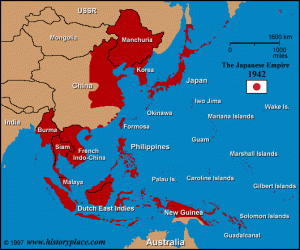
Japan gained enormous wealth when it invaded China and a dozen or so other Asian countries during the WW2. Besides the Philippines and China, other countries and territories Japan occupied include Korea, Hong Kong, Guam, Taiwan, Portuguese Timor, Thailand, Burma and French Indochina – a large French colony now part of Cambodia, Laos and Vietnam – as well as Singapore, Brunei and other British colonies in the lands now known as Malaysia and Indonesia.
pacwar

Map of the Japanese Empire at its peak in 1942.

To say the Japanese Empire was vast would be an understatement. In terms of accumulated wealth and total population under its control, it was one of the largest empires in the history of the world.

Essentially, within the space of a few short years, Japan systematically stripped every conceivable wealth from the bulk of Asia. At the behest of Emperor Hirohito, the Imperial Army methodically pillaged everything of value they could find and almost literally left no stone unturned. This included ransacking museums and government treasuries, banks, royal palaces, temples, churches and mosques, and even the private homes of wealthy families.

The conquering Japanese were primarily after gold, a commodity that was not in short supply in Asia at that time. In fact, the elite ruling families in Asian countries had been collecting and storing gold – often hidden in ancestral tombs and the like – for up to 4000 years.

Japanese soldiers looted bullion by the truckload, and very little of the precious metal escaped their grasp. Accounts of them extracting gold fillings from the teeth of corpses is but one of many examples of their ruthless meticulousness.

In addition to these incalculable amounts of gold, gigantic quantities of diamonds, silver, platinum, precious gems, royal jewels and religious artifacts were also stolen. These colossal treasure troves were shipped to the Philippines in preparation for transportation to Japan. However, as the war in the Pacific intensified, the ever-increasing presence of Allied ships and US submarines made the transport of such treasure problematic for Japan. As a result, most of it had to be hidden in the Philippines.

That done, the treasure sites were booby-trapped by the Japanese to protect the riches they contained. The plan was to recover the assets after the war’s end. Of course, the Japanese assumed they’d be victorious over the Allied war machine.

Some researchers and treasure-hunters claim there are Imperial Japanese army maps in existence that reveal the whereabouts of these treasure sites. A series of the most important locations, known as Trillion Yen sites, contained gold and other precious metals valued during the war at one trillion yen. That’s 1,000,000,000,000 yen!

Some of the missing booty?

Taking inflation into account, one trillion yen in 1945 currency equates to approximately US$250 billion dollars, or a quarter of a trillion, per site in today’s money. That’s why we specify this figure in The Ninth Orphan as being the value of the treasure site Nine finds on behalf of his shadowy employers.

YamashitaTreasures

A trillion yen site?


Initially, there were dozens of Trillion Yen sites in the Philippines, but Naylor had confirmed that after the waves of bounty hunters – first the Americans under General MacArthur, then Marcos decades later – only one such site remained. Despite many attempts to find the location, it had remained undiscovered until Nine found it. The crafty orphan had somehow uncovered the elusive site’s location in the province of Benguet.The Ninth Orphan


The British connection

The bulk of Asia’s wealth wasn’t the only treasure that contributed to Yamashita’s booty. Great Britain inadvertently contributed also.

Britain’s little known link with the treasure dates all the way back to Hitler’s rise in the 1930’s. Fearing Germany was going to invade the UK, it’s believed Britain shipped the bulk of its gold reserves – including the Royal Family’s massive stockpile – to Singapore, which was under British rule at the time. When Singapore abruptly fell to the Japanese in 1942, Britain lost almost all its gold supplies overnight.

It has been asserted that Britain’s lost bullion never made it to Japan either and was instead buried in the Philippines along with the treasures from all the other Asian countries.


Suppressing the truth

Several Yamashita investigators have estimated that Japan’s total war plunder. amounted to more than 300,000 tons of gold and other treasures. Nobody knows what proportion was gold, but it’s worth noting the estimated total of the entire world’s gold officially mined throughout human history is only 174,100 tons.

That puts Yamashita’s Gold into perspective; it amounted to a massive percentage of the world’s total (mined) gold reserves.

One school of thought says leading nations conspired to withhold this plundered gold from the global marketplace after WW2. Those who subscribe to this theory argue that if ever that much gold flooded the market, or was even acknowledged, it would completely devalue gold overnight. Not to mention destabilize various currencies.

Whatever the case, it’s a fact that no economist would argue that a gold discovery of this magnitude would have virtually destroyed the value of monetary gold, or gold held by governing authorities as a financial asset, worldwide. Remember, up until 1971, a gold standard existed in most countries, including America. This meant most nations’ currencies were based on, or pegged to, a fixed quantity of gold.

US Presidential candidate William McKinley championed the gold standard.

As the US Government was the biggest holder of monetary gold, acknowledging the existence of Yamashita’s Gold would have seriously devalued America’s reserves and potentially its standing as the dominant economy.

If the truth about the finds in the Philippines had been publicly acknowledged, it would also have paved the way for substantial claims from those Asian countries the gold and other treasures originally belonged to. This would have promoted more rapid economic growth in the likes of China, Taiwan, Korea and Thailand than they experienced in the decades following WW2.

Many believe the US and other Western powers, including Britain and Germany, conspired to keep the existence of Yamashita’s Gold hush-hush while, at the same time, those powers used the gold to further their own agendas. It’s suspected those agendas include funding black ops to overthrow various governments and tampering with financial markets.

It is said every British Prime Minister and every US President since 1945 have known about the treasure hoard and have shaped their foreign policies around it.

Major financial institutions, including some of the world’s top banks, as well as international funding organizations are also said to be part of this conspiracy to suppress the truth about the existence of Yamashita’s Gold.

Many oil researchers have postulated that oil companies operate in much the same way. As George C. Scott’s character says to Marlon Brando’s character in the 1980 oil-themed movie The Formula: “You’re not in the oil business. You’re in the oil shortage business.”

That same formula (creating the illusion of a shortage) can equally apply to the devious management of precious metal and diamond markets. The 2006 political thriller film Blood Diamond starring Leonardo DiCaprio also touched on this issue.


Few knew more about Yamashita’s Gold than Naylor did. His own father had served in the Philippines under General MacArthur and, at the end of World War Two, had witnessed the earliest discoveries of Japan’s massive plunder. Naylor had also confirmed that the former president of the Philippines, Ferdinand Marcos, had obtained much of his personal fortune from later discoveries. The Ninth Orphan


I shall return (for the gold)

In 1942, US General Douglas MacArthur was forced to leave the Philippines as the nation was overrun by Japanese. MacArthur told journalists, “I shall return.”

MacArthur in khaki trousers and open necked shirt with five-star-rank badges on the collar. He is wearing his field marshal's cap and smoking a corncob pipe.

General MacArthur pictured in WW2 Manila.

Over 10,000 American troops stationed in the Pacific had already surrendered to the Japanese and MacArthur had been left without any reinforcements. Fearing for his general’s safety, President Roosevelt had ordered him to leave the Philippines.

MacArthur’s famous words I shall return meant a lot to the Filipino people who clung to the hope they’d eventually reclaim their freedom.

In October, 1944, after leading a series of strategically brilliant air and sea attacks against Japanese forces, General MacArthur stood on Philippine soil once more. “I have returned,” he told emotional Filipinos who had not forgotten his promise.

A group of men wading ashore. With General MacArthur is Philippine President Sergio Osmena and other US and Philippine Generals.

“I have returned.” – General MacArthur.

Unfortunately, like most fairy tales spun during wartime, the true motivations in MacArthur’s case were probably not quite as straightforward or innocent as they appeared to be.

He did return after leading the Allies to defeat the Japanese and kick them out of the Philippines. However, MacArthur may have been so keen to return to collect the riches he knew the Japanese had concealed all over the rugged island nation.

It is said that Charles Willoughby, the general’s Chief of Intelligence, had earlier in the war found evidence of the vast treasures buried throughout the Philippines.According to this theory, Willoughby and his staff had confirmed there were almost 200 Yamashita sites throughout the Philippines, including the all-important Trillion Yen sites.

Various independent researchers have concluded that MacArthur worked closely with the CIA immediately after WW2. Their goal: to locate and retrieve as many of the Yamashita treasure hoards as possible.

Among those independent researchers are prolific authors Sterling Seagrave and Peggy Seagrave who wrote in their 2003 book Gold Warriors: America’s Secret Recovery of Yamashita’s Gold that General MacArthur “used war loot to create a trust fund for Hirohito at Sanwa Bank” and “also set up the secret M-Fund”.

‘Gold Warriors’ investigates Yamashita’s Gold.

The Seagraves go into convincing detail about the evidence they apparently uncovered, proving MacArthur’s post-WW2 success in secretly recovering the bulk of Yamashita’s Gold for America. The authors also mention MacArthur’s right-hand man Charles Willoughby who they say“paid war criminals to rewrite history and manipulate Japan’s government,” immediately after the war as part of the covert operation. 


The Marcos Family

Imelda Marcos has said repeatedly over the years that her deceased husband and former President of the Philippines, Ferdinand Marcos, gained much of his considerable personal fortune by looting riches from various Yamashita treasure locations.

For example, Manila-based newspaper The Bulletin ran an article on February 3, 1992, with the headline Marcos widow claims wealth due to yamashita treasure. The article states “Imelda Marcos today claimed for the first time the basis of her late husband’s wealth was Japanese and other gold he found starting at the end of World War II.”

Imelda told the newspaper, “From what I heard and I was told, the late President Marcos went to the United States in 1945 to sell some of the gold.”

Ferdinand Marcos with wife Imelda.

In addition to Imelda’s statements, numerous investigators believe there was a joint venture between President Marcos and the US intelligence community who, it seems, had developed gold rush fever. It has been claimed Marcos arranged for CIA aircraft and even US Navy warships to transport the bullion into a worldwide network of offshore banks in various tax havens.

After Ferdinand Marcos was overthrown in 1986, the Philippine Government began an enquiry into Marcos’ activities undertaken during his term in power. Known as Operation Big Bird, its goal was to recover the rumored tens of billions in secret assets of Ferdinand and Imelda Marcos, which apparently included scores of Swiss bank accounts.

On April 7, 2013, beneath the headline Secret accounts, Manila’s The Philippine Star newspaper reported that Operation Big Bird failed to uncover the Marcos billions as they were too creatively stashed away in Swiss bank accounts. The Marcos’s had used a combination of pseudonyms and nameless, number-only Swiss accounts to make their fortune almost impossible to uncover.

The Philippine Star article also mentioned that the couple’s daughter, Imee Marcos, was embroiled in a new tax haven scandal.

Imee Marcos - August 2013.jpg

Imee Marcos held secret accounts.

Ongoing investigations showed she held “secret accounts” in the British Virgin Islands, a tax haven known for ironclad bank secrecy. The article went on to speculate whether Imee’s accounts were a residue of her parents’ controversial empire.


 The Roxas Buddhas

Probably the single biggest piece of evidence to support the existence of the rumored Yamashita’s treasure was a lawsuit filed in a Hawaiian state court in 1988. It involved Filipino treasure hunter Rogelio Roxas and the former Philippine president, Ferdinand Marcos. The lawsuit was for theft and human rights abuses, and named Marcos and his wife Imelda as the perpetrators.

In 1961, Roxas claimed to have met a former member of the Japanese Imperial Army who showed him maps revealing the location of a major treasure site. He also said he met another Japanese man who worked as General Yamashita’s interpreter and had seen a chamber full of bullion, including numerous gold Buddha statues.

Armed with maps and eyewitness accounts, Roxas began searching in earnest for the site.

Ten years later, in 1971, Roxas claimed to have discovered the underground chamber on the outskirts of Baguio City. Inside it, he found a 3-foot tall gold Buddha, which weighed approximately 1000 kilograms, and rows of staked boxes full of bullion. Roxas reportedly took one box, which was said to contain 24 solid gold bars from the chamber, as well as the gold Buddha and hid them in his home.

View upon residential area of Baguio City, Benguet, Luzon Island, Philippines

Baguio City…alleged site of some of Yamashita’s treasure.

Roxas also claimed that President Marcos soon heard about his discovery and ordered him to be arrested and beaten. The booty he’d recovered, along with all the remaining contents of the underground chamber, was confiscated for Marcos’ personal possession.

After Roxas protested vocally and spoke about his ill treatment to journalists, Marcos incarcerated Roxas for over a year. Upon release, Roxas laid low until Marcos was stripped of his presidency and kicked out of the Philippines in 1986. Then, in 1988, Roxas filed the lawsuit against Marcos and his wife seeking damages for the human rights abuses and the theft of his Yamashita discovery.

Befitting an international intrigue novel, Roxas died on the eve of trial and Ferdinand Marcos, who by then was living in exile in Hawaii, also passed away the following year.

Some researchers believe Roxas was murdered. This theory is supported by the research of Yamashita experts Sterling Seagrave and Peggy Seagrave in their aforementioned book Gold Warriors: America’s Secret Recovery of Yamashita’s Gold, in which they state that Roxas did indeed discover a “solid gold Buddha looted from Burma” and, “after President Marcos stole it”, that “Roxas was tortured and murdered to silence him”.

However, in a twist, Roxas was not completely silenced. Shortly before dying he gave a disposition testimony that was used as evidence in the ensuing court case.

In 1996, the Roxas estate received what was at that point the largest judgment ever awarded – US$22 billion. The inclusion of added interest boosted that amount to US$40.5 billion. Then, in 1998, the Hawaii Supreme Court reversed the damages award even though it held there was sufficient evidence to support the jury’s finding that Roxas had indeed found the treasure and that Marcos had seized it.

However, the court also held that the award for the chamber-full of gold was too speculative as there was no evidence of either quantity or quality. Instead, the court ordered a new hearing based solely on what Roxas had removed from the underground chamber, which were just the single golden Buddha and the box of gold bars.

After more protracted legal proceedings, the Roxas estate finally obtained a closing judgment against the now widowed Imelda Marcos. Roxas’ estate obtained a US$6 million judgment regarding the claim for human rights abuse.

That lawsuit ultimately concluded that Roxas had found the treasures he said he had and that it was likely part of the legendary Yamashita’s Gold. The complex case was concluded by the US Ninth Circuit Court of Appeal summarizing the allegations leading to Roxas’ final judgment as follows: “The Yamashita Treasure was found by Roxas and stolen from Roxas by Marcos’ men.”

This was astonishing considering that neither the US Government nor any other government had ever acknowledged the existence of the Yamashita treasure hoard.

#

Besides The Ninth Orphan, there have been various references to Yamashita’s Gold in popular culture over the years. In 1993, an episode of the American TV show Unsolved Mysteries screened in the US, questioning what happened to the treasures amassed by General Yamashita; international bestselling author Clive Cussler wrote about Yamashita’s Gold in his 1990 adventure novel Dragon; the treasure hoard also features heavily in the 2013 horror movie Dead Mine, which is primarily set in abandoned Japanese military bunkers in South-East Asia.

Yamashita the tiger's treasure.jpg

‘Yamashita: The Tiger’s Treasure’ was an award-winning film.

Treasure hunters from around the world continue to flock to the Philippines each year to find what remains of the Yamashita hoard. Some of them include descendants of Japanese WW2 veterans who served in the Philippines. There have also been reports of Japanese citizens purchasing land throughout the country in places they believe the treasures are still buried.

But, of course, we are dramatists, not historians. Therefore, we could be totally wrong about everything we’ve written on Yamashita’s Gold. In which case, you would be advised to cancel that treasure-hunting expedition you’ve booked for the summer and stick to playing the lottery!


Read more in The Orphan Conspiracies: 29 Conspiracy Theories from The Orphan Trilogy – available now via Amazon at: http://www.amazon.com/The-Orphan-Conspiracies-Conspiracy-Theories-ebook/dp/B00J4MPFT6/

A book that’s for the common people.


Happy reading! –James & Lance


******************************************************


Discussion: Book Trailers.

Discussion: Book Trailers

You know, to me movie and TV show trailers make sense.  They get audiences excited for what is a very visual medium.  But what about book trailers?

Most book trailers are just visual representations of the blurb that the author copies and pastes right above.  They’re getting more and more popular with the rise of social media marketing strategies among authors and publishers alike.  Yet I just don’t see the point.  I mean, you read the blurb above so why would you need to watch the trailer?  Maybe I’m missing something here but as a reader and blogger I don’t feel like they add anything to the whole bookish experience.

What I want to know is: What do you guys think of book trailers?  Do you enjoy them?  Why?  Are you like me and fail to see the point?  Let me know in the comments section!  This is a topic I’m not really all that familiar with so I’m more than willing to hear both sides of the argument.


Meanwhile, here’s a book trailer of sorts we did for The Ninth Orphan: http://www.youtube.com/watch?v=fml1Z5saLH0

Truthdig.com, the online news site that takes pride in “drilling beneath the headlines”, has done it again: it has conjured up the most insightful review we’ve managed to uncover yet on what surely will turn out to be one of the most talked-about books of 2014…

We refer, of course, to Luke Harding’s The Snowden Files, which provides an eye-opening overview of whistleblower Edward Snowden’s running battle with the National Security Agency after leaking thousands of classified files to news organizations.

Book reviewer Greg Miller, national security correspondent for The Washington Post, reminds readers via his truthdig.com review of Feb.21 that author Luke Harding is the same LH who is a correspondent for The Guardian newspaper, which broke the initial Snowden story.

Miller also reminds us that “the course that Snowden chose…surreptitiously stockpiling thousands of classified files, leaking them…and finally fleeing first to Hong Kong and then Russia has been polarizing. He has been condemned as treasonous and hailed as courageous. Either way, his story is one of the most compelling in the history of American espionage.”

Further excerpts (abridged) from Miller’s review follow:

“The Snowden Files”…is the first to assemble the sequence of events in a single volume. The book captures the drama of Snowden’s operation in often cinematic detail but doesn’t necessarily enhance our understanding of the magnitude and impact of the leaks. It is most successful when focused tightly on its then-29-year-old protagonist, whose youth and low station in the spy world were so at odds with the caliber of the material he accessed that his journalist contacts, upon meeting him for the first time, shook their heads in disbelief. Snowden comes across as almost icily composed. He seems to have been undaunted by the challenge of outmaneuvering his employer, the National Security Agency, the largest spy agency in the world. He choreographed his encounters with journalists and revealed himself to the world largely on his own terms…

…Although the book is billed as “the inside story of the world’s most wanted man,” there is no indication Harding had direct contact with his subject. Instead, it reads more like the inside account of Snowden’s interactions with The Guardian. The details drawn from those encounters are fascinating, if not always illuminating. Snowden was so concerned about security at the hotel where they met that the few times he left his room he placed a glass of water behind the door, positioned to spill on a piece of tissue paper marked with a symbol sketched in soy sauce…

…“The Snowden Files” won’t be the last book on this subject nor likely the best, with Gellman and Greenwald titles already in the works. But Harding has delivered a clearly written and captivating account of the Snowden leaks and their aftermath, succeeding beyond its most basic ambition, which was to arrive in bookstores first.

For the full review go to: http://www.truthdig.com/arts_culture/item/the_snowden_files_20140221

Many of the concerns Snowden has raised regarding America’s surveillance programs and its espionage methodologies are highlighted in our top rated conspiracy thriller series The Orphan Trilogy (The Ninth Orphan / The Orphan Factory / The Orphan Uprising). That’s not to say we necessarily sympathize with Snowden or approve of his actions, but we do sympathize with many of the ‘Big Brother’ concerns he and others like him have raised.

Product Details

The Orphan Trilogy exposes a global agenda designed to keep the power in the hands of a select few. Our antagonists are a shadow government acting above and beyond the likes of the White House, the FBI, the Pentagon and the NSA… Sounds familiar?

Merging fact with fiction, the trilogy illuminates shadow organizations rumored to actually exist. Our three novels explore a plethora of conspiracies involving real organizations like the CIA, MI6, and the UN, and public figures such as President Obama, Queen Elizabeth II as well as the Clinton, Marcos and Bush families.

The Orphan Trilogy is available via Amazon at: http://www.amazon.com/dp/B00BGGM05U/


Happy reading! –Lance & James


*******************************************


The bestselling philosophical thriller The Transhumanist Wager, by former National Geographic and New York Times correspondent Zoltan Istvan, really is a must-read – regardless of your religious persuasion.

It’s a novel every Christian and non-Christian should read. As one of those in the former camp, it challenged my beliefs without changing them, whilst giving me hours of entertaining reading – all at the same time!

I tried to write a summary of the storyline, but for the life of me I couldn’t improve on the publisher’s own summary, so here it is verbatim…

Set in the present day, the novel tells the story of transhumanist Jethro Knights and his unwavering quest for immortality via science and technology. Fighting against him are fanatical religious groups, economically depressed governments, and mystic Zoe Bach: a dazzling trauma surgeon and the love of his life, whose belief in spirituality and the afterlife is absolute. Exiled from America and reeling from personal tragedy, Knights forges a new nation of willing scientists on the world’s largest seasteading project, Transhumania. When the world declares war against the floating city, demanding an end to its renegade and godless transhuman experiments and ambitions, Knights strikes back, leaving the planet forever changed.

Before I was half-way through this book, I could see why religious authorities and scholars have branded it as “socially dangerous” and “revolutionary”: it challenges the current world order and also Christians’ acceptance and understanding of the ‘second coming’ and the afterlife.

If this wasn’t a work of fiction, I doubt I’d have read it. But it is fiction, and I’m very glad I did (read it). Not sure it’s “visionary”, as the book’s splurge would have us believe, but it sure is a page-turner.

Highly recommended!  –Lance Morcan

Product Details

Here’s what other Amazon reviewers have to say about The Transhumanist Wager:

“This book is a brilliant, provocative masterpiece.” –Immortal Life

“Protagonist Jethro Knights may become one of the grand characters of modern fiction.” -Psychology Today

“I enjoyed The Transhumanist Wager…an adventurous suspense-filled semi-sci-fi about sailing, love, and life extension.” –The Huffington Post

“A philosophical thriller…the Atlas Shrugged for transhumanism.” –Examiner.com

“A very powerful book…this is a must read.” –Serious Wonder

“It’s a page-turner. Istvan knows how to tell a compelling story.” –io9.com

“Really impressive…an unforgettable read.” –Sfmag

“A marvelous work of science fiction.” –IEET

****************************************